

The authors undertook this “archaeology of risk” with a clear aim: to outline what has been accomplished in risk research, evaluate how the field has developed, and uncover potential future avenues of research focus.
- Journal Selection and Timeframe:
- The study focuses on two journals considered central to the field of risk research: Risk Analysis and Journal of Risk Research. These journals are recognized as the primary arenas for publishing and debating risk research by those engaging in the risk community and identifying as interdisciplinary non-financial risk researchers.
- Risk Analysis began publication in 1981 and has been published on behalf of the Society for Risk Analysis (SRA) since its inception.
- Journal of Risk Research started in 1998, originally established by the SRA-Europe Executive Committee, and maintains strong ties to the SRA.
- The analysis spans the period from 1981 to 2023, covering the entire publication history of both journals up to the last full year of data collection.
- Data Collection and Tools:
- The research involved conducting a bibliometric analysis of journal article keywords.
- Data was collected from the Scopus database using a specific search strategy that filtered for “articles” or “reviews” published in the selected journals. This rigorous exclusion criterion ensured that only risk-focused papers relevant to the journal’s audience were included.
- After data cleaning, the final dataset comprised 5943 unique records for analysis. Specifically, 4390 articles were from Risk Analysis (1981–2023) and 1553 from Journal of Risk Research (1998–2023).
- Quantitative methods, VOSViewer visualization software, and Microsoft Excel were employed for the analysis. VOSViewer helps visualize data points as nodes and links, where node size represents keyword frequency, and clusters indicate connection strength.
- A minimum keyword occurrence threshold of five was set for visualization in VOSViewer.
- Analytical Approach:
- The authors performed keyword cleaning, including merging similar keywords (e.g., ‘covid’ and ‘COVID-19’).
- They examined trends in keyword use over time and their co-occurrence or clustering with other keywords.
- Keywords were categorized into three conceptual areas, based on the authors’ deep expertise as risk researchers:
- Core risk research domains.
- Risk theories and concepts.
- Hazard topics.
- Trend analysis was conducted using two-year tranches for frequency and five-year intervals for co-occurrence snapshots.
- A reflexive inductive and deductive thematic analysis of keywords was also carried out, drawing on existing literature and insights from the data.
The analysis revealed significant patterns in how risk research has evolved:
- Overall Publication Trends:
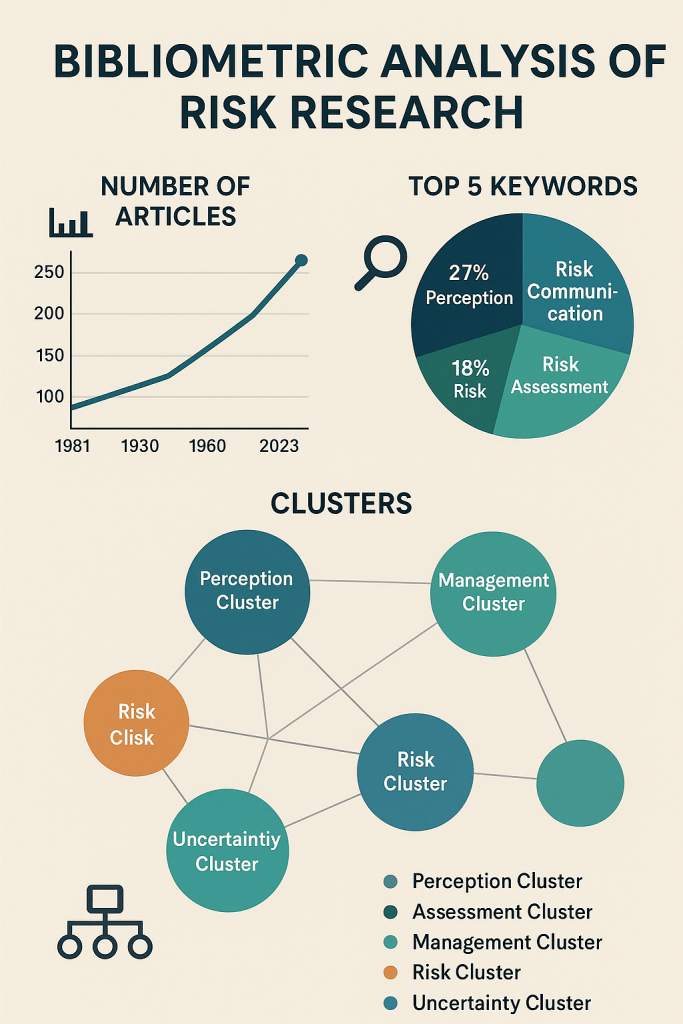
- Both journals have experienced steady growth in the average number of publications per year. The highest publication frequency was recorded in 2023 (282 articles), followed closely by 2019 and 2020 (268 articles each).
- Risk Analysis demonstrated a steeper growth rate (102.09 articles per year cumulatively) compared to Journal of Risk Research (59.73 articles per year cumulatively). Risk Analysis‘s record year was 2023 with 198 articles, while Journal of Risk Research peaked in 2020 with 112 articles.
- Most Commonly Used Keywords (1981–2023):
- Core Risk Domains: ‘Risk perception’ was the most frequently used keyword overall (718 occurrences), followed by ‘risk communication’ (478), ‘risk assessment’ (453), ‘risk’ (335), ‘risk management’ (249), and ‘uncertainty’ (230).
- Risk Theories and Concepts: ‘Trust’ was the most common concept keyword (175 occurrences), followed by ‘vulnerability’ (56), ‘mental models’ (41), ‘affect heuristic’ (32), and ‘social amplification of risk’ (25).
- Hazard Topics: ‘Climate change’ was the most common hazard topic keyword (111 occurrences), closely followed by ‘COVID-19’ (95), ‘terrorism’ (80), ‘food safety’ (62), ‘air pollution’ (57), and ‘nuclear power’ (41).
- Overall Keyword Clusters (1981–2023):
- The VOSViewer analysis identified 17 clusters of co-occurring keywords. Key clusters include:
- ‘Risk Perception’ (Orange Cluster): Strongly linked to public understanding, its determinants (affect, trust, values), specific environmental/technological risks (nuclear energy, nanotechnology, GMOs), and connections to ‘risk communication’, ‘science communication’, and public engagement.
- ‘Risk Assessment’ (Red Cluster): More technical, focusing on the practice of risk assessment (dose response, expert judgment, Monte Carlo analysis) and health risks (lung cancer, drinking water).
- ‘Risk Management’ (Dark Green Cluster): Connected to ‘risk analysis’ and ‘risk governance’, emphasizing concepts like ‘adaptation’, ‘social amplification of risk’, ‘disaster risk reduction’, and ‘systemic risk’. It also covered natural hazards (flooding) and technological risks (cybersecurity), and even included critical examination keywords like ‘gender’ and ‘reflexivity’.
- ‘Uncertainty’ (Purple Cluster): Linked to risk assessment methods (life cycle assessment) and risk perception concepts (psychometric paradigm, optimistic bias), with a strong focus on environmental risks.
- The VOSViewer analysis identified 17 clusters of co-occurring keywords. Key clusters include:
- Trends in Core Risk Research Domains Over Time (Two-Year Periods):
- While most core risk domain keywords grew in frequency, ‘risk perception’ and ‘risk communication’ saw significant overall increases, whereas ‘risk assessment’ did not grow at the same rate. By 2021–2023, the frequency of ‘risk assessment’ was half that of ‘risk communication’ and 40% of ‘risk perception’.
- ‘Risk management’ and ‘uncertainty’ also gained prominence, particularly from the mid-2000s onwards. Newer concepts like ‘risk governance’ and ‘resilience’ became more commonplace after the mid-2000s.
- Notable differences between journals: ‘Risk perception’ keywords decreased in Risk Analysis but consistently increased in Journal of Risk Research. Similarly, ‘risk communication’ rapidly increased in Journal of Risk Research while remaining stable in Risk Analysis. ‘Risk assessment’ was more common in Risk Analysis.
- Trends in Risk Theories and Concepts Over Time:
- Many risk theories and concepts gained prominence only in recent years. ‘Trust’, for instance, experienced two spikes in use, particularly from 2019 onwards, largely driven by publications in Journal of Risk Research.
- Other concepts like ‘vulnerability’, ‘cultural theory’, and ‘psychometric paradigm’ had their peak frequencies earlier than 2021–2023.
- Trends in Hazard Topics Over Time:
- ‘COVID-19’ exhibited the strongest growth among hazard topics, with 108 uses in 2021–2023, despite not appearing as a keyword before 2020.
- ‘Climate change’ saw two main peaks in frequency. ‘Terrorism’ keywords surged significantly after 2001.
- Journal differences were also observed: ‘Terrorism’, ‘food safety’, ‘air pollution’, and ‘nuclear waste’ were more consistently found in Risk Analysis articles, while ‘COVID-19’ and ‘climate change’ were more frequently referred to in Journal of Risk Research keywords.
- Mapping Trends in Risk Research (Five-Year Intervals):
- The analysis of keyword co-occurrence across five-year intervals from 1981 to 2023 highlighted dynamic shifts in research foci.
- Early periods (1980s-early 1990s) showed distinct clusters around risk assessment (technical, health-focused), risk analysis (uncertainty, decision), and psychology/sociology of risk (perception, communication, often with nuclear power).
- From 1994–1998, a quantitative risk analysis cluster emerged, distinct from other risk assessment methods.
- Later periods (mid-2000s onwards) showed the re-emergence of a ‘psychology of risk’ cluster, separate ‘risk communication’ clusters, and increasing prominence of ‘risk management’ and ‘resilience’ with policy and media foci.
- In the most recent period (2019–2023), ‘COVID-19’ research dominated a cluster, linking ‘risk assessment’ and ‘risk science’ with ‘health communication’ and ‘crisis communication’. A ‘risk analysis’ and ‘resilience’ cluster also emerged, focusing on environmental justice, community resilience, and social vulnerability, marking a departure from its historical analytical emphasis. There was also a notable ‘sociology of risk’ cluster amalgamating risk perception, communication, and management, indicating growing interdisciplinarity.
The authors delve into the factors shaping these observed trends:
- Reactive Nature of Risk Research:
- There is a strong reactive relationship between hazardous events and the publication of risk research. Major events like the Yucca Mountain decision, 9/11, the Paris Climate Agreement, and the COVID-19 pandemic directly correlated with surges in research on ‘nuclear waste’, ‘terrorism’, ‘climate change’, and ‘COVID-19’ respectively.
- However, this responsiveness is often characterized by a noticeable time lag due to the inherent timelines of data collection, analysis, peer review, and funding cycles. This delay can impact the practical value of timely research, highlighting the need for more flexible publication pathways.
- Role of Academic Publishing:
- Academic journals and special issues significantly shape the timing and focus of hazard-related publications, creating temporary surges in specific topics. While these issues enhance visibility, they can also skew the publication landscape.
- The observed growth in publication rates and keyword diversity might partly be an artifact of evolving academic publishing practices, such as the increasing emphasis on keyword optimization for digital indexing, rather than solely a direct indicator of substantive scholarly progress. Researchers may strategically expand keyword lists to improve discoverability.
- Shifts in Core Domains and Theories:
- The increasing prevalence of ‘risk perception’ and ‘risk communication’ keywords reflects a disciplinary shift towards understanding how risks are interpreted and conveyed, moving beyond purely quantitative assessments. This trend is influenced by theoretical developments like the psychometric paradigm and the Social Amplification of Risk Framework.
- The relative stagnation of ‘risk assessment’ keywords suggests that while it remains foundational, the focus within the two journals has shifted to perception and communication, emphasizing human and societal factors.
- The surge in ‘trust’ keyword use around 2005 is linked to the publication of several highly-cited works on the topic, illustrating how influential scholarly outputs and broader societal changes can shape theoretical constructs.
- Evolution of Keyword Clusters:
- The amalgamation of ‘risk perception’, ‘risk communication’, and ‘risk management’ into a ‘sociology of risk’ cluster in certain periods underlines the growth in interdisciplinary research and the recognition of risks as holistic phenomena.
- A divergence in ‘risk assessment’ terminology from the mid-1990s, with terms like ‘risk analysis’ and ‘probabilistic risk assessment’ appearing alongside, reflects historic domain-based divides influenced by pivotal events such as the Love Canal scandal and the National Academy of Sciences 1983 Red Book.
The authors acknowledge several limitations of their study and suggest avenues for future research:
Recommendations for Future Research:
- Future studies could expand upon the findings by examining the “Who” (individual researchers, their characteristics, and research domains), “Where” (research institutions, funding sources, research locations), “Why” (rationale for publishing), and “How” (publishing processes, special issue engagement) characteristics of authors.
- Integrating additional journals, broader data sources, and alternative methods of content analysis would provide a more nuanced and holistic representation of the field.
- Further research could involve primary data collection, such as surveys of risk researchers or interviews with seasoned members of the field to gather their experiences of changes over the last four decades.
In conclusion, this bibliometric analysis provides valuable insights for course designers in academia, early-career researchers, and all scholars in the field of risk, helping them understand the historical evolution, current priorities, and the interplay between academic processes and societal needs in shaping risk scholarship.
Reference: Warren, G. W., Duckett, S. M., & Löfstedt, R. (2025). An archaeology of risk: A bibliometric analysis of risk research. Journal of Risk Research. Advance online publication. https://doi.org/10.1080/13669877.2025.2485046.
Key concepts in this article
Bibliometric analysis Cybersecurity Peer review Thematic analysisConcepts link to the Glossary. Explore the knowledge graph →
Cite this page (APA 7)
Kurutkan, M. N. (2025, July 1). Archaeology of Risk: A Bibliometric Analysis. The Health Topics. https://healthtopic.org/topics/archaeology-of-risk-a-bibliometric-analysis/