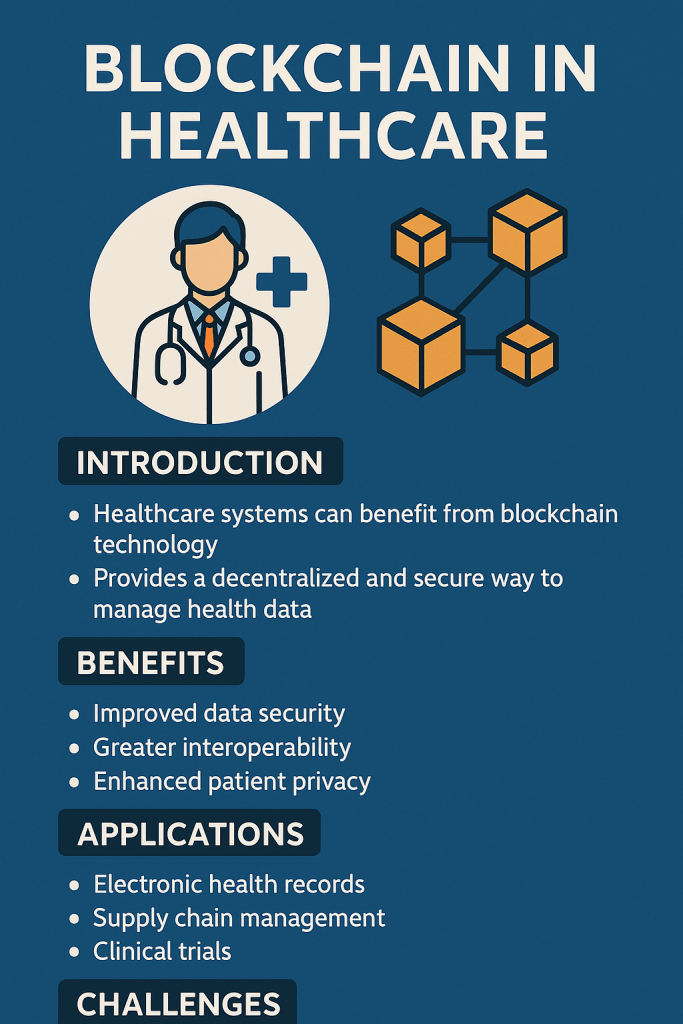
Blockchain technology presents a revolutionary paradigm for enhancing both the security and interoperability of healthcare data management, addressing the inherent complexities and costs of modern healthcare systems. By offering a distributed, secure, and reliable framework, blockchain is poised to transform how patient information is handled and shared.
Enhanced Security:
Blockchain fundamentally strengthens healthcare data security through:
- Decentralization and Immutability: Unlike traditional client-server Electronic Healthcare Record (EHR) systems, blockchain operates as a distributed database of transactions that is not dependent on centralized authorities or financial institutions, thereby eliminating a single point of failure. Data is stored in tamper-resistant forms. All transactions are recorded on an immutable ledger and cannot be modified or tampered with once committed, ensuring that all information is secure and trusted. This creates a secure and reliable decentralized system.
- Enhanced Data Integrity and Verification: Blockchain transactions are only updated or added through the creation of new hash values, meaning existing transactions cannot be modified. The network uses a SHA256 hash for adding transactions, providing features like one-way cryptography and resistance to collisions. This capability significantly improves the verification and integrity of healthcare data.
- Improved Access Control and Privacy: Blockchain enables managing access control of patient information and security of patient data from unauthorized users. A Consensus Protocol ensures that transactions are updated only when all verified users in the network agree to the condition of the transaction. A proposed blockchain-based EHR sharing system utilizes symmetric key cryptography to provide an access control policy. Patients can also voluntarily revoke access to their medical records from clinicians or laboratory staff. Crucially, the system stores only non-identifiable patient data like gender, age, and illnesses in blocks, with patients sharing their private key if they wish to share their identity for full access to their data. This ensures data remains confidential to those who do not have the private key of the patient.
- Reduction of Security Flaws and Cyber Threats: By removing intermediaries, blockchain reduces transparency and security issues related to the trust of third parties at any stage of a transaction. This decentralized approach helps prevent cyber threats, thereby improving confidentiality of patient information and confidence in the provider-patient relationship.
Enhanced Interoperability:
Blockchain dramatically improves healthcare data interoperability by:
- Reforming Healthcare Databases: Blockchain technology can reform the interoperability of healthcare databases, providing increased access to patient medical records, device tracking, prescription databases, and hospital assets, including the complete life cycle of a device within the blockchain infrastructure. It aims to improve the interoperability of health records between different organizations.
- Distributed Data Sharing: Blockchain allows for duplicating a network to another location, whether within the same facility, a healthcare delivery network, or as part of a national or international data sharing program. This capability facilitates sharing healthcare data with researchers, partner facilities, or insurance providers. Data is shared within the network and is ensured to be accurate, reliable, and consistent. New data added to a blockchain at one location can be distributed to the entire network, allowing all locations access to the latest data.
- Streamlined Access for Healthcare Providers: A proposed EHR sharing system outlines four participants: Patient, Clinician, Lab, and System Admin, each with defined smart contracts for actions such as
CreateMedicalRecord,GrantAccessToClinician,GrantAccessToLab, andRevokeAccess. Participants register, receive unique IDs and private keys, and only access records to which they have been granted access. Once a patient grants access, clinicians or laboratory participants can view and update permissioned EHR records. Clinicians and lab staff can also search available clinicians and laboratory staff over the network, which helps facilitate collaboration. - Real-time Access and Reduced Duplication: Blockchain builds systems that support real-time access to patients’ clinical data, enabling personalized healthcare in the Healthcare 4.0 era. Having patient data readily available on a blockchain registry allows clinicians to easily identify if a patient has been seen at other clinics or hospitals, providing a better understanding of the patient’s overall health and previous treatments. This can reduce duplication of investigations and treatments, leading to time and cost savings, increased efficiency, and enhanced patient-centered healthcare.
In conclusion, blockchain’s immutable, distributed, and secure nature offers a robust solution to the critical challenges of healthcare data management. It promises automated data collection and verification, ensuring correct and aggregated data that is resistant to tampering and cybercrime. By optimizing performance, such as improving system throughput by 1.75x and decreasing latency by 1.5x through various configurations, blockchain demonstrates its capability and importance as a potentially revolutionary technology for replacing current healthcare systems.
References
Tanwar, S., Parekh, K., & Evans, R. (2020). Blockchain-based electronic healthcare record system for healthcare 4.0 applications. Journal of Information Security and Applications, 50, 102407.