

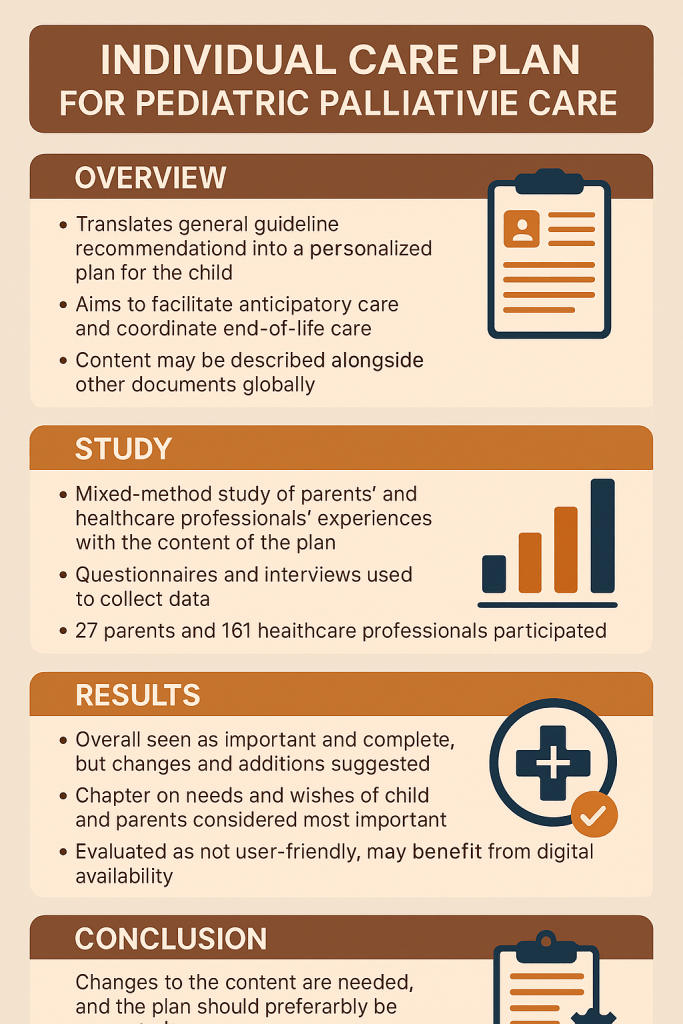
This article presents a mixed-method study investigating the experiences of parents and healthcare professionals (HCPs) with the content of the Individual Care Plan (ICP) 1.0 for pediatric palliative care (PPC). The ICP is designed to translate general guideline recommendations into a personalized care plan for children with life-limiting or life-threatening conditions, aiming to facilitate anticipatory care and coordinate end-of-life care. Unlike other global documents that may focus solely on medical decisions or advance care planning, the ICP uniquely combines the documentation of children’s and parents’ values and preferences with medical decisions and life-sustaining treatments, making it a comprehensive tool.
Despite its comprehensive nature, prior to this study, there was limited insight into user experiences with the ICP post-development. Therefore, the study’s primary objective was to enhance knowledge and understanding of the ICP’s content from the perspectives of both parents and HCPs, specifically examining its importance, completeness, and user-friendliness in daily practice.
The research employed a convergent parallel design, collecting data through questionnaires and individual (for parents) and focus group (for HCPs) interviews. A total of 27 parents and 161 HCPs from across the Netherlands participated, providing a broad perspective on the ICP’s content. Data were analyzed separately using descriptive statistics for quantitative data and thematic analysis for qualitative data, with results integrated to assess confirmation, expansion, or discordance.
Key findings revealed that while both parents and HCPs generally viewed the ICP’s content as important and complete, significant calls for changes and additions were made regarding its language, structure, and content. The chapter on “Needs, wishes, and goals” (Chapter 4) was consistently rated as the most important. Parents wished this chapter would better reflect “who their child is” and include details on communication, while HCPs desired its expansion to incorporate advance care planning outcomes more effectively. HCPs also identified a missing chapter for palliative sedation, crucial for guiding other professionals, and primary care HCPs wished for an overview of home resources. Parents expressed a desire for more extensive information on end-of-life care and disease-specific details.
A significant challenge highlighted was the ICP’s lack of user-friendliness. HCPs found it “very long” and difficult to quickly locate relevant information, particularly in acute situations, while both groups requested simpler language and a more logical structure. Difficulty keeping the document up-to-date, especially for medication and symptomatology, was also a major concern. The study strongly suggests that making the ICP available in a secure digital environment could be a solution to improve its usability and visibility of changes.
In conclusion, the study emphasizes that the essential content for an ICP in PPC is more extensive than previously recognized, requiring additions such as palliative sedation details, comprehensive care team overviews, and enhanced advance care planning integration. To effectively meet the needs of parents and HCPs, modifications to the ICP’s content are necessary, and its digital availability is highly recommended to improve user-friendliness and ensure timely updates.
REFERENCE:
Joren, C. Y., Kars, M. C., Kremer, L. C. M., Hofman, S. C., Rippen-Wagner, H., Slingerland-Blom, R., van der Velden, C., Schuiling-Otten, M., Verhagen, A. A. E., & Aris-Meijer, J. L. (2024). Parents’ and healthcare professionals’ experiences with the content of an individual care plan for pediatric palliative care: A mixed-method study. Palliative Care & Social Practice, 18, 1–12. https://doi.org/10.1177/26323524241277572
Cite this page (APA 7)
Kurutkan, M. N. (2025, July 8). Care Planning for Pediatric Palliative Care. The Health Topics. https://healthtopic.org/topics/care-planning-for-pediatric-palliative-care/