

A Comprehensive Overview of Digitalization in Medicine: Insights from a Bibliometric Analysis
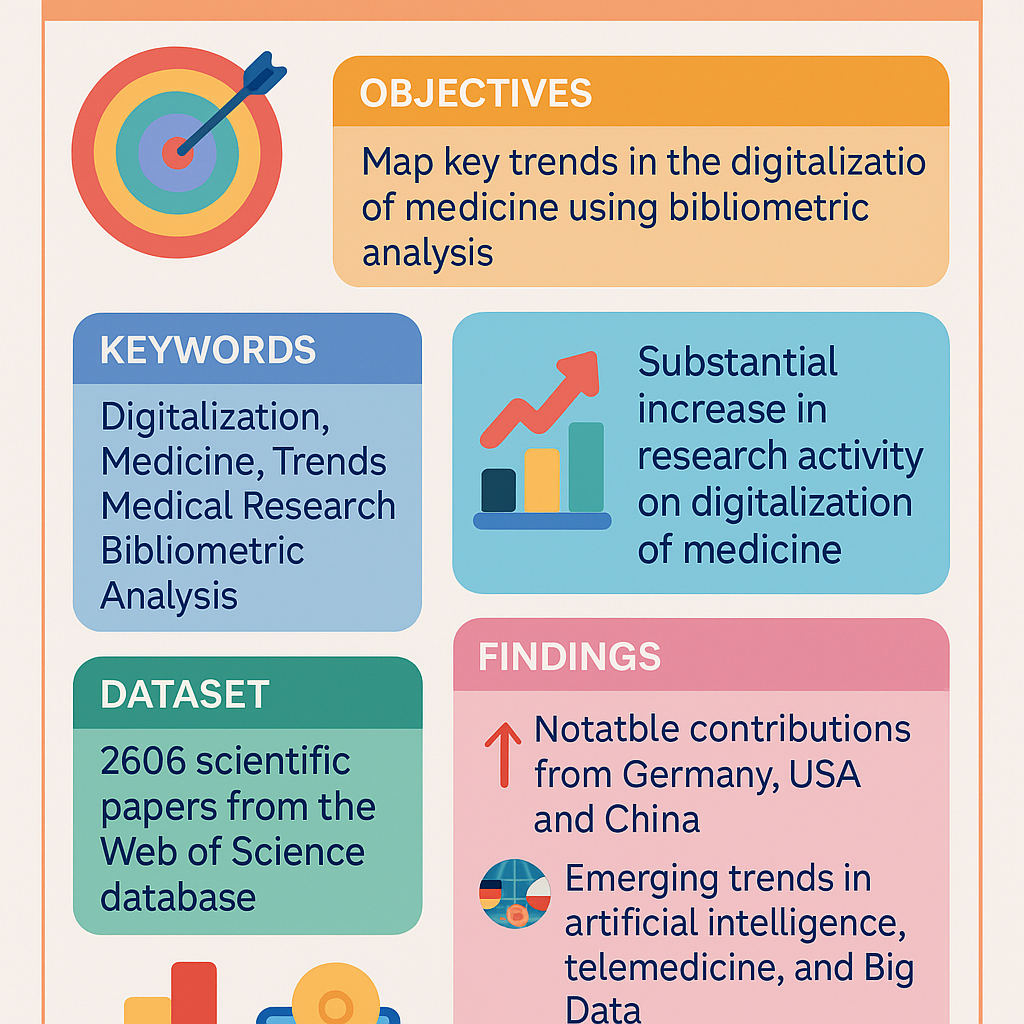
The article “What Is the Current Status of Research on the Impact of Digitalization in Medicine? A Bibliometric Analysis,” authored by Badareu et al. (2025) and published in Healthcare, offers an in-depth exploration of the rapidly evolving field of digitalization in medicine. This study leverages bibliometric techniques to analyze a robust dataset of 2,606 scientific papers sourced from the Web of Science database, spanning from 1975 to 2024. By employing VOSviewer software, the authors meticulously map the intellectual structure and research trends of digitalization in healthcare, providing valuable insights into its global impact, key contributors, and emerging directions.
The research addresses seven critical research questions, examining publication trends, prolific authors, co-citation patterns, leading countries, influential institutions, prevalent keywords, and highly cited works. The findings reveal a significant surge in research activity, particularly since 2010, driven by technological advancements and global events like the COVID-19 pandemic, which accelerated the adoption of telemedicine and remote monitoring solutions. The study identifies Germany, Romania, the United States, and China as leading contributors, with 743, 308, 267, and 239 publications, respectively. These countries benefit from advanced digital infrastructure, substantial academic resources, and strong international collaborations, as evidenced by initiatives like Digital Health Germany and NHS Digital in the UK.
Key institutions, such as Charité University Medicine Berlin (76 articles, 64 collaborations) and the University of Agronomic Sciences & Veterinary Medicine Bucharest (49 articles, 18 collaborations), emerge as centers of excellence, fostering extensive research networks with global partners like the University of Zurich and Karolinska Institute. The analysis of prolific authors highlights researchers like Tomuleasa C. (17 publications), Radic J., Radic M., and Vuckovic M. (16 publications each), whose recent contributions underscore the field’s dynamic growth. Co-citation analysis further emphasizes the influence of organizations like the World Health Organization (230 co-citations) and the European Commission (124 co-citations), alongside individual researchers such as Amar D. and Kuhn S., who focus on AI, telemedicine, and personalized treatments.
Keyword analysis reveals dominant themes, including “digitalization” (410 occurrences), “artificial intelligence” (139), “telemedicine” (124), and “Big Data” (79), reflecting the integration of advanced technologies into healthcare systems. These technologies enhance clinical decision-making, patient care, and resource management, though challenges like data security, regulatory frameworks, and the need for enhanced digital training for healthcare professionals persist. The most cited papers, such as Lindenbaum et al. (1981) with 359 citations and Andrews et al. (1991) with 319 citations, demonstrate the foundational role of earlier studies in shaping modern digital health innovations, from personalized medicine to digital monitoring protocols.
This study fills a critical gap by providing a comprehensive bibliometric analysis across all medical subfields, unlike previous studies that focused on specific areas like cardiology or mental health. It underscores the importance of international collaboration and interdisciplinary approaches in driving digital health advancements. Despite its strengths, the study acknowledges limitations, such as potential regional biases in the Web of Science database and the dominance of English-language publications, which may underrepresent non-English research.
Overall, Badareu et al.’s work offers a robust framework for understanding the current state and future directions of digitalization in medicine. It serves as a vital resource for researchers, policymakers, and healthcare professionals seeking to navigate the complexities of digital transformation, optimize medical practices, and address global health challenges through innovative technologies.
Data and methods in more detail
Badareu and colleagues searched the Web of Science Core Collection for “digitalization in medicine” in titles, abstracts and keywords, without restricting subject category, language or document type. The search returned 2,606 publications from 1975 to 2024, of which 2,291 were in English. They used VOSviewer to run citation, co-citation, keyword co-occurrence and co-authorship analyses, organised around seven research questions on publication trends, authors, co-cited authors, countries, institutions, keywords and the most cited works. Authors counted as prolific if they had at least five publications; 111 of 13,329 authors met this threshold.
Main findings
Output grew steadily and peaked at 499 publications in 2022. The authors link this rise to the COVID-19 pandemic and to advances in artificial intelligence and big data, while noting that database expansion may also play a role. Germany led with 743 publications, followed by Romania (308), the United States (267) and China (239). The most frequent keywords were “digitalization” (410 occurrences), “artificial intelligence” (139) and “telemedicine” (124). The World Health Organization (230) and the European Commission (124) were the most co-cited organisations, reflecting the policy weight of the topic.
Strengths and limitations
The study is among the first to map digitalisation across medicine as a whole rather than within single specialties such as cardiology or mental health. Its limitations include regional coverage bias in the database and relatively limited attention to non-English publications. Some of the most cited works in the dataset were older papers not directly focused on digitalisation, a familiar problem when broad search terms are used.
Implications
The authors argue that their map can support a flexible framework for adopting digital technologies that each health system can adapt to its own resources and access conditions. For researchers, the results also illustrate the value of combining performance analysis with science mapping when a field is growing quickly.
Reference
Badareu, G., Cârstea, S., Militaru, F., Siminică, M. I., & Cîrciumaru, D. (2025). What is the current status of research on the impact of digitalization in medicine? A bibliometric analysis. Healthcare, 13(2), 93. https://doi.org/10.3390/healthcare13020093
Cite this page (APA 7)
Kurutkan, M. N. (2025, June 18). Digitalization in Medicine: A Bibliometric Insight. The Health Topics. https://healthtopic.org/topics/digitalization-in-medicine-a-bibliometric-insight/