

An Introduction to “The iterative development and refinement of health psychology theories through formal, dynamical systems modelling: a scoping review and initial expert-derived ‘best practice’ recommendations”
Health psychology is a field dedicated to predicting, explaining, and influencing health behaviors to improve overall health and well-being. However, progress in this area is often hindered by a “theory crisis,” where existing health psychology theories are often underspecified, presented as imprecise natural language descriptions or simple “box-and-arrow diagrams” of construct interrelationships. This lack of precision makes it challenging to systematically develop, test, and refine theories, ultimately stifling the creation of effective interventions. Traditional “low-resolution measurement paradigms,” characterized by cross-sectional or non-intensive longitudinal surveys, have been insufficient for capturing the complex, dynamic, and within-person fluctuations characteristic of many health behaviors.
To address these challenges, the article highlights formal, dynamical systems modeling as a promising approach. This method involves translating a theory’s structure into a precise mathematical framework, such as a series of equations or logical statements. This allows for a more rigorous and verifiable representation of theoretical constructs and their interrelationships, moving beyond vague verbal descriptions. Unlike data-driven machine learning, formal modeling relies more on abduction—reasoning to the best explanation—making models more precise and verifiable. The addition of a “dynamical systems lens” specifically allows for the incorporation of non-linear, recursive causal relationships and the understanding of how health behaviors change over time at the within-person level. This approach is poised to bridge the gap between emerging “high-resolution measurement paradigm” empirical evidence (e.g., from smartphones and wearable devices) and existing health psychology theories.
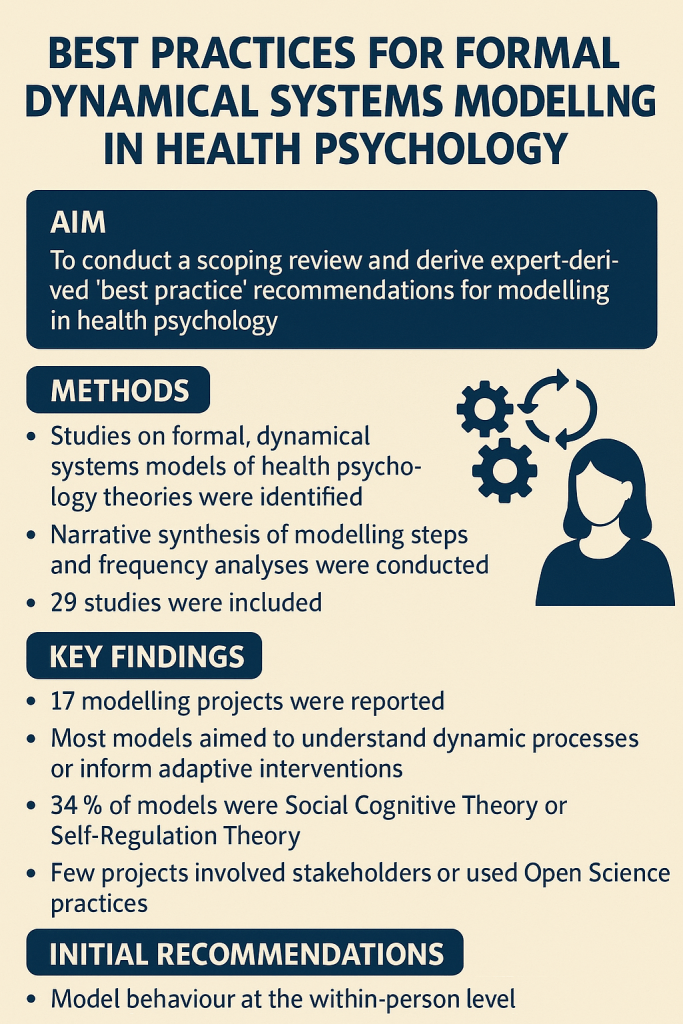
The scoping review discussed in this article aimed to synthesize the methodological steps taken by researchers in developing formal, dynamical systems models of health psychology theories that unfold at the within-person level. The review included 17 modeling projects reported across 29 studies, primarily concentrated among a small number of interdisciplinary teams in the United States (79.3%). These teams typically included experts from psychology/behavioral science/public health alongside mathematics/engineering/computer science.
Key findings from the review indicate that models primarily sought to:
- Better understand dynamic processes that influence health behaviors (69.0% of studies).
- Inform the development of adaptive interventions (31.0% of studies), such as Just-In-Time Adaptive Interventions (JITAIs).
The most commonly formalized theories were the Social Cognitive Theory (31.0%) and the Self-Regulation Theory (17.2%). While most studies simulated data from their models (72.4%) as an internal consistency check, fewer explicitly described simulated participant characteristics (24.1%) or specified simulation benchmarks (17.2%). External consistency checks involved fitting models to real-world data in 41.4% of studies, but participant characteristics were only described in 34.5% of studies, and model comparisons were rare (3.4%).
The review found that stakeholder involvement was low (only 3.4% of studies reported it), and most studies relied solely on existing theory to identify model components and structure. Additionally, a notable limitation was the sparse reporting of methodological details; for example, the software used was often not reported (44.8%), and justifications for model time steps or run lengths were frequently absent (58.6%). Open Science practices, such as making code or pseudo-code publicly available, were also uncommon (10.3%).
In response to these observations, the authors propose an initial set of expert-derived “best practice” recommendations aimed at improving the rigor, transparency, and accessibility of formal, dynamical systems modeling for health psychologists. These recommendations emphasize the importance of interdisciplinary teams, diverse knowledge sources, comprehensive model reporting, systematic consistency checks, and the adoption of Open Science principles to foster more robust theory development and effective interventions.
Reference for the Article:
Perski, O., Copeland, A., Allen, J., Pavel, M., Rivera, D. E., Hekler, E., Hankonen, N., & Chevance, G. (2025). The iterative development and refinement of health psychology theories through formal, dynamical systems modelling: a scoping review and initial expert-derived ‘best practice’ recommendations. Health Psychology Review, 19(1), 1–44. https://doi.org/10.1080/17437199.2024.2400977
Cite this page (APA 7)
Kurutkan, M. N. (2025, July 12). Dynamics in Health Psychology: Formal Modeling and Best Practices. The Health Topics. https://healthtopic.org/topics/dynamics-in-health-psychology-formal-modeling-and-best-practices/