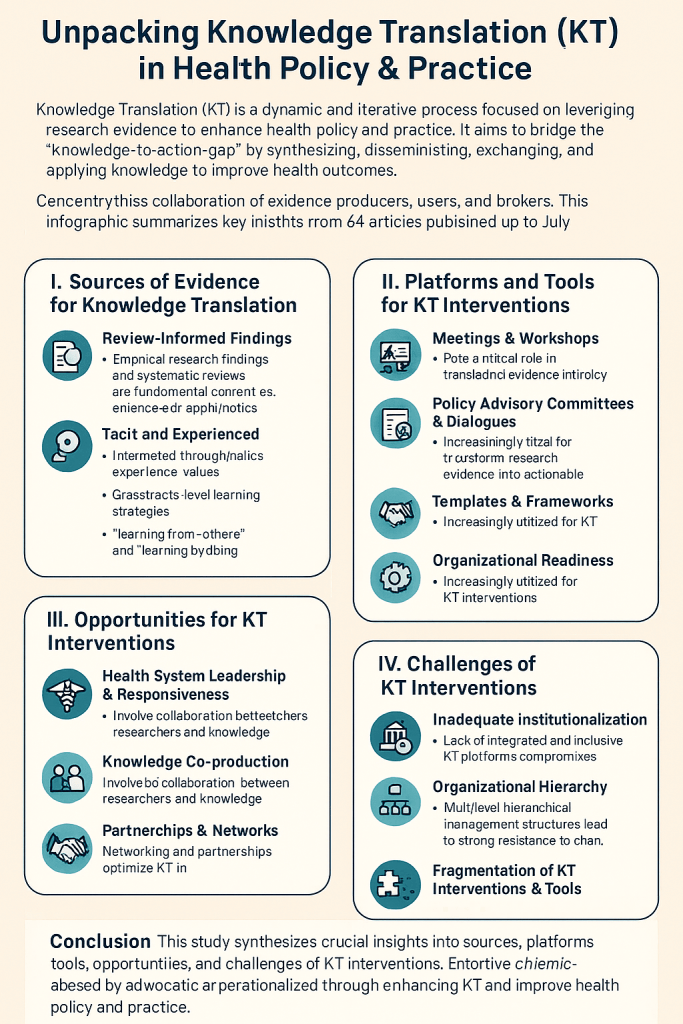
The article titled “A scoping review of knowledge translation in strengthening health policy and practice: sources, platforms, tools, opportunities, and challenges”, authored by Resham B. Khatri and colleagues (Aklilu Endalamaw, Tesfaye Mengistu, Daniel Erku, Eskinder Wolka, Frehiwot Nigatu, Anteneh Zewdie, and Yibeltal Assefa), was published in 2025 in the Archives of Public Health. The study presents a comprehensive synthesis of global evidence on Knowledge Translation (KT) as a critical mechanism to bridge the “knowledge-to-action” gap in health systems.
Purpose and Scope
The primary aim of the study was to identify and synthesize available literature regarding the sources of evidence used in KT, the platforms and tools employed, as well as the opportunities and challenges encountered in enhancing health policy and practice. KT is defined as a dynamic and iterative process that involves the dissemination, exchange, synthesis, and application of knowledge to improve health outcomes and strengthen healthcare systems. Central to this process is the collaboration between evidence producers (e.g., researchers and institutions), users (e.g., policymakers, healthcare providers), and brokers (e.g., intermediary organizations, advocacy groups, and civil society actors).
Methodology
This scoping review followed the PRISMA-ScR guidelines and used a comprehensive search strategy across seven major academic databases (PubMed, Scopus, Embase, CINAHL, Cochrane, PsycINFO, and Web of Science), supplemented by Google Scholar. The inclusion criteria were limited to English-language publications up to July 30, 2023. A total of 64 articles were selected after removing duplicates and screening titles, abstracts, and full texts. Thematic analysis was employed to organize findings into four categories: sources of evidence, platforms and tools, opportunities, and challenges.
Key Findings
- Sources of Evidence for KT
Two major categories of knowledge were identified:- Review-informed Findings: These include empirical research, systematic reviews, evaluation reports, policy briefs, and synthesized evidence supporting decision-making in health policy and clinical practice.
- Tacit and Experiential Knowledge: This refers to knowledge derived from experience, cultural context, and values. It is especially useful in grassroots-level implementation and training, emphasizing learning-by-doing and peer-based learning models.
- Platforms and Tools for KT Interventions
Several mechanisms facilitate KT:- Meetings and Workshops: Journal clubs, monitoring meetings, and capacity-building workshops support knowledge exchange.
- Policy Advisory Committees and Dialogues: These structures reduce the gap between research and policy, promote trust, and institutionalize KT processes.
- Templates and Frameworks: Tools like the Integrated Capacity Framework and Knowing Cycle Model support evidence structuring and performance monitoring.
- Digital Tools and Social Media: Online platforms, IT systems, telemedicine, and social media are increasingly used to share evidence, promote engagement, and extend healthcare access.
- Opportunities for KT Interventions
Enabling factors identified include:- Health System Leadership and Responsiveness: Leadership drives innovation, system-level adaptation, and resource access.
- Knowledge Co-production: Involves collaboration between researchers, decision-makers, and communities for more relevant and contextualized knowledge.
- Partnerships and Networks: Multidisciplinary and intersectoral partnerships enhance the translation of evidence into practice.
- Organizational Readiness: Institutions must possess absorptive capacity, training infrastructure, and digital tools to support KT.
- Contextualization of Evidence: Localized and culturally sensitive knowledge production aligns KT with community needs and strengthens motivation.
- Challenges of KT Interventions
Major barriers include:- Inadequate Institutionalization: Weak KT infrastructure, lack of training, high staff turnover, and minimal advocacy efforts hinder evidence use.
- Organizational Hierarchy: Resistance from rigid bureaucratic systems and poor communication between stakeholders reduce KT effectiveness.
- Fragmentation of KT Tools: Disjointed tools, poor integration into clinical workflows, misinformation on social media, and a lack of real-time data systems weaken KT implementation.
Conclusion and Implications
The study concludes that effective KT requires a combination of structured institutional platforms, context-specific tools, and collaborative partnerships. Both explicit (scientific) and tacit (experiential) knowledge are essential for effective decision-making and policy formulation. Leadership, responsiveness, and organizational readiness are crucial for operationalizing KT. Addressing structural barriers such as institutional fragmentation and hierarchical resistance is vital to strengthen KT and, consequently, health systems. This review serves as a foundation for advancing evidence-informed health policy and practice in diverse global contexts.
Limitations
The authors acknowledge limitations, including the exclusion of non-English studies and initial screening conducted by a single researcher. Nonetheless, the study is strengthened by its wide database coverage and thematic breadth.
Reference: Khatri, R. B., Endalamaw, A., Mengistu, T., Erku, D., Wolka, E., Nigatu, F., … & Assefa, Y. (2025). A scoping review of knowledge translation in strengthening health policy and practice: sources, platforms, tools, opportunities, and challenges. Archives of Public Health, 83(1), 78.