

This source details Vinmec Times City International Hospital’s journey to become the first hospital in Vietnam to achieve dual accreditation from the College of American Pathologists (CAP) Laboratory Accreditation Program and Joint Commission International. It outlines the two-year process (2020-2022), highlighting the collaborative efforts of staff and leadership in implementing international quality standards for their laboratory services. The article emphasizes the challenges faced, such as language barriers and establishing new policies, but ultimately concludes that the significant investment of time and resources yielded invaluable improvements in patient care and laboratory operations. This success positions Vinmec as a leader in healthcare quality within Vietnam and offers insights for other developing nations seeking similar accreditation.
- Hospital Background and Context
- Vinmec Health Care System, which includes Vinmec Times City International Hospital, is highlighted as one of Vietnam’s largest non-profit private hospitals, belonging to Vingroup Joint Stock Company.
- Established in 2012, Vinmec Health Care System aims to provide international-standard healthcare services in Vietnam.
- Vinmec Times City International Hospital, located in Hanoi, specifically serves the people of North Vietnam and is part of a system of seven hospitals across the country.
- The article provides context on the pathologist-to-population ratio in Vietnam, noting approximately 600 anatomic pathologists for a population of nearly 96.2 million in 2019, which translates to about 6 pathologists per million people.
- Motivation and Initial Planning
- The decision to pursue CAP LAP was made in 2018 after discussions among the laboratory director, the CEO of Vinmec Health Care System, and the CEO of Vinmec Times City, aiming to raise laboratory standards.
- In February 2019, a CAP international regional leader visited the hospital to discuss the steps for accreditation, including obtaining checklists and enrolling in the CAP Proficiency Testing (PT) Program.
- Vingroup’s strategy emphasizes investment in quality as a crucial expenditure. The hospital successfully persuaded company leadership of the advantages of maintaining testing quality and the financial benefits of informed treatment decisions based on precise results, thereby securing approval and funding for the CAP certification process.
- The journey to the first inspection officially took two years from the start of the scheduled laboratory accreditation plan (2020-2022), but the time from initial conversations to final preparations was more than three years (2018-2022).
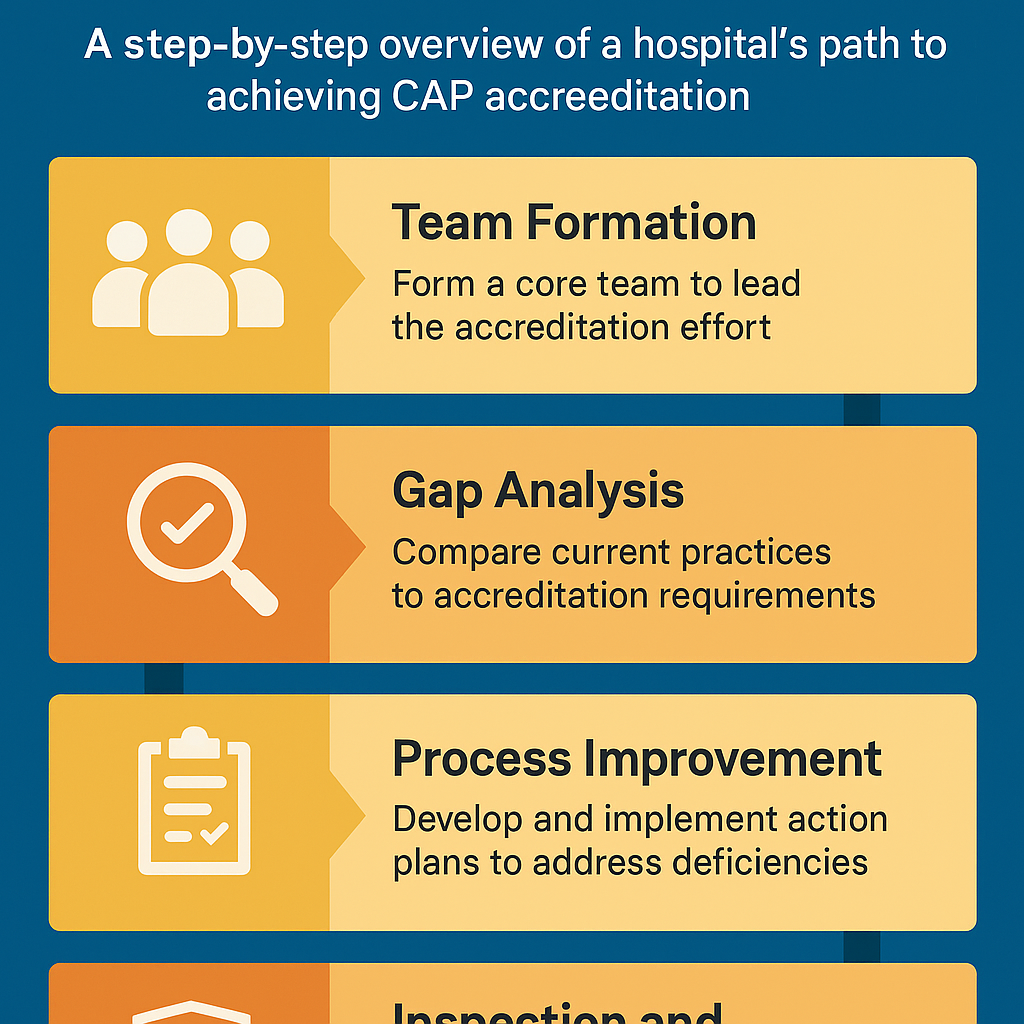
- Team Formation and Structure (2020, First Quarter)
- A core accreditation team was established to initiate the project. This team comprised 14 people, including the laboratory director, the heads of each subdiscipline (microbiology, biochemistry, hematology, and anatomic pathology (AP)), a CAP LAP coordinator, four lead technicians, and four CAP LAP coordinators from each subdiscipline.
- The CAP LAP leader (Laboratory Director) was accountable for all laboratory activities.
- A CAP LAP coordinator was responsible for connecting the laboratory with hospital administration and governing boards.
- Heads of subdisciplines developed solutions for checklists applicable to their specialties with assistance from lead technicians.
- Each subdiscipline also had a nominated CAP coordinator in charge of managing their subdiscipline’s CAP project and communicating with various stakeholders.
- The CEO, Chief Medical Officer (CMO), and head of the quality management department consistently participated, with a designated person leading problem resolution to remove barriers.
- Meetings for this core group initially occurred monthly for the first 1.5 years, increasing to bi-weekly, then weekly, and finally every 2-3 days during the last month before the inspection.
- Proficiency Testing (PT) and Quality Management System (2020, Second Quarter)
- The laboratory enrolled in the CAP PT Program for all tests on its activity menu across all four subdisciplines to compare their work with laboratories worldwide.
- The PT Program covered the entire spectrum of activity, including pre-analytic, analytic, and post-analytic phases, as well as histology, cytology, and immunohistochemistry programs.
- While other specialties had engaged in external PT programs compliant with ISO 15189:2012, the AP specialty had not participated in any external proficiency program before, making CAP PT the inaugural external quality assurance program for AP in Vietnam.
- CAP PT was crucial for accredited laboratories, providing external validation for their diagnoses and helping to prevent internal disputes among pathologists.
- Participation taught them to categorize discrepancies and develop an AP quality management system, fostering a culture where errors were viewed as learning opportunities.
- Remedial activities for CAP PT diagnosis failures included literature reviews and mutual education, with the individual who made an inaccurate diagnosis delivering a lecture within two months.
- Checklist Translation, Challenges, and Policy Development (2020, Third Quarter – 2021, Third Quarter)
- The project proceeded by working on the checklists and developing responses.
- It was found that the ISO 15189:2012 accredited microbiology, biochemistry, and hematology divisions met up to 60% of CAP requirements, but the AP division had relatively few written policies adhering to CAP LAP standards.
- Given the significant differences in English capabilities among AP staff, the four required checklists (Anatomic Pathology, Cytopathology, All Common, and General) were translated into Vietnamese over a month to ensure full comprehension by all staff members. These translated documents are also valuable for future interactions with other Vinmec hospitals.
- Instead of assigning duties by checklist, tasks were assigned based on specific responsibilities and individual abilities, such as competency assessment, test method validation, instrument management, and quality management.
- The most challenging section was ANP.22978, related to the validation/verification of predictive marker testing, particularly the difficulty in obtaining validated tissue microarrays (TMAs) from overseas sources due to cost and availability.
- The policy development involved three stages:
- Drafting: Researching standard operating procedures, their formatting, and content.
- Discussion and Consensus: Daily 1-2 hour morning meetings where key players reviewed drafts, ensured checklists were addressed, and policy implementation was practical. This stage involved at least three rounds of debate over at least six months to achieve agreement.
- Integration and Education: Integrating new policies into daily operations, documenting records, and conducting monthly reviews of the quality management program.
- The core group also met monthly to finalize the General (GEN) and All Common (COM) checklists collaboratively for the entire laboratory.
- Support and Communication
- The laboratory maintained close interaction with CAP LAP staff in Northfield, Illinois, primarily via customer service email, to clarify questions, even connecting with specific committees like immunohistochemistry.
- Tremendous support was received from the hospital’s leadership boards. Meetings with hospital leadership increased in frequency from monthly to bi-weekly and then once or twice a week as the inspection approached.
- Leadership support was crucial for addressing issues like fixation quality, which required engagement with various departments and personnel.
- Mock Inspections (2021, Fourth Quarter – 2022, January)
- An initial simulated run was conducted in early October 2021, applying the ROAD methodology (Reading, Observing, Asking, and Detecting) within each subdiscipline.
- A second mock inspection was successfully conducted two months before the actual inspection, mimicking the real process by visiting faculties and questioning staff on protocols.
- These mock inspections helped leaders understand staff performance, adherence to policy, and areas needing administrative assistance. They also assisted in discovering deficiencies and providing recommendations for improvements.
- Inspection and Results (2022, March)
- Due to the COVID-19 pandemic, the inspection was conducted virtually.
- Three interpreters were recruited to assist with translation, as the inspection was required in English. Staff continued their regular duties during the inspection to allow for accurate assessment.
- Identified deficiencies, though not trivial, were all aimed at improving processes, safeguarding patients, and ensuring clear communication between laboratory and clinical staff. Corrective actions sometimes required further clarification with inspectors.
- Annual satisfaction surveys indicated that implemented modifications, particularly in surgical reports compliant with CAP cancer procedures, enhanced doctors’ ability to identify and manage patients more efficiently.
- While turnaround time did not improve and even slowed slightly, the quality of result reports reached international standards, leading to positive feedback from clinicians.
- Discussion and Broader Implications
- The accreditation process progressively transformed the laboratory culture, guiding pathologists and technicians toward collaborative efforts for optimal patient test results.
- Maintaining these standards is recognized as a continuous endeavor requiring daily participation, learning, sharing, and revision. Continuous learning from the CAP PT Program, virtual courses, and conferences is part of their practice to stay current with world-class quality.
- CAP accreditation is especially beneficial in AP, where regulatory limitations and ISO standards have not yet been fully implemented in Vietnam.
- For developing countries like Vietnam, pursuing CAP LAP is significant due to the universal principles of healthcare that apply globally, regardless of cultural differences.
- The process of collaboration, developing standard procedures, and achieving consensus among hospital leadership and laboratory sections is a major benefit.
- The positive feedback from medical staff colleagues regarding improved test quality and patient experience is another invaluable, though economically difficult to quantify, benefit.
- However, the journey involved a significant investment: an estimated 20,000 staff hours and over $300,000 in proficiency testing over two years.
- The authors acknowledge the added economic burden for non-English-speaking countries following an accreditation pathway established by an exclusively English-speaking organization like CAP. They suggest that artificial intelligence or other technological advancements could facilitate this pathway for laboratories lacking extensive translation resources. Access to CAP members willing to answer questions was immensely helpful.
- Achieving CAP accreditation, one of the most difficult and comprehensive quality management programs, provides convincing evidence of its high value to the hospital and patients. This recognition allows Vinmec Times City to participate further in peer-inspection processes and impart lessons learned to other hospitals globally. The authors affirm that while human effort and financial support are crucial, the value acquired is tangible and worthwhile.
Reference: Nguyen, H. T., Vance, G. H., Hassell, L. A., Dinh, D. T., Nguyen, Q. N., Vu, P. T. T., & Truong, D. C. (2025). The accreditation journey for a hospital in the developing world. Archives of Pathology & Laboratory Medicine, 149(7), 602–606. https://doi.org/10.5858/arpa.2024-0266-SA
Cite this page (APA 7)
Kurutkan, M. N. (2025, August 4). Hospital Accreditation in the Developing World: A Vietnam Case Study. The Health Topics. https://healthtopic.org/topics/hospital-accreditation-in-the-developing-world-a-vietnam-case-study/