

Unlocking Family Support in Intensive Care: Insights from the FICUS Study’s Implementation Journey
Families of patients in Intensive Care Units (ICUs) often face significant stress and negative mental health impacts, with up to 60% experiencing high levels of distress. Despite best practice guidelines recommending active partnerships between ICU staff and families, their implementation has been partial, creating a crucial “know-do gap” in evidence-based, family-focused critical care.
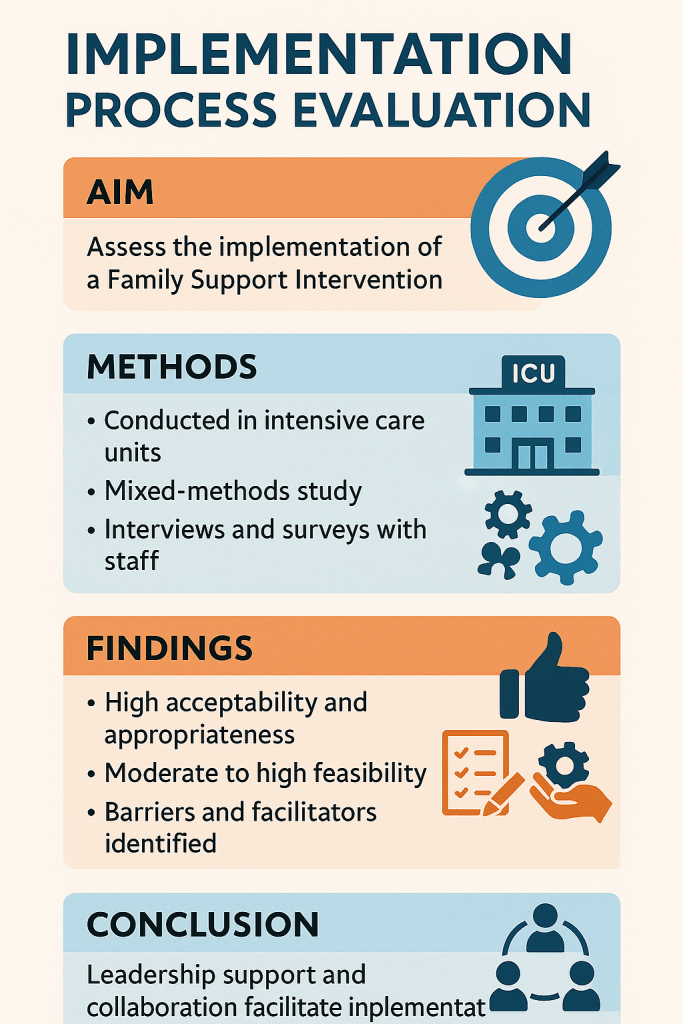
The “Exploring Implementation Processes of a Multicomponent Family Support Intervention in Intensive Care Units (FICUS) Study” directly addresses this challenge. As a vital component of the larger FICUS effectiveness-implementation hybrid study, this process evaluation aimed to profoundly understand the implementation progress of a novel Family Support Intervention (FSI) in adult ICUs, identify the factors influencing its integration, and explore various implementation pathways.
About the Study: Conducted between June 2022 and July 2023 across eight Swiss ICUs, this study utilized a convergent mixed-methods multiple case study design, comprehensively investigating the FSI’s journey. Guided by the Normalisation Process Theory (NPT), it delved into how the FSI, which comprises a new family nursing role and a family care pathway (including early engaging, supporting, and communicating with families), became embedded in routine practice. Forty key clinical partners (including family nurses, local implementers, and nurse/physician leaders) participated, providing insights through small group interviews and psychometric questionnaires (AIM, FIM, IAM, NoMAD) at early and mid-implementation stages.
Key Findings and Insights: The study revealed that the FSI’s integration progressed effectively, with generally high levels of acceptability and appropriateness perceived by key clinical partners.
- High Acceptability: Driven by positive feedback from families and family nurses’ (FNs) own positive experiences, such as building deeper trust and continuity with families.
- High Appropriateness: Key clinical partners (KPs) experienced the FSI as highly relevant for addressing family needs, particularly through therapeutic family conversations which allowed families to reflect on their situation and recognize their resources.
- Moderate Feasibility: This was the main challenge, largely influenced by the demands of delivering the FSI within a rigid clinical trial framework. FNs found it challenging to adhere to standardized timelines and protocols, especially when families’ immediate needs required prompt intervention. Limited staff capacity and time resources also posed significant barriers.
The implementation progress was shaped by a combination of factors:
- Barriers Identified: Beyond the study-related constraints, differing attitudes among interprofessional ICU team members towards the necessity of family meetings and a hesitancy towards the new family nurse role within some teams also acted as hindrances.
- Crucial Facilitators: Strong leadership support was consistently identified as a key enabler across all ICUs, providing essential flexibility and autonomy for family nurses. Enhanced interprofessional collaboration and family nurses’ growing skills and self-confidence through experience and reflection also significantly boosted implementation.
Implementation Pathways: The study identified two distinct implementation pathways among the ICUs:
- Early Adopters: These ICUs demonstrated high acceptability, appropriateness, and feasibility, coupled with high scores across all Normalisation Process Theory (NPT) constructs (coherence, cognitive participation, collective action, and reflexive monitoring) from the outset. They showed strong interprofessional commitment and effectively managed study-related challenges.
- Protracted Adopters: While also showing high acceptance and appropriateness, these ICUs experienced moderate feasibility and mixed results in some NPT constructs, particularly in coherence, collective action, and reflexive monitoring. They continued to face study-related challenges beyond the initial implementation months. Notably, by mid-implementation, the protracted adopters had largely caught up with the early adopters in terms of implementation level.
Implications for Practice and Research: This research provides invaluable insights for clinicians, researchers, and policymakers aiming to implement complex family-focused interventions in dynamic clinical environments like ICUs. It underscores the critical need for:
- Tailored and adaptive implementation processes that include explicit support structures and strategies.
- Local interprofessional leadership support to build capacity and facilitate necessary changes within ICU teams.
- Considering intervention adaptability and flexibility to ensure a better fit with population needs and diverse cultural/contextual factors, especially outside of rigid trial settings.
This study contributes significantly to the body of knowledge in implementation science, offering a methodological inspiration for future process evaluations alongside clinical trials in critical care.
Reference: Oesch, S., Verweij, L., Riguzzi, M., Finch, T., & Naef, R. (2024). Exploring Implementation Processes of a Multicomponent Family Support Intervention in Intensive Care Units (FICUS) Study: A Mixed-Methods Process Evaluation. Journal of Advanced Nursing.
Key concepts in this article
Implementation scienceConcepts link to the Glossary. Explore the knowledge graph →
Cite this page (APA 7)
Kurutkan, M. N. (2025, July 10). Implementing Family Support in Intensive Care Units. The Health Topics. https://healthtopic.org/topics/implementing-family-support-in-intensive-care-units/