

Moral distress is recognized as a complex and multifactorial phenomenon that poses a significant challenge for human resources within healthcare systems. It is defined as painful feelings and/or psychological disequilibrium experienced when an individual believes and knows the ethically ideal action to take but is prevented from carrying it out due to perceived institutional obstacles like lack of time, supervisory support, medical power, institutional policies, or legal limitations. The defining concept of moral distress is the pressure to act unethically when a provider believes something is ethically wrong and has little power to change the situation.
Key components of moral distress include complicity in wrongdoing, lack of voice, wrongdoing allied with professional values, repeated experiences, and root causes at patient, unit, and system levels. Frequent exposure to moral distress has been shown to cause adverse consequences on the performance and psychological health of workers, as well as on healthcare outcomes for patients. It also significantly impacts healthcare professionals’ turnover intent and professional quality of life. While moral distress in operating rooms and surgical units is a complex phenomenon influenced by multiple factors, there is often little agreement on the specific conditions that cause it.
Study Aims: Given the complexity and multifactorial nature of moral distress, this mixed-method study aimed to comprehensively investigate the phenomenon among nurses:
- To investigate the frequency and intensity of nurses’ moral distress in surgical units and operating rooms.
- To explore their experiences regarding the risk factors of moral distress.
- To develop a conceptual model of risk factors for moral distress specifically within surgical units and operating rooms.
Methodology: The study employed an exploratory mixed-method sequential explanatory design.
- Quantitative Stage: A descriptive survey was initially conducted to assess the moral distress levels of nurses.
- Setting and Participants: The study was carried out in surgical units (general surgery, neurosurgery, ophthalmology, ENT, orthopedics, and gynecology) and operating rooms of four teaching hospitals affiliated with Qom University of Medical Sciences.
- Sample: 180 nurses participated, selected through stratified random sampling from a total population of 224 nurses. The participants included nurses from surgical technology, anesthetist nursing, and clinical nursing subgroups.
- Data Collection: Data were collected using the Moral Distress Scale-Revised (MDS-R) questionnaire, which measures both the frequency and intensity of moral distress across 21 items. A demographic questionnaire was also used.
- Qualitative Stage: Following the quantitative phase, semi-structured interviews were conducted to delve deeper into nurses’ experiences and provide insight into the reasons for the diversity in the quantitative findings.
- Participants: 20 nurses were selected using purposeful sampling and maximum variation sampling, specifically targeting those with the highest and lowest frequency and intensity scores of moral distress.
- Data Analysis: The qualitative data were analyzed using conventional content analysis as introduced by Graneheim and Lundman, involving transcription, open coding, categorization, and theme development. Rigor was ensured through credibility, transferability, dependability, and confirmatory criteria, including member checks and external audits.
Key Findings: The study revealed significant insights into moral distress among surgical nurses:
- Overall Moral Distress: The mean total moral distress score ranged from 12 to 221, with an average of 116.8 (SD 42.73), indicating a moderate frequency and moderately high intensity of moral distress in operating rooms and surgical units.
- Causes of Distress: The causes of moral distress cited with the highest frequency and intensity were related to the ‘role of healthcare providers’. Specifically, “working with incompetent team members,” “working with unsafe providers,” and “poor team communication” were highlighted.
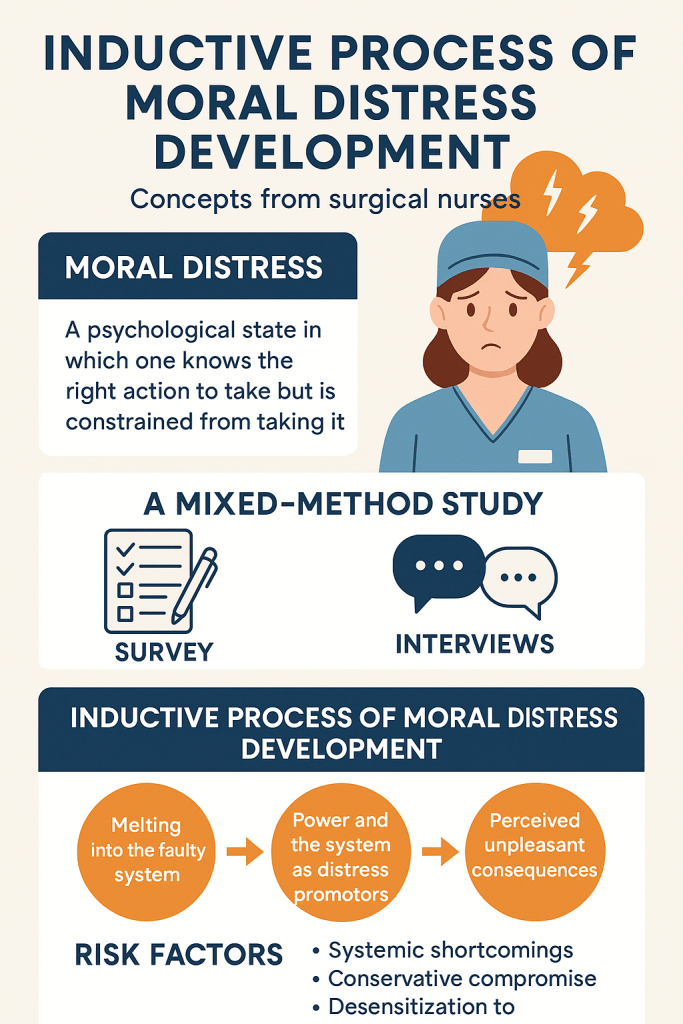
- Inductive Process of Distress Development: The qualitative findings illuminated an “inductive process of moral distress development” experienced by nurses, categorized into three main themes:
- Melting into a faulty system: This described a gradual desensitization where nurses accepted unprofessional norms and behaviors to survive within the system. Subcategories included conservative compromise, weak assertiveness to resist immorality, and desensitization to unprofessionalism.
- Power and the system as distress promotors: Systemic risk factors were identified, such as mobbing by powerful team members (e.g., leaders, surgeons, seniors) who forced actions not aligned with ethical principles, and failure to team-based support, where nurses lacked support from colleagues, supervisors, or managers when facing ethical challenges.
- Perceived unpleasant consequences: Moral distress led to adverse outcomes at individual and systemic levels. Subcategories included psychological exhaustion (e.g., emotional exhaustion, anxiety, persistent twinge of conscience) and perceived perplexity and powerlessness (e.g., confusion, disillusionment, sense of futility).
- Correlations:
- There was a significant relationship between the frequency and intensity of perceived distress (r = 0.28, P-value = 0.01).
- Married nurses reported significantly higher total moral distress scores and frequency of perceived distress compared to single nurses.
- Female nurses reported higher intensity of distress than male nurses.
- However, no significant differences were found in total moral distress scores based on gender, profession groups, working shifts, or academic degree. There was also no significant relationship between distress intensity and age or working experience.
Conclusion: The study concludes that moral distress in surgical units and operating rooms is a cyclic process influenced by both systemic and individual factors. The lack of team-based support and the presence of mobbing by powerful members are key systemic risk factors. Individual factors, such as weak assertiveness, desensitization to unprofessionalism, and conservative compromise strategies, also significantly contribute to distress. These factors collectively lead to unpleasant consequences, including psychological exhaustion and perceived perplexity and powerlessness, which in turn facilitate the nurses’ “melting into the faulty system” and further perpetuate the cycle of distress. The findings underscore the importance of creating supportive environments and interventions to mitigate moral distress and its adverse effects on nursing staff.
Reference: Hosseinpour, A., & Keshmiri, F. (2024). Inductive process of moral distress development in viewpoints from surgical nurses: a mixed-method study. BMC Nursing, 23(191), 1–13. https://doi.org/10.1186/s12912-024-01786-3
Cite this page (APA 7)
Kurutkan, M. N. (2025, July 8). Moral Distress Development in Surgical Nurses. The Health Topics. https://healthtopic.org/topics/moral-distress-development-in-surgical-nurses/