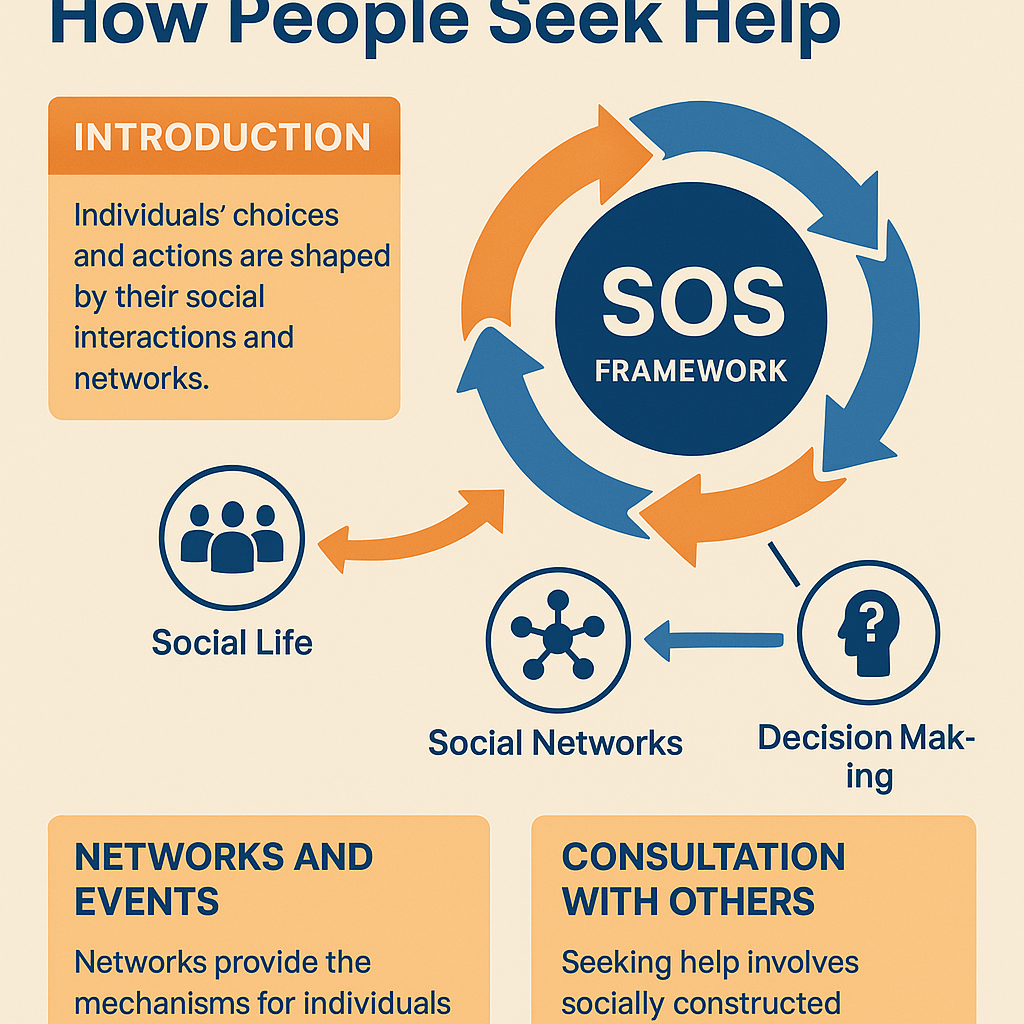
This article, “Beyond Rational Choice: The Social Dynamics of How People Seek Help” by Bernice A. Pescosolido, published in the American Journal of Sociology in January 1992, addresses a fundamental problem in sociology and other social sciences: how people make decisions.
The author highlights a significant intellectual movement in the social sciences by the early 1980s, advocating for more complex theories, data collection efforts, and analytical tools to match the complexity of social life. This era is characterized by a push towards synthesis and reintegration across various streams within sociology and the building of cross-disciplinary bridges, moving beyond traditional disciplinary boundaries. A prominent aspect of this movement is the development of a transdisciplinary, multilevel framework based on a contextualized view of rational actors engaged in purposive action, often rooted in a revised rational choice theory.
Pescosolido argues that while this rational action framework offers many insights, it fails to capture essential features of social life. The article contends that the rational choice explanation, with economic psychology as its fundamental microdynamic, presents only one useful way to explore social action and denies sociology’s most likely contribution to understanding decision-making. The author posits that this approach tends to strip individuals from society in five key ways:
- It assumes free-standing individuals as the decision-making unit, rather than the individual in interaction.
- It treats the social merely as an overlay to individual mental events, abandoning the pivotal process of interaction as the mechanism for social phenomena.
- It removes the embeddedness of problems and solutions within social networks, often failing to see network contacts as decisions or actions themselves.
- Its focus on discrete choices often plucks actions from the larger event that necessitates action and sets a course of action.
- It raises questions about its applicability as a general orientation to all social action, often ignoring actions that proceed through cultural routines rather than conscious cost-benefit calculations, thereby generalizing economic expertise to all behavior.
To address these limitations, the article introduces the Social Organization Strategy (SOS) framework, which offers a complementary approach to social action and decision-making. The SOS framework is presented as a network and event-centered counterpart to rational choice, resting on fundamental sociological principles: social interaction is the basis of social life, and social networks provide the mechanism through which individuals learn about, understand, and handle difficulties. Key tenets of the SOS framework include:
- The “elementary actor” is social and pragmatic, not isolated and ever-consciously rational.
- The focus of analysis shifts from the individual to the individual in patterned interaction with others, conceptualizing social life as dynamic streams of action where social interaction is the mechanism.
- The proper unit of analysis is the social network, with interactional events replacing individuals and social networks replacing social atoms.
- Global macrovariables representing context (e.g., time, place) are seen as different substantive and structural networks, fundamentally tied to individuals and their histories.
- It proposes that a particular action, choice, or decision is embedded in a social process where network interactions not only influence preferences and define situations but also drive the entire process of decision-making.
The article illustrates the utility of the SOS framework through its application to lay decision-making for medical care, a field where the need for a counterpart approach has been more directly recognized due to its strong multidisciplinary tradition and shifts in the sociomedical profile of health. The study of medical care utilization serves as a case to review theoretical approaches to decision-making and provides the background for the SOS framework using data from the National Survey of Access to Medical Care (1975-76).
Methodologically, the SOS approach frames decision-making in terms of the episode rather than the choice, focusing on the entire sequence of actions surrounding an event. It asks: Are there discernable patterns, combinations of options, or strategies that individuals use during an illness episode? And, if so, are these patterns socially organized?. Using clustering techniques, the analysis identifies eight distinct help-seeking strategies, including those involving only physicians, family, or doing nothing, and various combinations of professional and lay advisors, nonprescription drugs, and home remedies. These findings demonstrate that individuals’ responses to illness uncertainty are complex and involve “different pathways to the use or nonuse of physicians”.
While acknowledging data limitations that require using social characteristics as proxies for networks, the article employs multinomial logit models to assess the social organization of these strategies. The results suggest that social contingency variables are significantly associated with these strategies and distinguish among strategies that include physicians. Factors like race, age, marital status, size of place, skepticism of medicine, family income, and characteristics of the illness (type and severity) influence the string of medical care options individuals employ.
In conclusion, the article argues that the SOS framework provides a different but complementary perspective to understanding human behavior, particularly in decision-making. It supports the utility of pursuing a counterpart orienting framework, highlighting that help-seeking strategies are socially organized into embedded strategies, with a limited repertoire of pluralistic and single choices, and that individuals’ strategies are influenced by social and medical contingencies affecting network opportunities. The author emphasizes the need for future research to develop dynamic, multimethod data collection protocols to fully capture social processes and network influence.
Reference: Pescosolido, B. A. (1992). Beyond Rational Choice: The Social Dynamics of How People Seek Help. American Journal of Sociology, 97(4), 1096–1138