

Unlock the Future of Healthcare: A Groundbreaking Analysis of Value-Based Healthcare (VBHC)
In an era characterized by rising healthcare expenditures, growing chronic disease burdens, and persistent workforce shortages, the imperative to transform healthcare delivery has never been more urgent. Value-based healthcare (VBHC) emerges as a promising approach, aiming to enhance quality and efficiency by focusing on outcomes that are most meaningful to patients while simultaneously optimizing costs. Despite a growing interest in VBHC, the existing literature has often suffered from a significant knowledge gap due to the absence of a clear conceptualization of VBHC itself.
A recent, comprehensive concept analysis, titled “Toward a Clearer Understanding of Value-Based Healthcare: A Concept Analysis”, published in the Journal of Nursing Management, directly addresses this critical gap. Authored by Vahe Kehyayan, Yasin M. Yasin, and Areej Al-Hamad, this timely review provides an insightful and evidence-based definition of VBHC, offering a crucial framework for its understanding and effective implementation.
Drawing on a systematic concept analysis approach—specifically the Walker and Avant framework—the study illuminates the multifaceted nature of VBHC, underscoring its potential to transform healthcare delivery by aligning outcomes with patient values and reducing costs. Key insights from this analysis include:
- A Comprehensive Definition: VBHC is precisely defined as “a patient-centered healthcare delivery model that aims to maximize the value of services provided to patients by focusing on improving health outcomes and optimizing the cost-effectiveness of care.” It is characterized by the strategic alignment of healthcare practices, policies, and stakeholder engagements to prioritize quality, efficiency, and patient satisfaction.
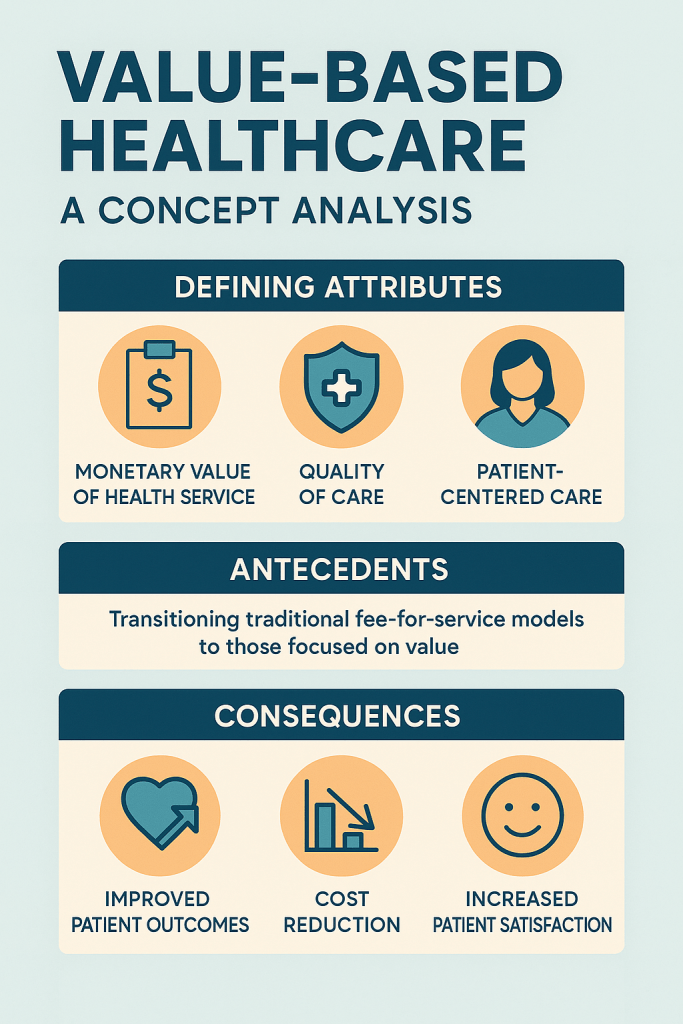
- Three Defining Attributes: The analysis identifies three interconnected characteristics that are central to VBHC:
- Monetary Value of Health Service: This attribute focuses on achieving a delicate balance between cost-efficiency and patient outcomes, by reducing unnecessary treatments, redundant consultations, and inefficient resource utilization. It also incorporates concepts like “Park’s Sweet Spot Theory” which suggests an “optimal nurse staffing zone” to maximize health outcomes at the most efficient costs, rather than simply increasing staffing indiscriminately.
- Quality of Care: This involves factors such as ease of access, efficacy, and interpersonal aspects of healthcare delivery, crucially including patient experience and satisfaction as key markers. High-quality care directly contributes to economic sustainability by minimizing inefficiencies and errors.
- Patient-Centered Care (PCC): This emphasizes the active engagement of patients in their care and treatment decisions, incorporating their preferences, beliefs, and values into all aspects of care delivery. PCC acts as a catalyst for better outcomes and patient satisfaction, reducing wasteful practices and enhancing trust. These three attributes are not isolated but are interrelated and reinforce one another, forming a cohesive and synergistic framework for achieving VBHC’s overarching goals.
- Crucial Antecedents for Transition: For a successful shift from traditional fee-for-service models to value-focused ones, several conditions or factors are necessary:
- Availability of comprehensive healthcare data to enable the measurement and analysis of outcomes and costs.
- Supportive healthcare policy and reimbursement models that incentivize value over volume, such as pay-for-performance and bundled payments.
- Robust stakeholder engagement, fostering a collaborative effort among patients, healthcare providers, payers, healthcare managers, and policymakers.
- Key Interrelated Consequences: The successful implementation of VBHC leads to a series of significant impacts on the healthcare system:
- Improved patient outcomes, as the focus shifts to the quality and effectiveness of care.
- Cost reductions, achieved by eliminating waste and optimizing resource allocation.
- Increased patient satisfaction, fostered by patient-centered, transparent, and tailored care.
- Practical Applications: The paper enriches the analysis by including model, borderline, and contrary cases, offering practical insights into how VBHC principles can be applied in real-world settings and illustrating the variability in implementation and potential outcomes. It also identifies empirical referents—observable indicators—that help assess the implementation and impact of VBHC in practice.
- Implications for Nursing Management: The findings hold significant implications for nursing management, highlighting the crucial role nurse managers play in enhancing leadership, optimizing resource allocation, fostering workforce development, improving operational efficiency, and promoting patient engagement within VBHC frameworks.
This groundbreaking analysis provides a clear roadmap for healthcare decision-makers. By aligning programs with its three core attributes—monetary value, quality, and patient-centered care—stakeholders can ensure critical prerequisites (like data, policies, and engagement) are in place and anticipate improved outcomes, lower costs, and greater patient satisfaction. It supports strategic resource distribution and high-level policy and financial decisions, reinforcing its role as a fundamental driver of efficient healthcare investment. This makes it an essential read for healthcare leaders, researchers, policymakers, and practitioners committed to achieving high-quality, sustainable healthcare, aligning with global initiatives such as the United Nations’ Sustainable Development Goals.
Full Reference:
Kehyayan, V., Yasin, Y. M., & Al-Hamad, A. (2025). Toward a Clearer Understanding of Value-Based Healthcare: A Concept Analysis. Journal of Nursing Management. https://doi.org/10.1155/jonm/8186530
Cite this page (APA 7)
Kurutkan, M. N. (2025, July 25). Understanding Value-Based Healthcare: A Concept Analysis. The Health Topics. https://healthtopic.org/topics/understanding-value-based-healthcare-a-concept-analysis/