

This article, titled “Artificial Intelligence in Health Professions Education assessment: AMEE Guide No. 178,” is published in Medical Teacher and authored by Ken Masters, Heather MacNeil, Jennifer Benjamin, Tamara Carver, Kataryna Nemethy, Sofia Valanci-Aroesty, David C. M. Taylor, Brent Thoma, and Thomas Thesen. The authors are affiliated with various medical education and health institutions across the globe, including Sultan Qaboos University, University of Toronto, Texas Children’s Hospital, McGill University, Baycrest Academy for Research and Education, Royal College of Physicians and Surgeons of Canada, Gulf Medical University, Toronto Metropolitan University, and Dartmouth College Geisel School of Medicine at Dartmouth. The article was published online on January 9, 2025.
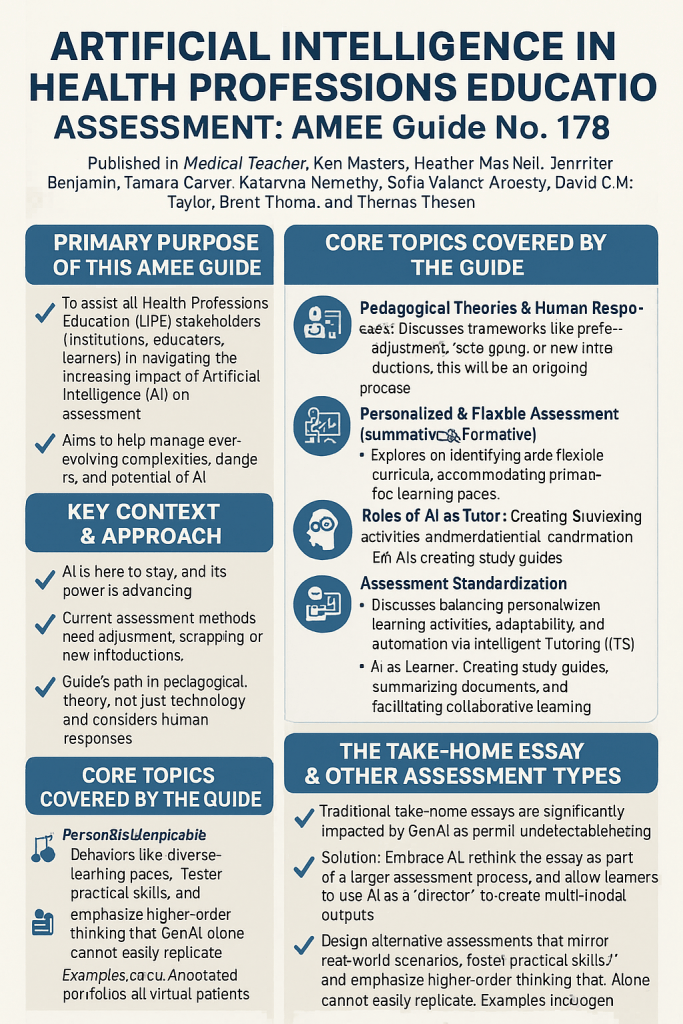
The primary purpose of this AMEE Guide is to assist all Health Professions Education (HPE) stakeholders – including institutions, educators, and learners – in navigating the increasing impact of Artificial Intelligence (AI) on assessment. Recognizing that AI, particularly Generative AI (GenAI) like ChatGPT 3.5, has significantly changed the landscape of learning and assessment, the Guide aims to provide a path forward amidst the ever-evolving complexities, dangers, and potential of AI. It acknowledges the deterministic realization that AI is here to stay and that current assessment methods need to be adjusted or new ones introduced, which will be an ongoing process.
The Guide grounds its approach in pedagogical theory, rather than just technology, and considers the range of human responses to AI. It delves into crucial topics such as:
- The conceptual view of AI’s impact on personal and flexible assessment and standardisation.
- The roles of AI as a tutor and as a learner.
- Its implications for competency-based assessment.
- Difficult and ethical issues related to AI in HPE assessment, including data sourcing, bias, faculty and learner use, and the limitations of AI detection tools.
- Faculty development necessary for effective AI integration.
- The technicalities of acknowledging AI usage in assessment.
By addressing these areas, the authors intend to allay fears in the face of change and demonstrate possibilities that allow educators and learners to harness the full potential of AI in HPE assessment. The Guide specifically focuses on identifying areas in HPE assessment that can be enhanced by AI usage while acknowledging potential problems it may cause.
Reference: Masters, K., MacNeil, H., Benjamin, J., Carver, T., Nemethy, K., Valanci-Aroesty, S., … & Thesen, T. (2025). Artificial Intelligence in Health Professions Education assessment: AMEE Guide No. 178. Medical Teacher, 1-15.
Cite this page (APA 7)
Kurutkan, M. N. (2025, June 27). AI in Health Professions Education Assessment. The Health Topics. https://healthtopic.org/topics/ai-in-health-professions-education-assessment/