
Methodological Coherence, Fit, Alignment and Congruence, Read Through a Web of Science Title Corpus (1981 to 2026)
Prof. Dr. Mehmet Nurullah Kurutkan, Düzce University, Faculty of Business, Department of Health Management
Abstract
A study is coherent when its parts follow from one another: the question follows from what is already known, the design follows from the question, the analysis follows from the design, and the claims go no further than the evidence allows. This chapter introduces that idea at 101 level and then moves step by step to its more demanding forms. It is built on a Web of Science Core Collection title search with thirteen coherence phrases, which returned 102 records. Screening kept 53 records that treat coherence as a property of research and set aside 49 that use the same words for something else. The retained literature works at three levels: the single study (20 records), a body of studies that must be comparable (14 records), and a construct, theory or field (19 records). The chapter traces the history of the idea, compares its rival names and definitions in one schema, separates it from neighbouring concepts such as rigour, validity and triangulation, catalogues typical incoherences, and ends with a practical protocol and a worked example from health management. Interest is recent and accelerating: 42 of the 53 records (79%) appeared from 2016 onward and 19 (36%) from 2024 onward.
Keywords: methodological coherence; methodological fit; methodological alignment; methodological congruence; internal coherence; research design; research quality; meta-research
Open the interactive module: Follow Deniz, a first-year PhD student, as she repairs her own study design station by station: build the coherence chain, practise the fit grid, spot the misfit and audit your own study.
Coherence Lab: Interactive Module →
1. Why coherence? An opening example
Imagine a manuscript submitted to a health services journal. Its research question asks how nurses experience moral distress during night shifts. Its stated paradigm is constructivist. Its sample is 18 nurses interviewed in depth. So far, the pieces fit. Then the analysis section reports Cohen’s kappa between two coders as proof of objectivity, the results count how many nurses mentioned each theme, and the discussion concludes that night shifts cause moral distress and recommends a national staffing ratio.
No single step in that paper is wrong in isolation. Interviews are a good way to study experience. Kappa is a legitimate statistic. Staffing ratios are a reasonable policy topic. The problem lies between the steps. A constructivist question about meaning has been answered with tools that assume a single true coding, and an exploratory design has been asked to carry a causal, population-level claim. Reviewers often sense this mismatch before they can name it. The name is methodological coherence (also called methodological fit, alignment or congruence): the degree to which the elements of a study are consistent with one another and with the claims built on them.
The example is not invented for convenience. Halpin (2026) describes exactly this trap, in which widely accepted markers of rigour such as intercoder agreement mask a deeper contradiction with the study’s own assumptions about knowledge. Fleming (2026) shows the mirror image in a quantitative setting: an exploratory analysis of mRNA vaccine lots was judged against regulatory quality-control standards designed for a different purpose, producing what the author calls a category error. In both cases the fault is relational, not local.
This chapter is about that relational property. It answers five questions in order: where the idea comes from, what it is called, what it means, how it differs from related ideas, and how a researcher can check and build it in practice.
Box 1. One-sentence definition used in this chapter. A study is methodologically coherent when its research question, philosophical stance, theory, design, data, analysis and claims form a chain in which each link is justified by the one before it and none promises more than the next can deliver.
2. How this chapter was built: corpus and screening
The chapter rests on a Web of Science Core Collection title (TI) search for thirteen phrases: methodological coherence, research coherence, internal coherence, theoretical coherence, conceptual coherence, epistemological coherence, methodological congruence, methodological consistency, research design coherence, methodological alignment, theoretical alignment, research design alignment and methodological fit. Letters, book reviews, meeting abstracts, proceeding papers, books, book chapters and corrections were excluded at source. The export (102 records, 1981 to 2026) contained full bibliographic data and abstracts for 89 records; cited-reference fields were not included, so the chapter uses descriptive bibliometrics and qualitative synthesis rather than co-citation mapping.
Screening rule. A record was retained if coherence (or fit, alignment, congruence, consistency) referred to a property of research: of a study’s design, of a set of studies, or of the constructs and theories that research uses. A record was excluded if the same phrase described something outside research practice, such as the internal coherence of a scripture passage, a quantum field, a radar signal, a curriculum, a patient’s sense of coherence, or a child’s mental concepts. One record was a translated republication of another and was removed as a duplicate. Each title and abstract was read in full; the classification for every record is listed in the appendix.
Table 1. Records returned and retained by search phrase.
| Search phrase in title | Records returned | Retained | Retention rate |
|---|---|---|---|
| internal coherence | 29 | 2 | 7% |
| conceptual coherence | 27 | 9 | 33% |
| theoretical coherence | 11 | 8 | 73% |
| methodological consistency | 11 | 11 | 100% |
| methodological alignment | 5 | 5 | 100% |
| methodological congruence | 5 | 5 | 100% |
| methodological coherence | 5 | 5 | 100% |
| methodological fit | 4 | 4 | 100% |
| epistemological coherence | 2 | 1 | 50% |
| theoretical alignment | 2 | 2 | 100% |
| research coherence | 1 | 1 | 100% |
| research design coherence / alignment | 0 | 0 | not applicable |
| Total | 102 | 53 | 52% |
Table 1 carries a methodological lesson of its own. The phrases that contain the word methodological are precise: every record they returned was relevant. The generic phrases internal coherence and conceptual coherence are noisy: they brought in physics, theology, oncology and child psychology. A search strategy, in other words, has its own coherence problem, and its precision depends on how tightly its terms are tied to the construct.
The 49 excluded records fell into eight groups: cognitive science and philosophy of concepts (8), learners’ conceptual understanding in science and mathematics teaching (8), physics, engineering, neuroscience and genomics (7), textual, doctrinal and legal coherence (7), curriculum, programme and policy coherence (6), the salutogenic Internal Coherence Scale used with cancer patients (6), other clinical and miscellaneous uses (6), and one duplicate. The 53 retained records comprise 34 articles (four in early access), 11 reviews and 8 editorial pieces, and have been cited 3,199 times in the Core Collection (median 5). Citation is highly concentrated: Edmondson and McManus (2007) alone account for 2,277 citations, or 71% of the total.
Figure 1. Corpus construction and screening flow (n = 102 identified, 53 retained).
3. A short history, 1981 to 2026
The retained corpus grows slowly for two decades and then sharply: 11 records before 2016, 23 between 2016 and 2023, and 19 in 2024 to 2026 alone, of which 9 carry a 2026 date. Four phases can be distinguished.
Phase 1 (1986 to 2001): the coherence of constructs. The earliest retained records ask whether a concept used in research hangs together. Robertson (1986) described the alcohol dependence syndrome as a statistical phenomenon of little theoretical coherence; Keil (1991) asked whether cognitive science was more than the sum of its parts; Gedo (1997) examined the theoretical coherence of psychoanalytic metapsychology; Hupcey (1998) showed that social support had been defined and measured in so many incompatible ways that it no longer named one thing; and Aujoulat et al. (2001) found the health promoting hospital concept lacked the conceptual coherence needed to guide implementation. The intellectual root of this line lies just outside the corpus: Murphy and Medin (1985), excluded here because it concerns mental concepts rather than research, argued that concepts cohere because a theory binds their features together. That insight later travels into methodology: a construct is coherent when a theory explains why its parts belong together.
Phase 2 (2004 to 2012): naming the property of a study. The decisive shift is from the coherence of a concept to the coherence of a research project. Hoadley (2004) introduced methodological alignment in design-based research: making sure that the methods actually test what researchers think they are testing. Edmondson and McManus (2007) then gave the field its most cited formulation, methodological fit, defined as internal consistency among the research question, prior work, research design and theoretical contribution, and tied it to the maturity of existing theory. Davis (2012) brought the term methodological coherence to an occupational therapy editorial audience. In parallel, qualitative methodologists outside this title corpus were making the same move: Morse et al. (2002) listed methodological coherence as the first verification strategy, Carter and Little (2007) linked epistemology, methodology and method, and Tracy (2010) made meaningful coherence one of eight big-tent criteria.
Phase 3 (2015 to 2020): instruments, combinations and comparability. Coherence becomes something that can be appraised and engineered. Willgens et al. (2016) developed the Methodological Congruence Instrument for five qualitative traditions. Beach (2018) showed how hard alignment becomes when two methods with different ontologies of causation (qualitative comparative analysis and process tracing) are combined. Bass and Milosevic (2018) used methodological fit to argue for ethnography in corporate social responsibility research. At the same time a second, quantitative strand appears: Whittle et al. (2017) and Rose et al. (2018) asked whether studies of the same phenomenon were measured consistently enough to be compared.
Phase 4 (2021 to 2026): coherence as a marker of quality and an object of meta-research. Palermo et al. (2021) defined internal coherence as alignment between ontology, epistemology, axiology, methodology and methods and argued it is a marker of quality over and above checklists. Knight et al. (2022) extended methodological fit to international business with a contingency framework, Lorello and Kuper (2024) carried internal coherence into clinical anaesthesia, and Jacobsen and McKenney (2024) applied fit to educational design research. The 2026 cluster turns coherence into an audit criterion: Fidan (2026) audited case studies in sustainability journals, Wainstein (2026) qualitative reporting in genetic counselling, Buddrus and Liebe (2026) digital health systematic reviews, and Araña and Czernek-Marszałek (2026) proposed a meta-methodological framework that launches a curated methods collection in tourism research.
Figure 2. Retained records per year, stacked by level of coherence (study, body of studies, construct or field), 1986 to 2026.
4. One idea, many names: the vocabulary
The literature uses at least eight labels for overlapping ideas, and each carries a slightly different emphasis. Knowing the emphasis helps a reader search better and a writer choose the term that matches the claim being made.
Table 2. The vocabulary of coherence: eight labels and their emphasis.
| Term | Core emphasis | Typical object | Anchor sources in the corpus |
|---|---|---|---|
| Methodological fit | Matching design to the maturity of prior theory (nascent, intermediate, mature) | Single study | Edmondson & McManus (2007); Bass & Milosevic (2018); Knight et al. (2022); Jacobsen & McKenney (2024) |
| Methodological alignment | Methods must test what the theory says; combined methods must share assumptions about causation | Single study, mixed designs | Hoadley (2004); Beach (2018); Pugh & Shank (2024); Fleming (2026) |
| Methodological congruence | Fit between the chosen methodology and the researcher’s philosophical perspective | Single study, mostly qualitative | Willgens et al. (2016); de Melo (2021); Wainstein (2026) |
| Methodological coherence | Unified research frame from question to claim; protocol and reviewer use | Single study, review | Davis (2012); Buddrus & Liebe (2026); Halpin (2026); Araña & Czernek-Marszałek (2026) |
| Internal coherence | Alignment of ontology, epistemology, axiology, methodology and methods | Single study | Palermo et al. (2021); Lorello & Kuper (2024) |
| Methodological consistency | Same phenomenon measured, analysed and reported the same way across studies | Body of studies | Whittle et al. (2017); Rose et al. (2018); Franz et al. (2022); Temmerman et al. (2025) |
| Theoretical / conceptual coherence | A construct or theory whose parts are explained by one logic | Construct, theory, field | Hupcey (1998); Harrison et al. (2017); Radovic et al. (2018); Gray et al. (2026) |
| Epistemic alignment | Analytic practices consistent with assumptions about knowledge and meaning | Analytic step | Halpin (2026) |
Two patterns stand out. First, consistency is almost always used for comparability across studies (10 of its 11 retained records sit at that level), whereas fit, alignment, congruence and coherence describe the inside of a single study. Second, theoretical and conceptual coherence belong to construct and field debates. The vocabulary is therefore not random: the choice of word signals the level at which the author is working. This chapter uses methodological coherence as the umbrella term because it is the broadest and the most recent label, and uses the others when their specific emphasis matters.
Figure 3. Which term is used at which level: retained records by search phrase and level of coherence (n = 53).
5. Definitions compared in a conceptual schema
Definitions differ less in what coherence is (all describe agreement among parts) than in which parts they include. Table 3 paraphrases ten definitions from the corpus; Figure 4 maps them against nine elements of a study.
Table 3. Ten definitions of coherence in the corpus, in chronological order.
| Source | Definition (paraphrased) |
|---|---|
| Hoadley (2004) | Methodological alignment: the methods used actually test what researchers think they are testing, so inferences follow from the theory being studied. |
| Edmondson & McManus (2007) | Methodological fit: internal consistency among research question, prior work, research design and theoretical contribution. |
| Willgens et al. (2016) | Methodological congruence: fit between the chosen methodology and the researcher’s philosophical perspective, extended to question, sampling and data collection, analysis and findings. |
| Beach (2018) | Alignment between the ontology of causation assumed by a method and the way the method is practised, especially when methods are combined. |
| Palermo et al. (2021) | Internal coherence: alignment between ontology, epistemology, axiology, methodology and methods. |
| Lorello & Kuper (2024) | Internal coherence as a marker of rigour that rests on ontology, epistemology and methodology. |
| Wilson (2025) | Coherent co-use of methodologies that agree in philosophy, use of theory, analytic strategy, quality indicators and treatment of researcher subjectivity. |
| Fleming (2026) | Evaluative standards aligned with a study’s stated aims, analytic scope and evidentiary boundaries. |
| Buddrus & Liebe (2026) | Methodological coherence across all stages of a systematic review, from the PICO question to search, eligibility, appraisal, synthesis and conclusions. |
| Araña & Czernek-Marszałek (2026) | A framework, prior to technique choice, that maps question types to designs and judges them by coherence, transparency, sufficiency, cumulative contribution and reflexivity. |
Figure 4. Conceptual schema: the elements of a study that each definition requires to be aligned. Dark cells mark an element named in the definition.
Three observations follow from the schema. First, methodology and design appear in seven of the ten definitions, claims in six, and the research question, philosophical stance and analysis in five each; together they form the minimal core. Second, definitions from qualitative methodology add the philosophical layer (ontology, epistemology, axiology) and the researcher (reflexivity, subjectivity), whereas definitions from management and evaluation add prior theory and claims. Third, the newest definitions (Wilson, 2025; Fleming, 2026; Araña & Czernek-Marszałek, 2026) add an element none of the earlier ones named explicitly: the standards by which the study is judged. Coherence is thus no longer only a property the author builds, but also a property the reviewer must respect.
Combining these layers yields the working definition used in the rest of the chapter (Box 1): coherence is the justified, traceable agreement of nine elements, namely question, prior theory, philosophical stance, design, data and sampling, analysis, claims, evaluative standards and researcher position.
6. Neighbouring concepts: what coherence is not
Coherence is often confused with ideas that sit next to it. The simplest test is to ask what each concept evaluates: coherence evaluates the relations between parts, whereas most neighbours evaluate a part.
Table 4. Coherence and its neighbouring concepts.
| Neighbouring concept | What it evaluates | How it relates to coherence |
|---|---|---|
| Rigour | Whether each procedure is carried out carefully and to standard | Necessary but not sufficient: a study can be rigorous step by step and still incoherent as a whole (Palermo et al., 2021; Fidan, 2026) |
| Internal validity | Whether a causal inference is protected from alternative explanations | One link of the chain (design to claim) in causal research; coherence also covers non-causal and interpretive studies |
| Reliability, inter-rater agreement | Whether measurement or coding is repeatable | A procedure whose meaning depends on the paradigm: agreement is coherent in a realist design and can be incoherent in a constructivist one (Halpin, 2026) |
| Trustworthiness, methodological integrity | Whether qualitative findings are credible and adequately grounded | Close partner; integrity is often defined to include coherence (Levitt et al., 2017; Wilson, 2025) |
| Checklist or reporting compliance | Whether required items are reported | Reporting can be complete while the logic is broken; coherence is a quality judgement over and above checklists (Palermo et al., 2021) |
| Triangulation, mixed methods | Whether several sources or methods converge | Only coherent if the combined methods share compatible assumptions (Beach, 2018; Knight et al., 2022) |
| Methodological pluralism | Openness to many methods in a field | Not the opposite of coherence: pluralism at field level requires coherence in each study (Araña & Czernek-Marszałek, 2026) |
| Methodological consistency, standardisation | Whether different studies of one phenomenon use comparable procedures | Coherence at the level of a body of studies (Section 7, Level 2) |
| Conceptual clarity | Whether a construct is defined unambiguously | Precondition of construct coherence (Gray et al., 2026; Hupcey, 1998) |
Two false friends deserve a warning because they share the vocabulary but not the meaning. Internal consistency in psychometrics (for example Cronbach’s alpha) is a property of items in a scale, not of a research design. The Internal Coherence Scale and Antonovsky’s sense of coherence are salutogenic constructs measured in patients; six such records appeared in the search and were excluded (Appendix). A reviewer who writes that a study “lacks internal coherence” means something entirely different from an oncologist who reports a patient’s internal coherence score.
Figure 5. Coherence among its neighbours: concepts that evaluate a single part of a study (outer ring) versus concepts that evaluate the relations between parts (centre).
7. Types of coherence: three levels
The screening produced a typology that the literature uses implicitly but rarely states: coherence operates at three nested levels. Each level asks a different question and fails in a different way.
Table 5. Three levels of coherence.
| Level 1: Study coherence | Level 2: Cumulative coherence | Level 3: Construct and theory coherence | |
|---|---|---|---|
| Records in corpus | 20 | 14 | 19 |
| Guiding question | Do the parts of this study follow from one another? | Can these studies be compared and added up? | Does this construct or theory hang together? |
| Typical labels | fit, alignment, congruence, internal or methodological coherence | methodological consistency, congruence of metrics | theoretical, conceptual, epistemological coherence; theoretical alignment |
| Typical failure | A design or analysis that cannot carry the stated question or claim | Heterogeneous measures, thresholds or reporting that make synthesis impossible | A construct defined and measured in incompatible ways; rival models with no shared logic |
| Exemplars | Edmondson & McManus (2007); Palermo et al. (2021); Halpin (2026) | Rose et al. (2018); Hong & Bae (2021); Bairnsfather et al. (2025); Chen (2026) | Hupcey (1998); Harrison et al. (2017); Coulter et al. (2020); Gray et al. (2026) |
Level 1, study coherence, is the core of this chapter and of the methodological literature. Its unit is the single project and its users are authors, supervisors and reviewers.
Level 2, cumulative coherence, concerns evidence that should accumulate. It is dominated by health and life sciences: utility values in health technology appraisals (Rose et al., 2018; Hong & Bae, 2021), definitions of postoperative cognitive dysfunction (Glumac et al., 2021), brain volumetry across scanners (Temmerman et al., 2025) and hippocampal measures of navigation (Tu et al., 2024). Bairnsfather et al. (2025) capture the level in their title: near-universal agreement on the definition of absolute pitch, yet pitch-naming accuracy thresholds ranged from 20% to 100% across 95 studies. Agreement on a concept does not guarantee comparable measurement.
Level 3, construct and theory coherence, concerns the building blocks that studies borrow. Hupcey (1998) showed that social support had absorbed so many neighbouring concepts that it needed redefinition; Harrison et al. (2017) found that mindfulness interventions for chronic pain rested on competing, imprecise mechanisms; Radovic et al. (2018) proposed dimensions to bring order to mathematics learner identity; and Gray et al. (2026) found environmental social work theoretically fragmented. The British Journal of Social Work exchange (Coulter et al., 2020; Mc Kenny, 2020) shows that construct coherence is contested: unifying models can gain coherence and lose useful distinctions.
The levels are linked. A study cannot be coherent if it borrows an incoherent construct (Level 3 feeds Level 1), and a body of evidence cannot be coherent if its individual studies define and measure the outcome differently (Level 1 feeds Level 2).
Figure 6. Three nested levels of coherence and how failures propagate between them.
8. The coherence chain within a study
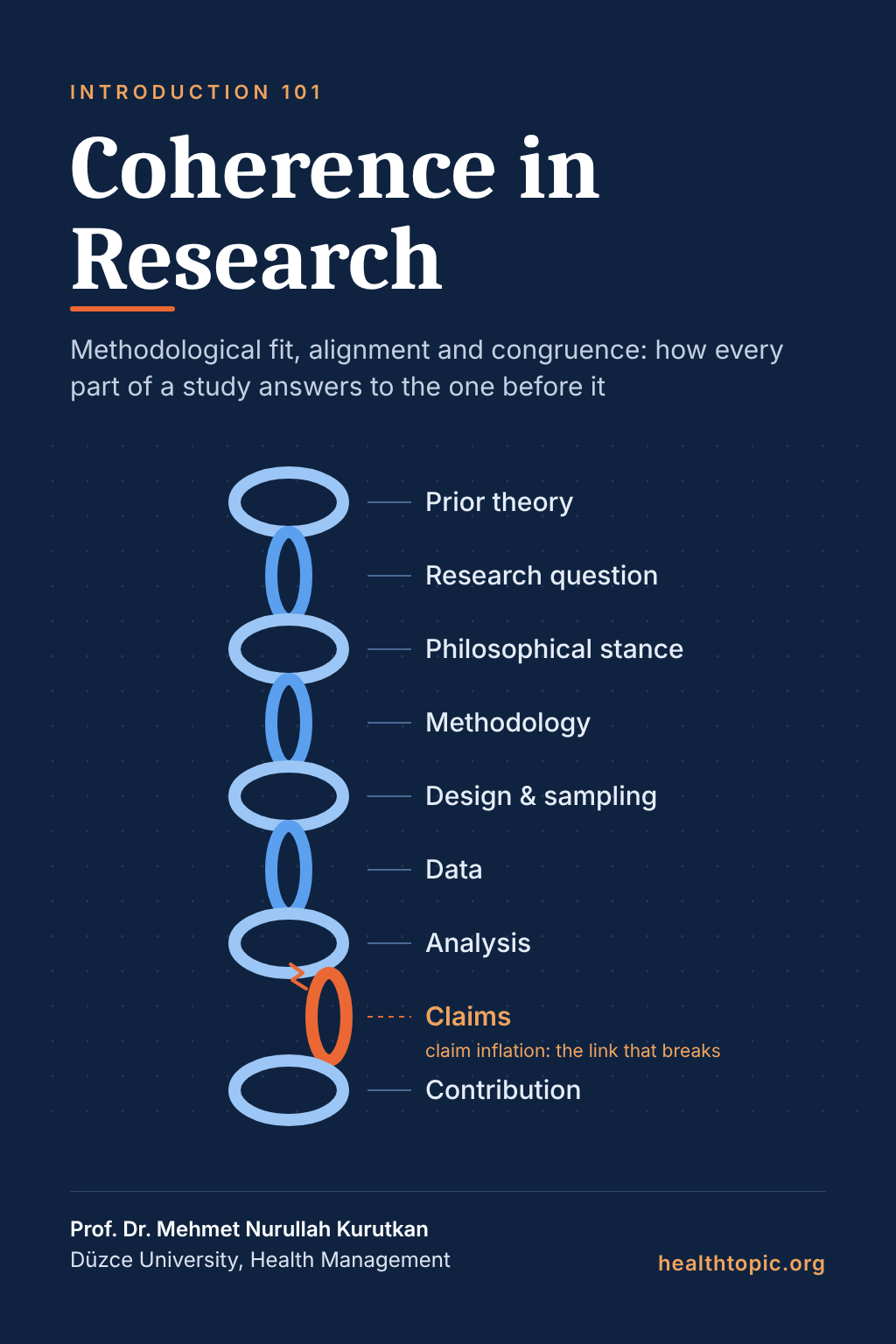
At Level 1, coherence can be pictured as a chain of links. A useful way to read the chain is that each link answers to the one before it: the question must be justified by the state of prior theory, the design by the question, and so on to the claims. Figure 7 shows the chain; the list below gives the test question for each link.
Figure 7. The coherence chain: nine elements of a study and the justification each owes to the previous one. Feedback arrows show that later elements may revise earlier ones in iterative designs.
- Prior theory to question. Is the question appropriate to what is already known? Little prior theory calls for open, exploratory questions; mature theory calls for focused, testable ones (Edmondson & McManus, 2007).
- Question to philosophical stance. Does the question assume one reality to be measured, or meanings to be interpreted, or structures to be challenged (Palermo et al., 2021)?
- Stance to methodology. Is the methodology (for example grounded theory, phenomenology, an experiment, a case study) one whose tradition shares that stance (Willgens et al., 2016)?
- Methodology to design and sampling. Does the sampling logic (statistical, theoretical, purposive) follow from the methodology?
- Design to data. Are the data the kind of evidence the question needs, and enough of it (the sufficiency principle of Araña & Czernek-Marszałek, 2026)?
- Data to analysis. Does the analytic technique respect the assumptions of the data and the paradigm (Halpin, 2026), and is it applied rather than merely named (Fidan, 2026)?
- Analysis to claims. Do the claims stay within the analytic scope and evidentiary boundaries (Fleming, 2026)?
- Claims to contribution. Does the contribution match the type of study, such as suggestive theory from nascent work or incremental refinement from mature work (Edmondson & McManus, 2007)?
- Evaluation to all of the above. Are reviewers and readers applying standards that fit the study’s own aims and tradition (Fleming, 2026; Wainstein, 2026)?
The chain is not always linear. Educational and design-based research moves between orientations over time (research for, on and through interventions), so fit must be guarded across phases, not just checked once (Hoadley, 2004; Jacobsen & McKenney, 2024). Coherence in such designs is dynamic: each change in question is followed by a deliberate change in method.
The fit grid. The most widely used single tool for links 1, 5, 6 and 8 is the contingency logic of Edmondson and McManus (2007), summarised below.
Table 6. The fit grid, adapted from Edmondson and McManus (2007).
| State of prior theory | Research question | Data | Analysis | Theoretical contribution |
|---|---|---|---|---|
| Nascent | Open-ended, how and why | Qualitative, collected to discover | Pattern identification, thematic coding | Suggestive theory, new constructs |
| Intermediate | Relational, proposing new links | Hybrid: qualitative and quantitative | Exploratory statistics with content analysis | Provisional theory linking established and new constructs |
| Mature | Focused hypotheses about established constructs | Quantitative, established measures | Statistical inference, formal testing | Supported or refined existing theory |
Two forms of misfit follow from the grid. Using a hypothesis-testing design where theory is nascent tests constructs that do not yet exist in usable form. Using purely open-ended interviews where theory is mature tends to rediscover what is already known.
9. Themes in the literature
Each retained record was assigned to one primary theme on the basis of its title, keywords and abstract. Six themes emerged (Figure 8).
Figure 8. Six themes in the retained literature, by number of records and period of publication (n = 53).
Theme 1. Coherence as a marker of quality beyond checklists (7 records). This theme argues that coherence is what checklists miss. Palermo et al. (2021) critiqued published nutrition studies and found alignment between epistemology and methodology but misalignment between epistemology, axiology and method. Fidan (2026) audited case studies in two leading sustainability journals and named a “ceremonial data analysis problem”: a technique is cited but not interpreted. Wainstein (2026) assessed 34 qualitative articles in genetic counselling using congruence, knowingness and transparency. Willgens et al. (2016) and Davis (2012) offer the earlier instruments and editorial framing, and Lorello and Kuper (2024) and Halpin (2026) carry the argument to clinical and qualitative audiences.
Theme 2. Fit as a contingency on theory and question (6 records). The best match between design and study depends on the state of knowledge and the type of question. Edmondson and McManus (2007) anchor the theme; Knight et al. (2022) argue that international business research has over-relied on confirmatory designs and call for exploratory work with both data types; Bass and Milosevic (2018) show which type of ethnography fits which CSR question; Jacobsen and McKenney (2024) apply fit to phases of design research; and Araña and Czernek-Marszałek (2026) generalise the idea into a six-type question matrix with explicit warnings against methodological defaulting, the habit of choosing a method before the question is clear.
Theme 3. Combining methods and paradigms (6 records). When two traditions meet, coherence must be negotiated. Beach (2018) shows that QCA and process tracing assume different ontologies of causation, so their guidelines conflict; Wilson (2025) offers 22 guiding questions for the coherent co-use of interpretive description and reflexive thematic analysis; de Melo (2021) asks systems-thinking research to use methods congruent with complexity; Pugh and Shank (2024) align visual methods with a transactional theory of occupation; and Romm (2024) reviews a book on paradigms and their methodological alignment.
Theme 4. Comparability and standardisation of evidence (13 records). This is the largest Level 2 theme and the most applied. It spans health technology assessment (Rose et al., 2018; Hong & Bae, 2021), clinical measurement (Whittle et al., 2017; Glumac et al., 2021; Temmerman et al., 2025), neuroscience (Tu et al., 2024), environmental monitoring (Fujiyoshi et al., 2023; Pakhomova et al., 2024), construction management (Franz et al., 2022), language testing (Shamshir et al., 2026), phylogenomics (Tucker et al., 2016), psychology (Bairnsfather et al., 2025) and cross-national education statistics (Heuser et al., 2012). Its common message: without consistent procedures, studies cannot be pooled, compared or trusted to show trends.
Theme 5. Construct and theory consolidation (17 records). The oldest and largest theme concerns whether constructs and theories are coherent enough to be researched: alcohol dependence (Robertson, 1986), social support (Hupcey, 1998), health promoting hospitals (Aujoulat et al., 2001), mindfulness mechanisms (Harrison et al., 2017), mathematics identity (Radovic et al., 2018), personalised learning (Walkington & Bernacki, 2020), relationship-based social work (Coulter et al., 2020) and environmental social work (Gray et al., 2026). Citlak (2025) extends the argument to psychology’s theory crisis.
Theme 6. Coherence in evaluation and research assessment (4 records). The newest theme turns coherence onto those who judge research. Fleming (2026) argues that critique must be aligned with the aims and boundaries of the work critiqued; Buddrus and Liebe (2026) found that 48% of 250 sampled digital health systematic reviews had low or very low PICO specification and 64% reported inconclusive or weak evidence; Chen (2026) asks for methodological consistency in selecting Highly Cited Researchers across fields and regions; and Glenn (2022) questions whether rating agencies should reward coherence of a researcher’s portfolio at all, a reminder that coherence at the level of a career is a different and more debatable ideal.
10. Common incoherences and how to diagnose them
Incoherence is easier to recognise when it has a name. Table 7 lists ten recurring patterns found in or implied by the corpus, the link of the chain each one breaks (numbered as in Section 8) and a question that exposes it.
Table 7. Ten common incoherences, the links they break and how to repair them.
| # | Incoherence | Broken link | Typical symptom | Diagnostic question | Repair |
|---|---|---|---|---|---|
| 1 | Methodological defaulting | 1, 3 | The method was chosen first, the question written to suit it | Would this question have led me to this method if I did not already know the method? | Restate the question; choose design from the question type (Araña & Czernek-Marszałek, 2026) |
| 2 | Theory-maturity misfit | 1 | Hypothesis testing on constructs not yet defined, or open interviews in a saturated field | What is the state of prior theory on this exact relation? | Use the fit grid (Edmondson & McManus, 2007) |
| 3 | Paradigm drift | 2, 6 | Constructivist stance, but objectivity proven through coder agreement or theme counts | Does each quality criterion make sense under my own assumptions about knowledge? | Choose criteria native to the paradigm (Halpin, 2026; Wainstein, 2026) |
| 4 | Incompatible combination | 3, 6 | Two methods with different assumptions about causation joined without discussion | Do both methods understand cause in the same way? | Sequence and justify the combination, or choose one logic (Beach, 2018) |
| 5 | Sampling logic mismatch | 4, 7 | Purposive sample, statistical generalisation in the discussion | What kind of generalisation does my sampling allow? | Claim analytic or theoretical, not statistical, generalisation |
| 6 | Construct mismatch | 3, 5 | A construct defined one way and measured another | Does each item measure the definition I gave? | Align definition and operationalisation (Hupcey, 1998; Radovic et al., 2018) |
| 7 | Ceremonial analysis | 6 | A technique is named and cited, but its steps and decisions are not shown | Could a reader repeat or audit what I did? | Report decisions, not labels (Fidan, 2026) |
| 8 | Claim inflation | 7, 8 | Cross-sectional or exploratory evidence presented as causal or policy-ready | Is every verb in my conclusion (causes, proves, should) licensed by the design? | Scale the claim to the evidentiary boundary (Fleming, 2026) |
| 9 | Underspecified question | 1, 5 | Review question without clear population, intervention, comparison or outcome; vague search terms | Could two people screen the same record the same way? | Specify the question frame before searching (Buddrus & Liebe, 2026) |
| 10 | Evaluation misfit | 9 | A study is criticised against standards of another tradition | Which standards did this study promise to meet? | Judge by the study’s own aims and tradition (Fleming, 2026) |
Pattern 8 is particularly common in health management research that uses structural equation models on cross-sectional survey data. A serial mediation model can be estimated with excellent fit indices and still be incoherent if the discussion describes the mediators as causal mechanisms established by the study. The statistical fit of a model is not the methodological fit of a study: the first evaluates a model against data, the second evaluates a design against its question and claims.
At Level 2, the dominant pattern is measurement heterogeneity: different instruments, thresholds, scanners or reporting formats for the same outcome (Bairnsfather et al., 2025; Temmerman et al., 2025). At Level 3 it is construct sprawl: a term that has absorbed so many neighbouring meanings that it no longer refers to one phenomenon (Hupcey, 1998; Gray et al., 2026).
11. A step-by-step protocol with a worked example
The literature offers many principles but few procedures. The protocol below condenses the corpus into seven steps that can be used while planning a study, while writing it up, or while reviewing someone else’s. It is deliberately simple at the start and more demanding at the end.
Step 1. Write the claim first. Draft, in one sentence, the strongest claim you hope to be entitled to make at the end. Its verbs (describe, explore, explain, predict, cause, should) set the evidentiary bar for everything else.
Step 2. Classify the question. Decide whether it is descriptive, exploratory, explanatory, predictive, causal or evaluative, and locate the state of prior theory as nascent, intermediate or mature (Edmondson & McManus, 2007; Araña & Czernek-Marszałek, 2026).
Step 3. Make the stance explicit. State, in two or three sentences, what you assume about reality, knowledge and the role of values and of yourself (Palermo et al., 2021). If you cannot state it, choose it.
Step 4. Choose methodology, design and sampling from Steps 2 and 3. Not the reverse. Name the tradition you are following and its core authors (Willgens et al., 2016).
Step 5. Fill in the coherence matrix. For each of the nine elements, write what you did and why it follows from the previous element.
Table 8. Coherence matrix template.
| Element | What I chose | Why it follows from the previous element | Status |
|---|---|---|---|
| Prior theory | |||
| Question | |||
| Stance | |||
| Methodology | |||
| Design and sampling | |||
| Data | |||
| Analysis | |||
| Claims | |||
| Evaluation standards |
Step 6. Run the ten diagnostic questions of Table 7 and mark each link as aligned, partly aligned or misaligned.
Step 7. Repair the weakest link, then re-check its neighbours. Changing one link often moves the next. The usual and cheapest repair is to lower the claim; the more ambitious repair is to strengthen the design.
Worked example: patient safety culture and incident reporting
A health management team wants to know why nurses in Turkish public hospitals under-report adverse events. Their first draft and their revised plan are compared below.
Table 9. Worked example: first draft versus revised plan.
| Element | First draft (incoherent) | Revised plan (coherent) |
|---|---|---|
| Claim | Low safety culture causes under-reporting; the Ministry should mandate reporting training | Nurses’ accounts reveal mechanisms through which safety climate shapes reporting decisions, offered as propositions for testing |
| Question | Does safety culture affect reporting? | How do nurses decide whether to report an adverse event, and what role does unit safety climate play? |
| Prior theory | Treated as mature (safety culture scales exist) | Mature on safety culture measurement, nascent on the reporting decision process in this context |
| Stance | Not stated | Interpretivist, with a realist reading of mechanisms |
| Methodology | Survey with one open question | Exploratory sequential mixed methods: interviews, then survey |
| Sampling | 300 nurses by convenience | Phase 1: 20 nurses purposively varied by unit and incident experience; Phase 2: stratified sample of nurses across hospitals |
| Analysis | Regression plus word counts of open answers | Phase 1: reflexive thematic analysis; Phase 2: structural model of propositions from Phase 1 |
| Evaluation standards | Unclear | Phase 1 judged by qualitative criteria; Phase 2 by measurement and structural model criteria |
The first draft breaks links 1, 5 and 8 at once: it treats a nascent process question as mature, uses data that cannot show decision processes, and makes a causal and policy claim from a cross-sectional design. The revision does not make the study bigger for its own sake; it makes each part answer to the one before it.
12. Projection: where the field is heading
The corpus points to five developments that are likely to shape the next decade.
From principle to audit. Until about 2020, coherence was mostly advocated. Since 2021 it is increasingly measured: journals and fields are being audited for it (Palermo et al., 2021; Fidan, 2026; Wainstein, 2026; Buddrus & Liebe, 2026). The next step is likely to be structured coherence appraisal tools that sit beside reporting guidelines rather than inside them.
From author to reviewer and editor. Several 2026 papers address reviewers and editors directly, offering reviewer questions and editorial recommendations (Araña & Czernek-Marszałek, 2026) or warning against misapplied evaluative standards (Fleming, 2026). Coherence is becoming a shared responsibility of the whole publication system.
From single methods to integration. Mixed, multi-modal and multi-method designs are growing, and each combination raises the alignment problem anew (Beach, 2018; Pugh & Shank, 2024; Wilson, 2025). Expect more guidance on the coherent co-use of specific method pairs.
Artificial intelligence as a new coherence risk. Generative AI now assists with screening, coding and drafting. Abstract-based automated screening depends on how clearly review questions are specified (Buddrus & Liebe, 2026), and an AI tool that codes interview data may carry assumptions about meaning that the study’s own stance rejects, which is the problem of epistemic alignment described by Halpin (2026). Coherence checks will need to cover the tools as well as the methods.
Coherence at the level of evidence and assessment. Level 2 work on methodological consistency is spreading from clinical measurement to environmental monitoring, construction and research evaluation itself (Chen, 2026). Research assessment systems will have to decide whether they reward coherent bodies of work or tolerate, as Glenn (2022) argues, wide-ranging interdisciplinary exploration.
Gaps that remain. The corpus contains no validated quantitative index of study coherence, no empirical test of whether more coherent studies are cited more or replicated better, and very few studies from health management or from non-English-speaking settings. These gaps define a research agenda: developing and validating a coherence appraisal instrument for health services research; auditing coherence in a national or disciplinary literature, such as health management articles published in Turkey; and testing whether coherence predicts peer-review outcomes or later replication.
A limitation of this chapter. The corpus is a title search; studies that discuss coherence only in their abstract or full text (for example Morse et al., 2002, or Tracy, 2010) are not in it and were cited here as background. The classification of records into levels and themes was made by a single reader and should be treated as an interpretive map rather than a measurement.
13. Key takeaways and study questions
Key takeaways
- Coherence is a property of the relations between the parts of a study, not of any single part. A study can be rigorous at every step and still incoherent.
- The literature works at three levels: the single study (fit, alignment, congruence), the body of studies (methodological consistency) and the construct or theory (theoretical and conceptual coherence).
- The many labels are not interchangeable. Fit stresses the state of prior theory, alignment the match of methods to theory and to each other, congruence the match to philosophical stance, consistency comparability across studies.
- The most useful single tool remains the contingency logic of Edmondson and McManus (2007): nascent, intermediate and mature theory call for different questions, data, analyses and contributions.
- Recent work turns coherence into an audit criterion for journals, reviews and research assessment, and extends it to the standards reviewers use.
- The cheapest repair for an incoherent study is usually to scale down its claims; the better repair is to choose the design from the question rather than the reverse.
Study questions
- Take a published article in your field. Fill in the coherence matrix of Section 11. Which link is weakest?
- Why can high inter-coder agreement be a sign of incoherence in one study and of rigour in another?
- Using the fit grid, describe a research question on nurse turnover for each of the three states of prior theory.
- A meta-analysis pools studies that measure the same outcome with five different instruments. Which level of coherence is threatened, and what would you report?
- Is a statistically well-fitting structural equation model evidence of methodological fit? Explain the difference.
- Should research assessment reward coherence of a researcher’s whole portfolio? Use Glenn (2022) to argue both sides.
Practise what you have read: test every idea in this chapter with interactive exercises and instant feedback.
Coherence Lab: Interactive Module →
14. References
Araña, J. E., & Czernek-Marszałek, K. (2026). Methods serve inquiry: A framework for methodological coherence in tourism research. Annals of Tourism Research, 121, Article 104300. https://doi.org/10.1016/j.annals.2026.104300
Aujoulat, I., Le Faou, A., Sandrin-Berthon, B., Martin, F., & Deccache, A. (2001). Implementing health promotion in health care settings: Conceptual coherence and policy support. Patient Education and Counseling, 45(4), 245–254. https://doi.org/10.1016/S0738-3991(01)00188-4
Bairnsfather, J. E., Mosing, M. A., Osborne, M. S., & Wilson, S. J. (2025). Conceptual coherence but methodological mayhem: A systematic review of absolute pitch phenotyping. Behavior Research Methods, 57(2), Article 61. https://doi.org/10.3758/s13428-024-02577-z
Bass, A. E., & Milosevic, I. (2018). The ethnographic method in CSR research: The role and importance of methodological fit. Business & Society, 57(1), 174–215. https://doi.org/10.1177/0007650316648666
Beach, D. (2018). Achieving methodological alignment when combining QCA and process tracing in practice. Sociological Methods & Research, 47(1), 64–99. https://doi.org/10.1177/0049124117701475
Buddrus, U., & Liebe, J.-D. (2026). Evaluating methodological coherence and evidence recognition in digital health systematic reviews: Sample-based meta-research study. Online Journal of Public Health Informatics, 18, Article e78210. https://doi.org/10.2196/78210
Carter, S. M., & Little, M. (2007). Justifying knowledge, justifying method, taking action: Epistemologies, methodologies, and methods in qualitative research. Qualitative Health Research, 17(10), 1316–1328. https://doi.org/10.1177/1049732307306927
Chen, X. (2026). Improving methodological consistency in selecting Highly Cited Researchers to address field and regional disparities. Quantitative Science Studies, 7, 296–325. https://doi.org/10.1162/QSS.a.456
Citlak, A. (2025). The problem of conceptual coherence in psychology: Where should we look for a proper psychological theory? Journal of Theoretical and Philosophical Psychology. Advance online publication. https://doi.org/10.1037/teo0000310
Coulter, S., Houston, S., Mooney, S., Devaney, J., & Davidson, G. (2020). Attaining theoretical coherence within relationship-based practice in child and family social work: The systemic perspective. British Journal of Social Work, 50(4), 1219–1237. https://doi.org/10.1093/bjsw/bcz110
Davis, J. A. (2012). Methodological coherence: Establishing a unified research frame. Canadian Journal of Occupational Therapy, 79(3), 131–132. https://doi.org/10.2182/cjot.2012.79.3.1
de Melo, A. T. (2021). Reflections on methodological congruence in systems and complexity-informed research: Comment on “What can policy-makers get out of systems thinking? Policy partners’ experiences of a systems-focused research collaboration in preventive health”. International Journal of Health Policy and Management, 10(6), 347–350. https://doi.org/10.34172/ijhpm.2020.231
Edmondson, A. C., & McManus, S. E. (2007). Methodological fit in management field research. Academy of Management Review, 32(4), 1155–1179. https://doi.org/10.5465/amr.2007.26586086
Fidan, S. S. (2026). Unpacking rigor and methodological consistency in sustainability-related case study research. Business Strategy and the Environment, 35(4), 5859–5878. https://doi.org/10.1002/bse.70480
Fleming, R. M. (2026). Methodological alignment and interpretive boundaries in mRNA vaccine analysis. Journal of Evaluation in Clinical Practice, 32(5), Article e70576. https://doi.org/10.1111/jep.70576
Franz, B., Leicht, R., El Asmar, M., & Molenaar, K. (2022). Methodological consistency for quantitative analysis and reporting in project delivery system performance research. Journal of Construction Engineering and Management, 148(9), Article 04022080. https://doi.org/10.1061/(ASCE)CO.1943-7862.0002338
Fujiyoshi, S., Yarimizu, K., Perera, I., Abanto, M., Jorquera, M., & Maruyama, F. (2023). Learning from mistakes: Challenges in finding holobiont factors from environmental samples and the importance of methodological consistency. Current Opinion in Biotechnology, 80, Article 102897. https://doi.org/10.1016/j.copbio.2023.102897
Gedo, J. E. (1997). Reflections on metapsychology, theoretical coherence, hermeneutics, and biology. Journal of the American Psychoanalytic Association, 45(3), 779–806. https://doi.org/10.1177/00030651970450030401
Glenn, I. (2022). Research ratings, research coherence and justifying the butterfly. South African Journal of Science, 118(7-8), Article 13015. https://doi.org/10.17159/sajs.2022/13015
Glumac, S., Kardum, G., & Karanovic, N. (2021). Is it time to redefine cognitive dysfunction after cardiac surgery? The importance of methodological consistency. Acta Clinica Croatica, 60(1), 127–130. https://doi.org/10.20471/acc.2021.60.01.18
Gray, M., Akbas, E., & Meng, Q. (2026). Seeking conceptual clarity and theoretical coherence in social work scholarship on the environment. British Journal of Social Work. Advance online publication. https://doi.org/10.1093/bjsw/bcag080
Halpin, S. N. (2026). Recalibrating epistemic alignment: A researcher’s journey toward methodological coherence. Qualitative Research. Advance online publication. https://doi.org/10.1177/14687941261451385
Harrison, A. M., Scott, W., Johns, L. C., Morris, E. M. J., & McCracken, L. M. (2017). Are we speaking the same language? Finding theoretical coherence and precision in mindfulness-based mechanisms in chronic pain. Pain Medicine, 18(11), 2138–2151. https://doi.org/10.1093/pm/pnw310
Heuser, B. L., Drake, T. A., & Owens, T. L. (2012). Evaluating cross-national metrics of tertiary graduation rates for OECD countries: A case for increasing methodological congruence and data comparability. Journal of College Student Retention: Research, Theory & Practice, 14(1), 9–35. https://doi.org/10.2190/CS.14.1.b
Hoadley, C. M. (2004). Methodological alignment in design-based research. Educational Psychologist, 39(4), 203–212. https://doi.org/10.1207/s15326985ep3904_2
Hong, J., & Bae, E.-Y. (2021). A review of utility measurement methods used in pharmacoeconomic submissions to HIRA in South Korea: Methodological consistency and areas for improvement. PharmacoEconomics, 39(10), 1109–1121. https://doi.org/10.1007/s40273-021-01066-x
Hupcey, J. E. (1998). Social support: Assessing conceptual coherence. Qualitative Health Research, 8(3), 304–318. https://doi.org/10.1177/104973239800800302
Jacobsen, M., & McKenney, S. (2024). Educational design research: Grappling with methodological fit. Educational Technology Research and Development, 72(5), 2743–2762. https://doi.org/10.1007/s11423-023-10282-5
Keil, F. C. (1991). On being more than the sum of the parts: The conceptual coherence of cognitive science. Psychological Science, 2(5), 283. https://doi.org/10.1111/j.1467-9280.1991.tb00154.x
Knight, G., Chidlow, A., & Minbaeva, D. (2022). Methodological fit for empirical research in international business: A contingency framework. Journal of International Business Studies, 53(1), 39–52. https://doi.org/10.1057/s41267-021-00476-5
Levitt, H. M., Motulsky, S. L., Wertz, F. J., Morrow, S. L., & Ponterotto, J. G. (2017). Recommendations for designing and reviewing qualitative research in psychology: Promoting methodological integrity. Qualitative Psychology, 4(1), 2–22. https://doi.org/10.1037/qup0000082
Lorello, G. R., & Kuper, A. (2024). What’s in a name? Internal coherence as a marker of rigour in research. Journal of Clinical Anesthesia, 92, Article 111216. https://doi.org/10.1016/j.jclinane.2023.111216
Mc Kenny, R. (2020). Commentary on Coulter et al. 2019 “Attaining theoretical coherence within relationship-based practice in child and family social work: The systemic perspective”. British Journal of Social Work, 50(5), 1630–1635. https://doi.org/10.1093/bjsw/bcaa072
Morse, J. M., Barrett, M., Mayan, M., Olson, K., & Spiers, J. (2002). Verification strategies for establishing reliability and validity in qualitative research. International Journal of Qualitative Methods, 1(2), 13–22. https://doi.org/10.1177/160940690200100202
Murphy, G. L., & Medin, D. L. (1985). The role of theories in conceptual coherence. Psychological Review, 92(3), 289–316. https://doi.org/10.1037/0033-295X.92.3.289
Pakhomova, S., Berezina, A., Zhdanov, I., Mekhova, O., Ilinskaya, A., Golyakov, A., Polivanova, T., Gebruk, A., Lusher, A. L., & Yakushev, E. (2024). Floating microplastics in Svalbard fjords: High spatial variability requires methodological consistency in estuarine systems. Marine Pollution Bulletin, 207, Article 116803. https://doi.org/10.1016/j.marpolbul.2024.116803
Palermo, C., Reidlinger, D. P., & Rees, C. E. (2021). Internal coherence matters: Lessons for nutrition and dietetics research. Nutrition & Dietetics, 78(3), 252–267. https://doi.org/10.1111/1747-0080.12680
Pugh, H. K., & Shank, K. S. H. (2024). Theoretical and methodological alignment through multi-modal research designs: Advancing the transactional perspective of occupation. Journal of Occupational Science, 31(2), 271–286. https://doi.org/10.1080/14427591.2023.2213697
Radovic, D., Black, L., Williams, J., & Salas, C. E. (2018). Towards conceptual coherence in the research on mathematics learner identity: A systematic review of the literature. Educational Studies in Mathematics, 99(1), 21–42. https://doi.org/10.1007/s10649-018-9819-2
Robertson, I. (1986). The alcohol dependence syndrome: Concept as a stimulus to inquiry. 3. A modest statistical phenomenon of little theoretical coherence. British Journal of Addiction, 81(2), 190–193.
Romm, N. R. (2024). Engaging with paradigmatic stances in social science research: A book review of Bunmi Omodan’s Research Paradigms and Their Methodological Alignment in Social Sciences. The Qualitative Report, 29(10). https://doi.org/10.46743/2160-3715/2024.7758
Rose, M., Rice, S., & Craig, D. (2018). Does methodological guidance produce consistency? A review of methodological consistency in breast cancer utility value measurement in NICE single technology appraisals. PharmacoEconomics – Open, 2(2), 97–107. https://doi.org/10.1007/s41669-017-0040-5
Shamshir, S. S. M., Yusoff, N. M. R. N., & Baharudin, H. (2026). Toward methodological coherence in C-test studies: A systematic review of scoring, validation, and measurement practices. Arab World English Journal, 17(2), 78–93. https://doi.org/10.24093/awej/vol17no2.6
Temmerman, J., Vanremoortel, A., Bjerke, M., D’hooghe, M. B., Nagels, G., Pauwels, A., Sima, D., Smeets, D., Van Schependom, J., Wittens, M. M. J., Engelborghs, S., & D’haeseleer, M. (2025). Real-world brain volumetry in multiple sclerosis: Importance of methodological consistency and clinical relevance of gray matter atrophy. Frontiers in Neurology, 16, Article 1637835. https://doi.org/10.3389/fneur.2025.1637835
Tracy, S. J. (2010). Qualitative quality: Eight “big-tent” criteria for excellent qualitative research. Qualitative Inquiry, 16(10), 837–851. https://doi.org/10.1177/1077800410383121
Tu, A. S., Krohn, N. A., Cooper, O. C., Puthusseryppady, V., McIntyre, C., & Chrastil, E. R. (2024). Do total hippocampus and hippocampal subfield volumes relate to navigation ability? A call towards methodological consistency. Cortex, 181, 233–257. https://doi.org/10.1016/j.cortex.2024.08.011
Tucker, D. B., Colli, G. R., Giugliano, L. G., Hedges, S. B., Hendry, C. R., Lemmon, E. M., Lemmon, A. R., Sites, J. W., Jr., & Pyron, R. A. (2016). Methodological congruence in phylogenomic analyses with morphological support for teiid lizards (Sauria: Teiidae). Molecular Phylogenetics and Evolution, 103, 75–84. https://doi.org/10.1016/j.ympev.2016.07.002
Wainstein, T. (2026). Qualitative research reporting in genetic counseling: A state-of-the-art assessment and recommendations for enhancing methodological congruence and quality. Journal of Genetic Counseling, 35(1), Article e70160. https://doi.org/10.1002/jgc4.70160
Walkington, C., & Bernacki, M. L. (2020). Appraising research on personalized learning: Definitions, theoretical alignment, advancements, and future directions. Journal of Research on Technology in Education, 52(3), 235–252. https://doi.org/10.1080/15391523.2020.1747757
Whittle, C. J., Flavell, C. A., & Gordon, S. J. (2017). Methodological consistency and measurement reliability of transversus abdominis real time ultrasound imaging in chronic low back pain populations: A systematic review. Physical Therapy Reviews, 22(1-2), 48–59. https://doi.org/10.1080/10833196.2017.1287151
Willgens, A. M., Cooper, R., Jadotte, D., Lilyea, B., Langtiw, C., & Obenchain-Leeson, A. (2016). How to enhance qualitative research appraisal: Development of the methodological congruence instrument. The Qualitative Report, 21(12), 2380–2395.
Wilson, J. (2025). Interpretive description and reflexive thematic analysis: Exploring conceptual coherence and methodological integrity. Qualitative Health Research. Advance online publication. https://doi.org/10.1177/10497323251378303
15. Appendix: screening record
The full record-by-record classification of all 102 search results follows in Table A1.
Table A1. Screening decision, level or exclusion group, and primary theme for all 102 records.
| Record | Year | Search phrase in title | Decision | Level or exclusion group | Theme |
|---|---|---|---|---|---|
| Hoadley | 2004 | methodological alignment | Retained | Level 1 (study) | T2 Fit contingency |
| Edmondson & McManus | 2007 | methodological fit | Retained | Level 1 (study) | T2 Fit contingency |
| Davis | 2012 | methodological coherence | Retained | Level 1 (study) | T1 Quality marker |
| Willgens et al. | 2016 | methodological congruence | Retained | Level 1 (study) | T1 Quality marker |
| Beach | 2018 | methodological alignment | Retained | Level 1 (study) | T3 Combining methods |
| Bass & Milosevic | 2018 | methodological fit | Retained | Level 1 (study) | T2 Fit contingency |
| de Melo | 2021 | methodological congruence | Retained | Level 1 (study) | T3 Combining methods |
| Palermo et al. | 2021 | internal coherence | Retained | Level 1 (study) | T1 Quality marker |
| Knight et al. | 2022 | methodological fit | Retained | Level 1 (study) | T2 Fit contingency |
| Lorello & Kuper | 2024 | internal coherence | Retained | Level 1 (study) | T1 Quality marker |
| Jacobsen & McKenney | 2024 | methodological fit | Retained | Level 1 (study) | T2 Fit contingency |
| Pugh & Shank | 2024 | methodological alignment | Retained | Level 1 (study) | T3 Combining methods |
| Romm | 2024 | methodological alignment | Retained | Level 1 (study) | T3 Combining methods |
| Wilson | 2025 | conceptual coherence | Retained | Level 1 (study) | T3 Combining methods |
| Fleming | 2026 | methodological alignment | Retained | Level 1 (study) | T6 Evaluation and assessment |
| Wainstein | 2026 | methodological congruence | Retained | Level 1 (study) | T1 Quality marker |
| Fidan | 2026 | methodological consistency | Retained | Level 1 (study) | T1 Quality marker |
| Halpin | 2026 | methodological coherence | Retained | Level 1 (study) | T1 Quality marker |
| Araña & Czernek-Marszałek | 2026 | methodological coherence | Retained | Level 1 (study) | T2 Fit contingency |
| Buddrus & Liebe | 2026 | methodological coherence | Retained | Level 1 (study) | T6 Evaluation and assessment |
| Heuser et al. | 2012 | methodological congruence | Retained | Level 2 (body of studies) | T4 Comparability |
| Tucker et al. | 2016 | methodological congruence | Retained | Level 2 (body of studies) | T4 Comparability |
| Whittle et al. | 2017 | methodological consistency | Retained | Level 2 (body of studies) | T4 Comparability |
| Rose et al. | 2018 | methodological consistency | Retained | Level 2 (body of studies) | T4 Comparability |
| Glumac et al. | 2021 | methodological consistency | Retained | Level 2 (body of studies) | T4 Comparability |
| Hong & Bae | 2021 | methodological consistency | Retained | Level 2 (body of studies) | T4 Comparability |
| Franz et al. | 2022 | methodological consistency | Retained | Level 2 (body of studies) | T4 Comparability |
| Fujiyoshi et al. | 2023 | methodological consistency | Retained | Level 2 (body of studies) | T4 Comparability |
| Tu et al. | 2024 | methodological consistency | Retained | Level 2 (body of studies) | T4 Comparability |
| Pakhomova et al. | 2024 | methodological consistency | Retained | Level 2 (body of studies) | T4 Comparability |
| Temmerman et al. | 2025 | methodological consistency | Retained | Level 2 (body of studies) | T4 Comparability |
| Bairnsfather et al. | 2025 | conceptual coherence | Retained | Level 2 (body of studies) | T4 Comparability |
| Chen | 2026 | methodological consistency | Retained | Level 2 (body of studies) | T6 Evaluation and assessment |
| Shamshir et al. | 2026 | methodological coherence | Retained | Level 2 (body of studies) | T4 Comparability |
| Robertson | 1986 | theoretical coherence | Retained | Level 3 (construct, theory, field) | T5 Construct consolidation |
| Keil | 1991 | conceptual coherence | Retained | Level 3 (construct, theory, field) | T5 Construct consolidation |
| Gedo | 1997 | theoretical coherence | Retained | Level 3 (construct, theory, field) | T5 Construct consolidation |
| Hupcey | 1998 | conceptual coherence | Retained | Level 3 (construct, theory, field) | T5 Construct consolidation |
| Aujoulat et al. | 2001 | conceptual coherence | Retained | Level 3 (construct, theory, field) | T5 Construct consolidation |
| Speranza & Ouss | 2010 | epistemological coherence | Retained | Level 3 (construct, theory, field) | T5 Construct consolidation |
| McDonald & Navarrete | 2015 | conceptual coherence | Retained | Level 3 (construct, theory, field) | T5 Construct consolidation |
| Bowie & Cassim | 2016 | theoretical alignment | Retained | Level 3 (construct, theory, field) | T3 Combining methods |
| Schinckus | 2016 | conceptual coherence | Retained | Level 3 (construct, theory, field) | T5 Construct consolidation |
| Shriberg et al. | 2017 | theoretical coherence | Retained | Level 3 (construct, theory, field) | T5 Construct consolidation |
| Harrison et al. | 2017 | theoretical coherence | Retained | Level 3 (construct, theory, field) | T5 Construct consolidation |
| Radovic et al. | 2018 | conceptual coherence | Retained | Level 3 (construct, theory, field) | T5 Construct consolidation |
| Coulter et al. | 2020 | theoretical coherence | Retained | Level 3 (construct, theory, field) | T5 Construct consolidation |
| Coulter et al. (response) | 2020 | theoretical coherence | Retained | Level 3 (construct, theory, field) | T5 Construct consolidation |
| Mc Kenny | 2020 | theoretical coherence | Retained | Level 3 (construct, theory, field) | T5 Construct consolidation |
| Walkington & Bernacki | 2020 | theoretical alignment | Retained | Level 3 (construct, theory, field) | T5 Construct consolidation |
| Glenn | 2022 | research coherence | Retained | Level 3 (construct, theory, field) | T6 Evaluation and assessment |
| Citlak | 2025 | conceptual coherence | Retained | Level 3 (construct, theory, field) | T5 Construct consolidation |
| Gray et al. | 2026 | theoretical coherence | Retained | Level 3 (construct, theory, field) | T5 Construct consolidation |
| Murphy & Medin | 1985 | conceptual coherence | Excluded | Cognition and philosophy of concepts | not applicable |
| Read et al. | 1990 | conceptual coherence | Excluded | Cognition and philosophy of concepts | not applicable |
| Thagard | 1993 | conceptual coherence | Excluded | Cognition and philosophy of concepts | not applicable |
| Slaughter & Gopnik | 1996 | conceptual coherence | Excluded | Cognition and philosophy of concepts | not applicable |
| Sloman et al. | 1998 | conceptual coherence | Excluded | Cognition and philosophy of concepts | not applicable |
| Spiteri | 2007 | conceptual coherence | Excluded | Cognition and philosophy of concepts | not applicable |
| Le Floch | 2008 | conceptual coherence | Excluded | Cognition and philosophy of concepts | not applicable |
| Oppermann et al. | 2008 | conceptual coherence | Excluded | Cognition and philosophy of concepts | not applicable |
| Fainholc | 2011 | epistemological coherence | Excluded | Curriculum, programme and policy coherence | not applicable |
| Zaharia | 2014 | internal coherence | Excluded | Curriculum, programme and policy coherence | not applicable |
| Montero et al. | 2016 | internal coherence | Excluded | Curriculum, programme and policy coherence | not applicable |
| Moral et al. | 2022 | internal coherence | Excluded | Curriculum, programme and policy coherence | not applicable |
| Riano et al. | 2023 | internal coherence | Excluded | Curriculum, programme and policy coherence | not applicable |
| Hong et al. | 2026 | theoretical coherence | Excluded | Curriculum, programme and policy coherence | not applicable |
| Gedo | 1998 | theoretical coherence | Excluded | Duplicate (translated republication) | not applicable |
| Blown & Bryce | 2010 | conceptual coherence | Excluded | Learners’ conceptual coherence and teaching practice | not applicable |
| Ummels et al. | 2013 | conceptual coherence | Excluded | Learners’ conceptual coherence and teaching practice | not applicable |
| Ummels et al. | 2015 | conceptual coherence | Excluded | Learners’ conceptual coherence and teaching practice | not applicable |
| Ummels et al. | 2015 | conceptual coherence | Excluded | Learners’ conceptual coherence and teaching practice | not applicable |
| Cervetti et al. | 2016 | conceptual coherence | Excluded | Learners’ conceptual coherence and teaching practice | not applicable |
| Scott & Schumayer | 2017 | conceptual coherence | Excluded | Learners’ conceptual coherence and teaching practice | not applicable |
| Tan et al. | 2019 | theoretical coherence | Excluded | Learners’ conceptual coherence and teaching practice | not applicable |
| Sezen-Barrie et al. | 2023 | conceptual coherence | Excluded | Learners’ conceptual coherence and teaching practice | not applicable |
| Pennings | 1997 | internal coherence | Excluded | Other clinical and miscellaneous uses | not applicable |
| Weir & Gjerde | 2002 | internal coherence | Excluded | Other clinical and miscellaneous uses | not applicable |
| Albert et al. | 2011 | internal coherence | Excluded | Other clinical and miscellaneous uses | not applicable |
| Muñoz-Cofré et al. | 2019 | internal coherence | Excluded | Other clinical and miscellaneous uses | not applicable |
| Atef | 2026 | conceptual coherence | Excluded | Other clinical and miscellaneous uses | not applicable |
| Temponi et al. | 2026 | internal coherence | Excluded | Other clinical and miscellaneous uses | not applicable |
| Gennaro et al. | 1994 | internal coherence | Excluded | Physics, engineering, neuroscience, genomics | not applicable |
| Yoganarasimha et al. | 2006 | internal coherence | Excluded | Physics, engineering, neuroscience, genomics | not applicable |
| Duane | 2009 | internal coherence | Excluded | Physics, engineering, neuroscience, genomics | not applicable |
| Montaner et al. | 2009 | internal coherence | Excluded | Physics, engineering, neuroscience, genomics | not applicable |
| Mendes & Soares-Pinto | 2019 | internal coherence | Excluded | Physics, engineering, neuroscience, genomics | not applicable |
| Fitasov et al. | 2022 | internal coherence | Excluded | Physics, engineering, neuroscience, genomics | not applicable |
| Taghavi et al. | 2025 | internal coherence | Excluded | Physics, engineering, neuroscience, genomics | not applicable |
| Kröz et al. | 2009 | internal coherence | Excluded | Salutogenic Internal Coherence Scale | not applicable |
| Oei et al. | 2018 | internal coherence | Excluded | Salutogenic Internal Coherence Scale | not applicable |
| Mehl et al. | 2020 | internal coherence | Excluded | Salutogenic Internal Coherence Scale | not applicable |
| Li Oei et al. | 2020 | internal coherence | Excluded | Salutogenic Internal Coherence Scale | not applicable |
| Oei et al. | 2021 | internal coherence | Excluded | Salutogenic Internal Coherence Scale | not applicable |
| Mehl et al. | 2024 | internal coherence | Excluded | Salutogenic Internal Coherence Scale | not applicable |
| Kruger | 1981 | internal coherence | Excluded | Textual, doctrinal and legal coherence | not applicable |
| Pepperle | 1986 | internal coherence | Excluded | Textual, doctrinal and legal coherence | not applicable |
| Peels | 2000 | conceptual coherence | Excluded | Textual, doctrinal and legal coherence | not applicable |
| Di Pede | 2004 | internal coherence | Excluded | Textual, doctrinal and legal coherence | not applicable |
| Irina | 2012 | conceptual coherence | Excluded | Textual, doctrinal and legal coherence | not applicable |
| Molina | 2021 | internal coherence | Excluded | Textual, doctrinal and legal coherence | not applicable |
| Gudmundsdottir | 2025 | internal coherence | Excluded | Textual, doctrinal and legal coherence | not applicable |
Key concepts in this article
Methodological coherence Qualitative research Moral distress Thematic analysis Case study research Systematic review Reliability Adverse event Quality indicator Patient safety culture Grounded theory Validity Health technology assessment (HTA) Artificial intelligence (AI)Concepts link to the Glossary. Explore the knowledge graph →
Cite this page (APA 7)
Kurutkan, M. N. (2026, November 12). Coherence in Research: An Introduction (101). The Health Topics. https://healthtopic.org/topics/coherence-in-research-an-introduction-101/