
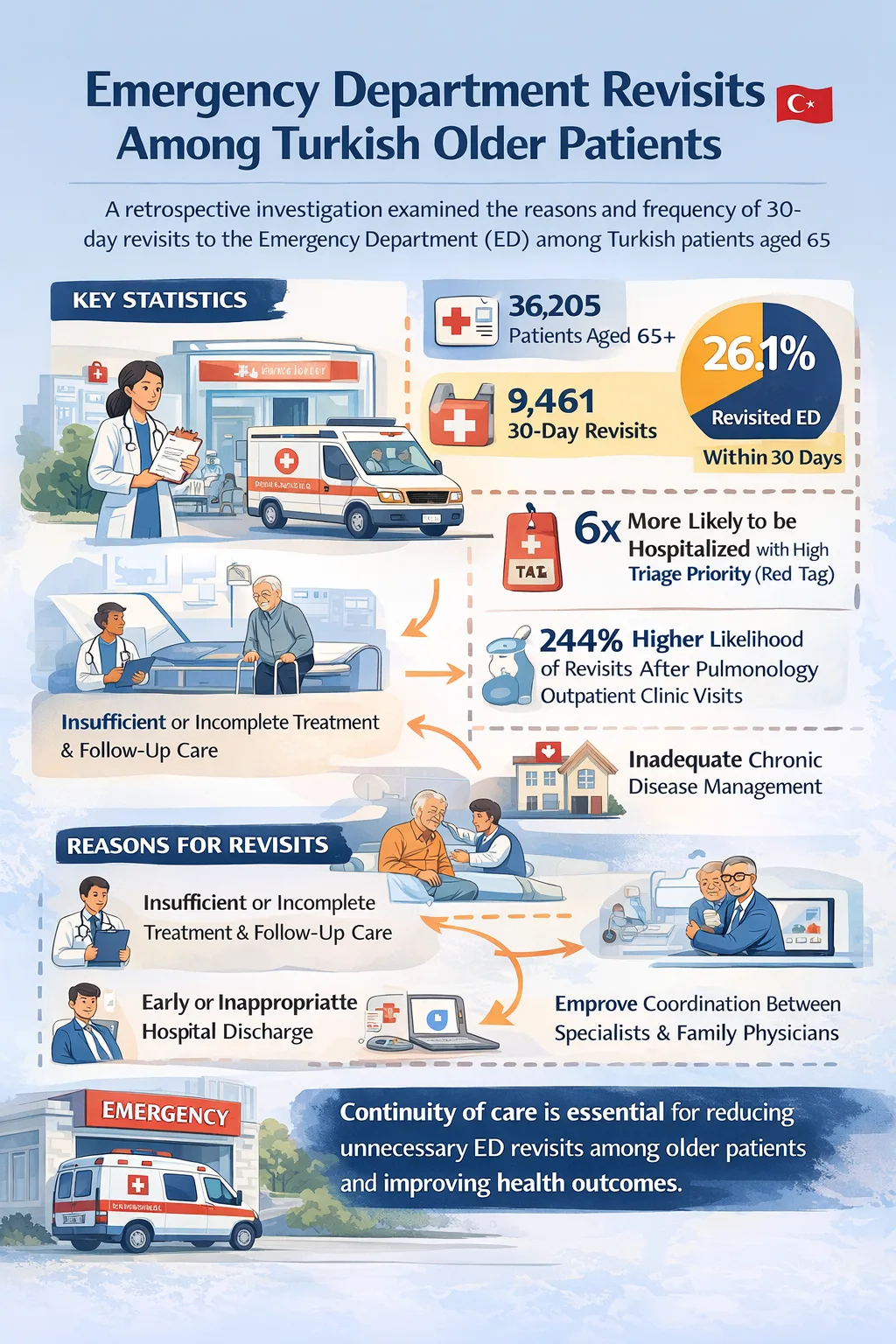
Population ageing has transformed emergency care demand patterns worldwide, placing unprecedented pressure on emergency departments (EDs) and exposing systemic gaps in post-discharge continuity of care. The article titled “A Retrospective Investigation of Emergency Department Revisits in Turkish Older Patients” addresses this structural challenge by examining the drivers, service pathways, and institutional determinants of 30-day ED revisits among geriatric patients in Türkiye. Positioned at the intersection of health services utilization, geriatric risk management, and care coordination, the study offers an evidence-based assessment of how healthcare system interactions shape repeat emergency use.
The conceptual premise of the study rests on the recognition that repeated ED visits among older adults are rarely random events. Instead, they reflect complex interactions among chronic disease burden, discharge planning quality, access to outpatient services, and the adequacy of post-hospital support systems. Revisits are therefore interpreted not merely as utilization outcomes but as performance indicators of healthcare system integration. Within international literature, 30-day revisit rates are widely used as proxies for care quality, transition success, and discharge effectiveness.
Methodologically, the study adopts a retrospective descriptive design based on electronic health record data from a large public training and research hospital in Türkiye. The dataset includes 36,205 patients aged 65 and older who presented to the emergency department over a one-year period. Of these, 9,461 patients, corresponding to 26.1%, revisited the ED within 30 days, establishing revisits as a substantial operational and clinical phenomenon. The population-level dataset strengthens external validity within the regional geriatric emergency context.
Analytical procedures combined descriptive statistics with binary logistic regression modeling to identify predictors of revisits and hospitalization outcomes. Independent variables included triage priority, prior hospital utilization, outpatient clinic contacts, discharge status, and demographic characteristics. This multivariable structure allowed the authors to map healthcare trajectories preceding repeat ED use.
One of the most striking findings concerns triage severity. Patients classified under red triage tags were 6.05 times more likely to be hospitalized compared to those in the yellow category, confirming triage acuity as a strong predictor of downstream resource utilization. This reinforces the operational value of triage classification not only for immediate care prioritization but also for forecasting inpatient demand.
Healthcare utilization history emerged as another critical determinant. Patients who had visited the hospital within the previous 30 days were 1.37 times more likely to revisit the emergency department. This pattern suggests cyclical healthcare use driven by unresolved clinical needs, inadequate follow-up, or fragmented care pathways.
Outpatient service utilization produced differentiated risk effects. Visits to internal medicine, cardiology, and pulmonology clinics significantly increased revisit likelihood, with pulmonology contacts showing the highest risk escalation. These associations indicate that chronic cardiovascular and respiratory conditions remain dominant drivers of emergency care dependency in older populations.
In contrast, home healthcare services demonstrated a protective effect. Older adults receiving home-based care were 65% less likely to revisit the ED. This finding underscores the preventive and stabilizing role of community-based monitoring, medication management, and functional support in reducing acute care reliance.
From a system design perspective, the study highlights coordination failures between outpatient specialty services and emergency care. Frequent specialist contact without effective disease stabilization suggests missed intervention windows, insufficient chronic disease management, or limited integration with primary care.
Policy implications emphasize expanding primary care accessibility, strengthening home healthcare infrastructure, and implementing structured follow-up systems such as telemonitoring and case management. By reframing ED revisits as preventable system events rather than inevitable geriatric outcomes, the article contributes actionable evidence for healthcare planners seeking to reduce avoidable emergency utilization while improving older patient outcomes.
Reference: Özkan, Ş., Kar, A., & Çelik, Y. (2026). A retrospective investigation of emergency department revisits in Turkish older patients. Ageing International, 51, Article 5. https://doi.org/10.1007/s12126-025-09648-2
Mini Dictionary: 10 Key Concepts
- Emergency Department Revisit: A repeat presentation to the emergency department within a defined period following discharge, commonly used as a healthcare quality indicator.
- 30-Day Revisit Metric: A standardized timeframe used to evaluate discharge planning effectiveness and continuity of care performance.
- Triage Priority (Tag Color): A clinical urgency classification system where red indicates life-threatening conditions, yellow urgent cases, and green non-urgent presentations.
- Healthcare Utilization History: The pattern and frequency of prior hospital or outpatient service use preceding an emergency visit.
- Outpatient Clinic Utilization: Engagement with specialty or general medical clinics for diagnosis, monitoring, or treatment before ED admission.
- Hospitalization Risk: The probability that an emergency visit results in inpatient admission, often predicted by acuity indicators.
- Care Transition: The process of transferring patients between care settings, especially from hospital to home or outpatient care.
- Home Healthcare Services: Community-based clinical support delivered in patients’ residences, including monitoring, treatment, and rehabilitation.
- Continuity of Care: The coordination and integration of healthcare services across providers and time.
- Avoidable Emergency Utilization: Emergency visits that could be prevented through effective primary care, chronic disease management, or follow-up systems.
Key concepts in this article
Healthcare utilization Chronic disease management Quality indicator Forecasting Electronic health record (EHR) ValidityConcepts link to the Glossary. Explore the knowledge graph →
Cite this page (APA 7)
Kurutkan, M. N. (2026, February 11). Factors Driving 30-Day ED Revisits in Older Patients. The Health Topics. https://healthtopic.org/topics/factors-driving-30-day-ed-revisits-in-older-patients/