
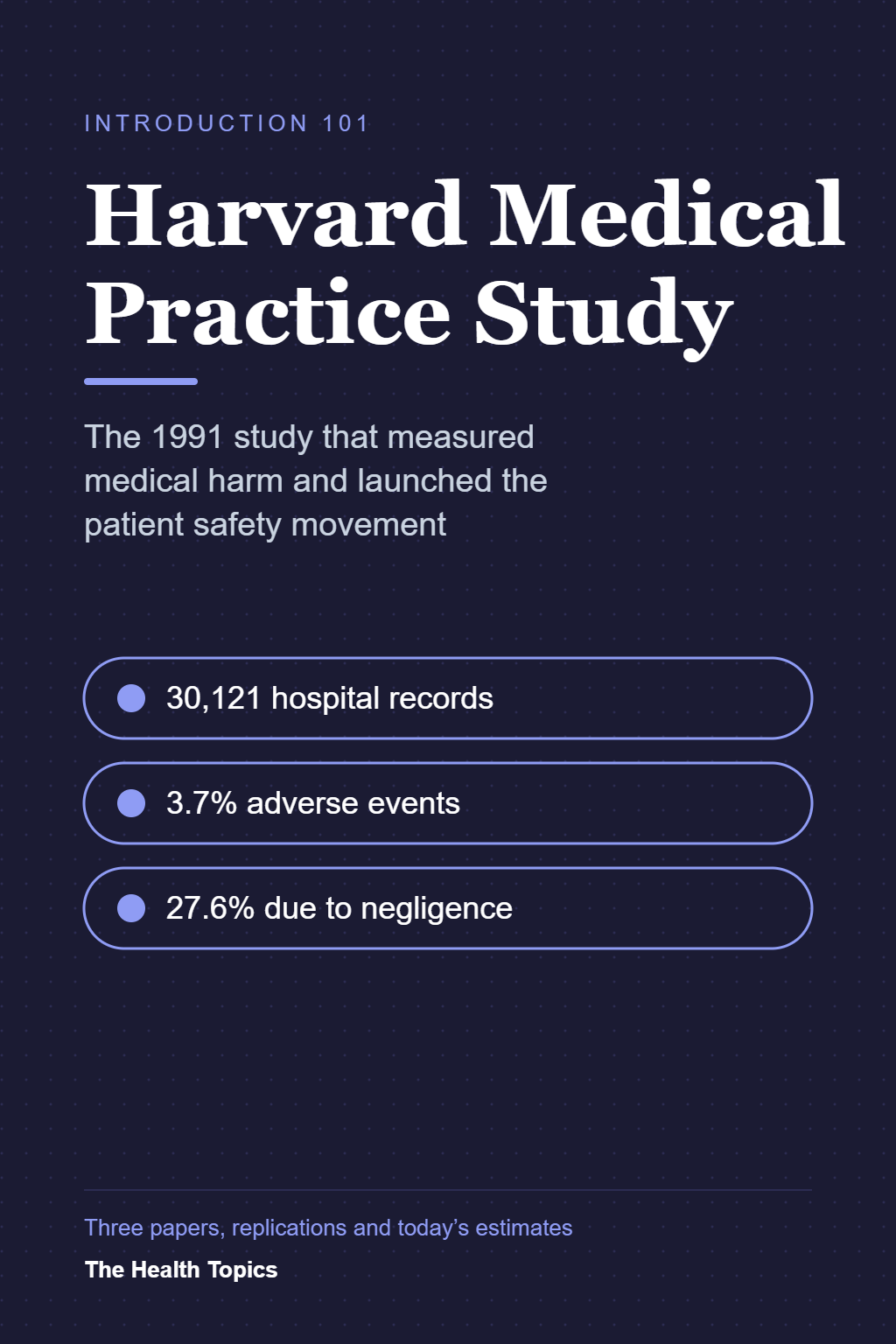
In brief: The Harvard Medical Practice Study (HMPS) reviewed 30,121 randomly selected 1984 hospital records from 51 New York hospitals and found that 3.7% of admissions involved an adverse event, an injury caused by medical management, and that 27.6% of these were due to negligence. Paper I measured how often harm occurred; Paper II, summarised here, described what kinds of harm occurred and where.
The Harvard Medical Practice Study: a general introduction
The HMPS was an interdisciplinary project on medical injury and malpractice litigation, run by researchers from Harvard’s schools of medicine, public health and law. Its two core findings appeared side by side in the New England Journal of Medicine on 7 February 1991: Brennan et al. reported the incidence of adverse events and negligence (HMPS I), and Leape et al. reported their nature (HMPS II). Together they became the most cited epidemiological baseline of the patient safety movement.
How the study worked
Nurses and medical record analysts screened each record against a list of criteria. Records that screened positive were reviewed independently by two physicians, who judged whether an injury had been caused by medical management rather than by the underlying disease and, if so, whether the care had fallen below the standard expected of a reasonable practitioner (negligence). Weighted totals were then used to project the findings to all discharges in New York State in 1984.
| Indicator | HMPS I result |
|---|---|
| Records reviewed | 30,121 records from 51 acute care, non-psychiatric hospitals |
| Adverse events | 3.7% of hospitalisations (95% CI 3.2 to 4.2) |
| Share due to negligence | 27.6% (95% CI 22.5 to 32.6) |
| Statewide projection | 98,609 adverse events and 27,179 negligent adverse events among 2,671,863 discharges |
| Consequences | 70.5% caused disability lasting under six months; 2.6% caused permanent total disability; 13.6% led to death |
| Gradients | Adverse event rates rose with age; the negligence share rose with injury severity |
Key terms to keep apart
- Adverse event: an injury caused by medical management, not by the disease itself. It says nothing about blame.
- Negligent adverse event: an adverse event caused by care below the expected standard. This is a legal concept and was the HMPS focus because of its malpractice purpose.
- Preventable adverse event: an adverse event attributable to an error. Later work, including the Institute of Medicine report, used preventability rather than negligence.
- Near miss: an error or hazard that did not reach the patient or did not cause harm. The HMPS, built on injuries, could not count these.
Why the study still matters
In 1999 the Institute of Medicine report To Err Is Human combined the New York data with a similar study of 1992 admissions in Utah and Colorado. Adverse events affected 2.9% of admissions in Utah and Colorado and 3.7% in New York, and 53% and 58% of them, respectively, were judged preventable; extrapolated to the 33.6 million US admissions of 1997, the figures implied at least 44,000 and perhaps as many as 98,000 hospital deaths a year from medical error (Kohn et al., 2000). That estimate turned patient safety into a policy issue.
The numbers were also contested. Critics argued that the death estimates were exaggerated and that judgements of preventability depend heavily on the reviewer (McDonald et al., 2000; Hayward & Hofer, 2001). The methods were reliable for their time but relied on paper charts, and outpatient care was not examined (AHRQ PSNet). Newer trigger-tool studies using electronic records report much higher rates: the SafeCare study of 11 Massachusetts hospitals found at least one adverse event in 23.6% of 2018 admissions (Bates et al., 2023). The lesson is less a single number than the method: harm must be measured systematically before it can be reduced.
The three papers and the book
| Publication | Question | Headline finding |
|---|---|---|
| Brennan et al. (1991), HMPS I | How often are hospital patients injured by medical management? | Adverse events in 3.7% of admissions; 27.6% of them due to negligence |
| Leape et al. (1991), HMPS II | What kinds of injury occur, where, and to whom? | Drug complications, wound infections and technical surgical complications were the commonest; errors in management were identified in 58% of adverse events, and nearly half of these were judged negligent |
| Localio et al. (1991), HMPS III | Do malpractice claims track negligent injuries? | Of 280 patients with negligent adverse events, 8 filed claims; statewide, negligent adverse events outnumbered claims by 7.6 to 1 |
| Weiler et al. (1993), A Measure of Malpractice | What does this mean for compensation policy? | A book-length analysis of medical injury, litigation and patient compensation |
HMPS III concluded that malpractice litigation infrequently compensates patients injured by negligence and rarely identifies, or holds providers accountable for, substandard care (Localio et al., 1991). A later follow-up of the same claims found that the outcome of litigation was predicted by the severity of the patient’s disability, not by whether negligence had occurred (Brennan et al., 1996). These findings still frame debates on tort reform and no-fault compensation.
The method travelled: replications around the world
| Study | Setting and year of care | Admissions with an adverse event |
|---|---|---|
| Harvard Medical Practice Study (Brennan et al., 1991) | New York State, 1984 | 3.7% |
| Utah and Colorado study (Kohn et al., 2000) | Utah and Colorado, 1992 | 2.9% |
| Quality in Australian Health Care Study (Wilson et al., 1995) | New South Wales and South Australia, 1992 | 16.6% |
| British pilot study (Vincent et al., 2001) | Two acute hospitals in London, 1999 | 10.8% |
| New Zealand study (Davis et al., 2002) | Public hospitals, 1998 | 12.9% |
| Canadian Adverse Events Study (Baker et al., 2004) | Acute care hospitals in five provinces, 2000 | 7.5% |
| Systematic review (de Vries et al., 2008) | Eight studies, 74,485 records | Median 9.2%; 43.5% preventable; 7.4% of events lethal |
Much of this spread reflects method rather than safety. When the Australian records were analysed with the definitions used in the Utah and Colorado study, the Australian rate fell to 10.6%, and the remaining gap with the US figure of 3.2% narrowed from more than fivefold to about threefold (Thomas et al., 2000). Comparing raw rates across countries without checking definitions, reviewer training and the threshold for disability is therefore misleading.
From negligence to preventable harm: today’s estimates
Later research replaced negligence with preventability as the central measure. A meta-analysis of 70 studies covering 337,025 patients estimated that about one in 20 patients (6%) is exposed to preventable harm in medical care, that 12% of this harm is severe or fatal, and that incidents related to drugs and other treatments account for the largest share (Panagioti et al., 2019). WHO’s first Global Patient Safety Report, published three years into the Global Patient Safety Action Plan 2021–2030, found that only around one third of countries had developed national action plans and programmes for patient safety (World Health Organization, 2024).
Five lessons for health managers today
- Measure before you manage: systematic record review reveals harm that voluntary incident reporting misses.
- Separate blame from learning: negligence is a legal judgement; preventability and systems analysis are better guides to improvement.
- Expect harm to concentrate: older patients, emergency care and diagnostic processes carried a disproportionate share of negligent events.
- Do not treat litigation as a safety signal: claims and negligent injuries rarely coincide.
- Compare methods before comparing rates: differences between countries often reflect definitions and review methods rather than care.
How to read the HMPS II article summary
HMPS II answers the question “what kind of harm, where, and to whom?”. Read it with three ideas in mind: drug complications, wound infections and technical surgical complications dominate the count; negligence is concentrated in diagnostic and non-invasive treatment errors and in the emergency department; and older patients carry a disproportionate share. Related material on this site: Adverse Events & Incident Analysis, The London Protocol and the wider Patient Safety collection.
Sources for this introduction
- Baker, G. R., Norton, P. G., Flintoft, V., Blais, R., Brown, A., Cox, J., et al. (2004). The Canadian Adverse Events Study: The incidence of adverse events among hospital patients in Canada. CMAJ, 170(11), 1678–1686. https://doi.org/10.1503/cmaj.1040498
- Bates, D. W., Levine, D. M., Salmasian, H., et al. (2023). The safety of inpatient health care. New England Journal of Medicine, 388(2), 142–153. https://doi.org/10.1056/NEJMsa2206117
- Brennan, T. A., Leape, L. L., Laird, N. M., Hebert, L., Localio, A. R., Lawthers, A. G., Newhouse, J. P., Weiler, P. C., & Hiatt, H. H. (1991). Incidence of adverse events and negligence in hospitalized patients: Results of the Harvard Medical Practice Study I. New England Journal of Medicine, 324(6), 370–376. https://doi.org/10.1056/NEJM199102073240604
- Brennan, T. A., Sox, C. M., & Burstin, H. R. (1996). Relation between negligent adverse events and the outcomes of medical-malpractice litigation. New England Journal of Medicine, 335(26), 1963–1967. https://doi.org/10.1056/NEJM199612263352606
- Davis, P., Lay-Yee, R., Briant, R., Ali, W., Scott, A., & Schug, S. (2002). Adverse events in New Zealand public hospitals I: Occurrence and impact. New Zealand Medical Journal, 115(1167), U271.
- de Vries, E. N., Ramrattan, M. A., Smorenburg, S. M., Gouma, D. J., & Boermeester, M. A. (2008). The incidence and nature of in-hospital adverse events: A systematic review. Quality and Safety in Health Care, 17(3), 216–223. https://doi.org/10.1136/qshc.2007.023622
- Hayward, R. A., & Hofer, T. P. (2001). Estimating hospital deaths due to medical errors: Preventability is in the eye of the reviewer. JAMA, 286(4), 415–420. https://doi.org/10.1001/jama.286.4.415
- Kohn, L. T., Corrigan, J. M., & Donaldson, M. S. (Eds.). (2000). To err is human: Building a safer health system. National Academies Press. https://www.ncbi.nlm.nih.gov/books/NBK225182/
- Localio, A. R., Lawthers, A. G., Brennan, T. A., Laird, N. M., Hebert, L. E., Peterson, L. M., Newhouse, J. P., Weiler, P. C., & Hiatt, H. H. (1991). Relation between malpractice claims and adverse events due to negligence: Results of the Harvard Medical Practice Study III. New England Journal of Medicine, 325(4), 245–251. https://doi.org/10.1056/NEJM199107253250405
- McDonald, C. J., Weiner, M., & Hui, S. L. (2000). Deaths due to medical errors are exaggerated in Institute of Medicine report. JAMA, 284(1), 93–95. https://doi.org/10.1001/jama.284.1.93
- Panagioti, M., Khan, K., Keers, R. N., Abuzour, A., Phipps, D., Kontopantelis, E., et al. (2019). Prevalence, severity, and nature of preventable patient harm across medical care settings: Systematic review and meta-analysis. BMJ, 366, l4185. https://doi.org/10.1136/bmj.l4185
- Thomas, E. J., Studdert, D. M., Runciman, W. B., Webb, R. K., Sexton, E. J., Wilson, R. M., et al. (2000). A comparison of iatrogenic injury studies in Australia and the USA I: Context, methods, casemix, population, patient and hospital characteristics. International Journal for Quality in Health Care, 12(5), 371–378.
- Vincent, C., Neale, G., & Woloshynowych, M. (2001). Adverse events in British hospitals: Preliminary retrospective record review. BMJ, 322(7285), 517–519. https://doi.org/10.1136/bmj.322.7285.517
- Weiler, P. C., Hiatt, H. H., Newhouse, J. P., Johnson, W. G., Brennan, T. A., & Leape, L. L. (1993). A measure of malpractice: Medical injury, malpractice litigation, and patient compensation. Harvard University Press.
- Wilson, R. M., Runciman, W. B., Gibberd, R. W., Harrison, B. T., Newby, L., & Hamilton, J. D. (1995). The Quality in Australian Health Care Study. Medical Journal of Australia, 163(9), 458–471.
- World Health Organization. (2024). Global patient safety report 2024. WHO. https://www.who.int/publications/i/item/9789240095458
Cite this page (APA 7)
Kurutkan, M. N. (2026, November 15). Harvard Medical Practice Study: An Introduction (101). The Health Topics. https://healthtopic.org/topics/harvard-medical-practice-study-an-introduction-101/