
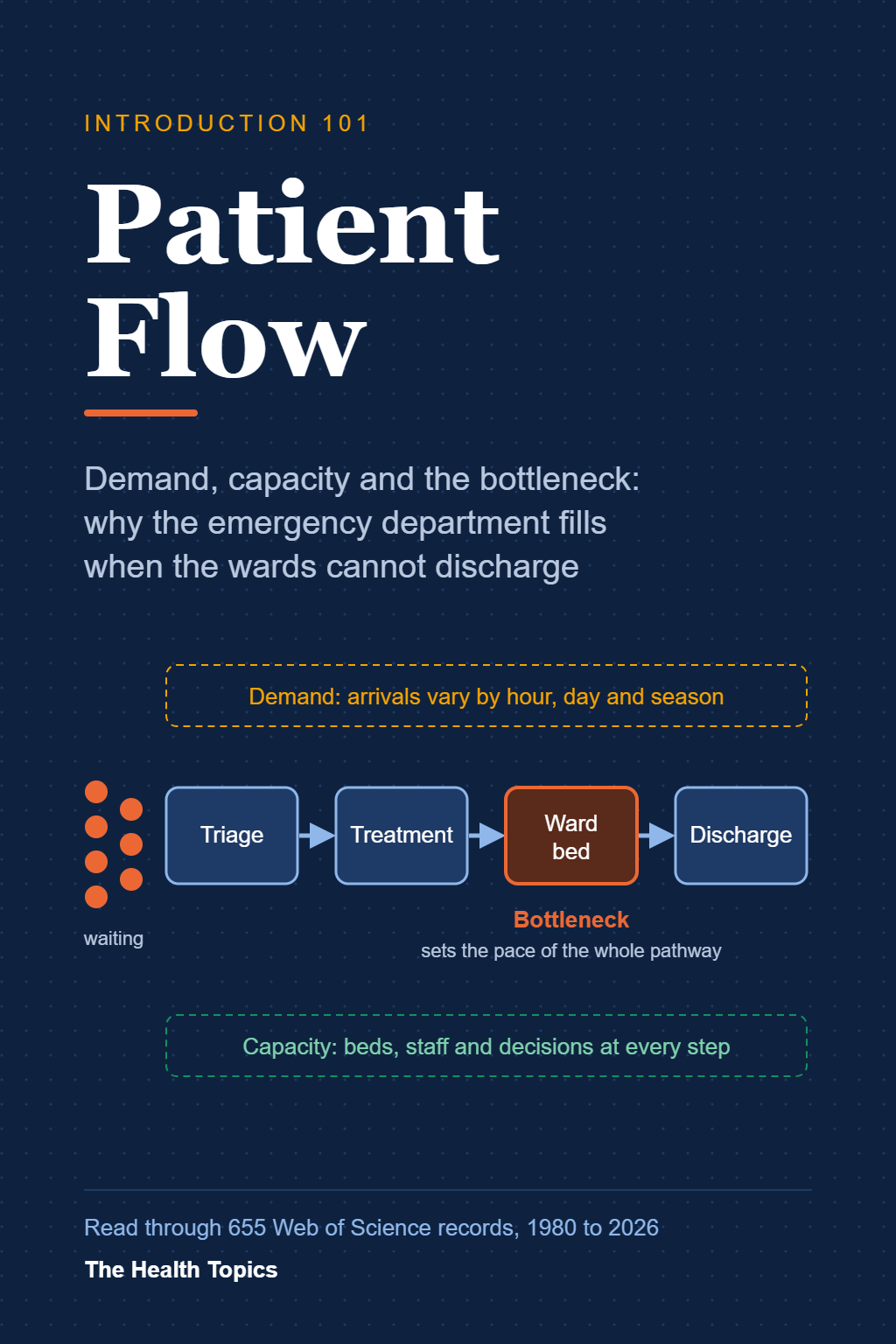
In brief: Patient flow is the movement of patients through a health service, from arrival to departure, and through the units, staff and resources they need on the way. Good flow means that demand and capacity are matched so that each patient receives the right care at the right time without avoidable waiting, transfers or delays. Poor flow shows up as crowded emergency departments, patients boarding on trolleys, cancelled operations and delayed discharges.
Open the interactive module: Follow Emre, a new patient flow manager, through his first month: simulate a day of arrivals and see how variability creates queues, find the bottleneck, test what bed occupancy does to the emergency department, check the evidence on interventions, diagnose six flow problems and score your own hospital.
Flow Lab: Patient Flow Interactive Module →
Learning objectives
After reading this chapter you should be able to:
- Define patient flow and distinguish it from throughput, crowding, length of stay, care pathways and capacity management.
- Explain why flow is a whole-system property and why emergency department crowding is often caused elsewhere in the hospital.
- Describe the main models used to study flow: queueing theory, simulation, lean thinking, network and process mining, and machine learning.
- Summarise the evidence on interventions such as fast track, team triage, medical assessment units and capacity command centres.
- Identify the main measurement problems and research gaps in patient flow research.
- Apply flow thinking to a service you know, including the trade-off between flow efficiency and resource efficiency.
Key concepts
Patient flow, throughput, demand and capacity, variability, bottleneck, crowding, access block and boarding, length of stay, discharge, occupancy, queueing theory, discrete event simulation, lean healthcare, capacity command centre.
How this chapter was produced
| Item | Detail |
|---|---|
| Database | Web of Science Core Collection, all indexes |
| Search string | TI=(“patient flow*” OR “patient throughput” OR “flow of patients” OR “hospital flow”) |
| Document types | Articles and reviews (reprints, notes, news items, corrections, book reviews, book chapters, letters, meeting abstracts, proceedings papers and editorial material excluded at search) |
| Export date and period | 15 November 2026; no year limit (records span 1980 to 2026) |
| Inclusion | The record studies the movement of patients through, or between, health services |
| Exclusion | Duplicates; homonyms in which “flow of patients” means a physiological or laboratory flow (blood, saliva, inhaler, cytometry); uses in which “patient flows” means something else (budget distribution in pharmacoeconomic models, a patient population) |
| Numbers | Found 666; duplicates 1; excluded at screening 10; included 655 |
| Coding | Setting, method and crisis context were coded from titles, keywords and abstracts with keyword rules and checked by reading; counts are indicative |
| Limitations | One database; title search only, so studies of flow that do not use these words in the title are missed; abstract-level reading; cited references were not in the export; 30 included records have no abstract |
Introduction: why patient flow matters
It is Monday, 10 a.m. in a large public hospital. The emergency department is full. Twelve patients have been assessed, treated and admitted, but they are still lying on trolleys because no ward bed is free. Upstairs, the medical wards are full too: several patients are medically ready to go home but are waiting for a consultant review, a pharmacy prescription, transport or a place in a nursing home. In the operating theatres, a planned operation has been cancelled because the intensive care bed it needed is occupied by a patient who could have moved to a ward yesterday.
Every unit in this story is busy, and every member of staff is working hard. The problem is not effort. It is the way patients move, or fail to move, between the units. This is what patient flow describes. Flow problems are rarely located where they become visible: the crowded emergency department is usually a symptom of blocked beds elsewhere (Miró et al., 2003; Riahi et al., 2026).
Patient flow matters for three reasons. First, delay harms patients. Delayed emergency department and hospital throughput is described as a critical threat to patient safety (Franklin et al., 2022), and boarding time and daily census are independently associated with longer stays, later physician contact and more patients leaving before treatment (Timm et al., 2008). Second, flow determines how much care a fixed amount of capacity can deliver; a hospital with good flow can treat more patients with the same beds. Third, flow is where clinical work, management and data meet, which makes it one of the most practical topics in health management.
History and development
The earliest records in the corpus already contain the two ideas that still shape the field: measuring how patients move, and modelling it. Cox (1980) simulated involuntary admissions to a psychiatric ward by computer. Berger et al. (1982) followed all 265 adult patients who visited a Soweto polyclinic on one day: four in five arrived before 10 a.m., two in five waited in five or more queues, and patients spent on average 171 minutes in the clinic for 24 minutes of attention. The authors used computer models to test an appointment system, which most patients said they would accept.
Through the 1980s and 1990s, patient flow studies were small and local: family planning clinics, recovery rooms, outpatient radiology and geriatric units. Output rose sharply after 2005. Emergency department crowding became the dominant problem, and studies began to show that it was driven by factors outside the department. Miró et al. (2003) recorded why each patient remained in a Barcelona emergency department and found that both department-related and hospital-related factors kept patients there; after a reorganisation, waiting time to be seen fell from 87 to 24 minutes.
From around 2010, systematic reviews consolidated the evidence on triage and fast-track interventions (Oredsson et al., 2011; Harding et al., 2011) and on modelling approaches (Wiler et al., 2011; Sobolev et al., 2011; Bhattacharjee & Ray, 2014). Operations management researchers brought theory from manufacturing, such as the theory of swift, even flow (Devaraj et al., 2013). Since 2020, three developments stand out: the COVID-19 pandemic, which turned flow into a crisis-management problem; machine learning for forecasting and discharge prediction (El-Bouri et al., 2021); and hospital capacity command centres that manage flow in real time (Franklin et al., 2022; Paterson et al., 2024). Figure 2 summarises this trajectory.
Definitions and conceptual scheme
There is no single agreed definition. The corpus offers several, each stressing a different dimension.
| Source | Year | Discipline | Definition (paraphrased) | Dimension stressed |
|---|---|---|---|---|
| Knarr & MacArthur | 2012 | Nursing leadership | The observable process a patient experiences during the delivery of care | Patient experience of the process |
| Devaraj et al. | 2013 | Operations management | Movement of patients that should be both swift (short throughput time) and even (low variability) | Speed and variability |
| Bhattacharjee & Ray | 2014 | Industrial engineering | Patient flows as the object of modelling for capacity planning, resource allocation and scheduling | Decision support |
| El-Bouri et al. | 2021 | Biomedical engineering | The problem of moving patients through healthcare services, from demand to discharge | Prediction across stages |
| Nguyen et al. | 2022 | Health informatics | The progression of patients along a pathway of care, such as from admission to discharge | Pathway |
| Benjamin & Jacelon | 2022 | Nursing (concept analysis) | Patient flow management as holistic perspectives, dynamic data and multiple priorities applied to enable timely, efficient, high-quality care | Management and judgement |
| Wang | 2023 | Systems engineering | The movement of patients through a healthcare facility | Physical movement |
| Manning & Islam | 2023 | Health planning | Effective flow exists when demand and capacity are matched | Demand and capacity balance |
The common core is movement over time through a sequence of steps that use limited resources. The definitions diverge on three questions. What is the unit of analysis: a facility, a pathway or a whole system? Is flow an objective process to be measured, or a managed activity that requires judgement? And is the goal speed, evenness or the match between demand and capacity? This chapter uses the following working definition: patient flow is the movement of patients through and between care settings over time, shaped by the match between demand and capacity at each step. Figure 3 shows the scheme.
Three ideas from operations management help to read the scheme. Demand and capacity: when arrivals exceed the rate at which a step can serve patients, a queue forms. Variability: even when average capacity is sufficient, uneven arrivals and service times create queues; variability in arrivals and length of stay has a major impact on capacity requirements, so models based on averages are misleading (de Bruin et al., 2005). Bottleneck: the step with the least spare capacity sets the pace of the whole pathway, and improvements elsewhere do not increase throughput.
Distinguishing neighbouring concepts
Patient flow is often used interchangeably with several related terms. They describe parts of flow, its symptoms or its management.
| Concept | What it describes | Relation to patient flow |
|---|---|---|
| Throughput | Number of patients served per unit of time | An output measure of flow; high throughput can coexist with long waits (Heaton et al., 2016) |
| Crowding | Demand exceeding the capacity of a department | A symptom of poor flow, usually driven by output blocks (Timm et al., 2008) |
| Access block and boarding | Admitted patients held in the emergency department because no bed is free | The point where hospital-wide flow failure becomes visible (Riahi et al., 2026) |
| Length of stay | Time a patient spends in a unit or hospital | The most common flow metric, but only one dimension (Fieldston et al., 2014) |
| Care pathway | A planned sequence of care for a patient group | Defines the intended route; can improve or constrain flow (Vallandingham et al., 2024) |
| Capacity management | Planning beds, staff and equipment against demand | The supply side of flow (Bhattacharjee & Ray, 2014) |
| Patient journey | The patient’s experience across contacts | The experiential side; flow research rarely captures it (Gualandi et al., 2020) |
Figure 4 compares these concepts on five attributes.
Types and variants
The corpus describes flow at different levels and in different conditions.
- Unit flow. Movement within one department, such as an emergency department, an imaging suite or an outpatient clinic. This is the most studied level.
- Hospital-wide flow. Movement between units: from emergency department to ward, from theatre to intensive care, from ward to discharge. Network analysis of two acute sites of a London hospital trust showed that a core subnetwork containing only 13 to 17% of transfer routes carried 83 to 90% of the patient flow (Bean et al., 2017).
- Flow between care settings. Movement between primary care, hospitals, rehabilitation and long-term care. A 2026 systematic review found 24 studies using seven methods for this level and called for more work on chronic conditions (Yang et al., 2026).
- Regional and international flows. Movement of patients between hospitals, regions or countries, including medical tourism (Lunt et al., 2013).
- Scheduled and unscheduled flow. Elective surgery and appointments can be planned and smoothed; emergency arrivals cannot, although they follow daily, weekly and seasonal rhythms (Dauncey et al., 2021).
- Surge and disaster flow. Pandemics, mass casualty incidents and natural disasters create sudden surges. Of the 655 records, 69 deal with such crises, 52 of them published since 2020. Disaster flow adds transport and coordination problems between scene and hospital (Magana et al., 2026).
A further distinction is between unidirectional flows, in which patients move to lower levels of care, and bidirectional flows, in which some patients move back up. Models that assume one direction underestimate capacity needs (Perera & Uslu, 2022).
Theoretical frameworks and models
Patient flow research borrows most of its theory from operations research and management. Seven frameworks appear in the corpus.
- Queueing theory. Treats each step as a server with arrival and service rates. Madsen and Kofoed-Enevoldsen (2011) found that a simple single-server queue model fitted a Danish emergency department with 27,000 patient cases almost perfectly, and that its capacity was surprisingly constant despite variations in staffing.
- Discrete event simulation and system dynamics. Simulate individual patients or aggregate stocks and flows to test changes before implementing them (Hung et al., 2007; Rohleder et al., 2011; Al-Karkhi & Byatt, 2025).
- Theory of swift, even flow. From manufacturing: productivity rises with the speed and evenness of flow. In 567 US hospitals, information technology was associated with swift and even patient flow, which in turn was associated with better financial and quality performance (Devaraj et al., 2013).
- Lean healthcare. Identifies and removes non-value-adding steps. A review of 40 ambulatory care studies found reductions in length of stay in 19 of 22 and in waiting time in 24 of 26 (Tlapa et al., 2020).
- Network analysis and process mining. Reconstruct real patient routes from administrative data and identify the routes that matter most for performance (Bean et al., 2017).
- Machine learning and forecasting. Predict arrivals, admissions, length of stay and discharge readiness (Peck et al., 2012; El-Bouri et al., 2021; Bishop et al., 2021; Susnjak & Maddigan, 2023).
- Human factors, complex systems and paradox theory. Treat flow as the product of people, teams and competing goals: control centres as socio-technical systems (Paterson et al., 2024), hospitals as complex systems that need whole-system approaches (Manning & Islam, 2023), and the tension between flow efficiency and resource efficiency (Vallandingham et al., 2024).
Themes and bibliometric profile
The 655 included records span 1980 to 2026. Output was below 20 records per five-year period until 2004, then rose to 53 in 2005 to 2009, 97 in 2010 to 2014, 157 in 2015 to 2019 and 219 in 2020 to 2024 (Figure 5). Two thirds of the records (435, 66%) were published from 2016 onward. The records have been cited 10,878 times in the Core Collection (median 8); the most cited is the systematic review of triage-related interventions by Oredsson et al. (2011). The leading journals are BMC Health Services Research (17 records), Health Care Management Science (13), Academic Emergency Medicine (13) and BMJ Open Quality (12). Author addresses are concentrated in the USA (212 records), the UK (89), Australia (65) and Canada (47).
The emergency department dominates: 248 records concern it, compared with 132 on inpatient wards and beds, 132 on outpatient, diagnostic and therapy services, 71 on surgery and intensive care, 42 on flows between settings or regions and 15 on mental health. A further 177 address the hospital as a whole or do not name a setting. Simulation is the most common method (147 records), followed by lean and quality improvement (92), queueing and mathematical models (83), information technology and real-time location systems (55) and machine learning (44). Figure 6 shows how settings and methods combine: simulation and lean dominate in the emergency department, while machine learning and network methods remain rare everywhere.
Six themes recur: emergency department crowding and front-end redesign; bed management, discharge and hospital-wide flow; modelling and forecasting; lean and quality improvement; information technology and command centres; and surge and crisis management.
The situation in Türkiye
Three records have an author address in Türkiye. Gunes and Yaman (2005) modelled the reallocation of resources and the matching of patients to hospitals after the consolidation of health insurance funds. Gül et al. (2017) analysed patient flow in a university hospital emergency department with fuzzy critical path and fuzzy programme evaluation techniques, using time data from 1,500 patients. Perera and Uslu (2022) simulated a neonatal unit with bidirectional patient flows for capacity planning. Given the scale of emergency department use and hospital occupancy pressures in Türkiye, this is a marked gap. Turkish studies published in national journals or indexed only in TR Dizin are outside this corpus.
What works: evidence on interventions
The corpus contains a substantial evidence base on interventions, most of it from emergency departments.
| Intervention | Evidence in the corpus | Strength |
|---|---|---|
| Fast track for less severe patients | Shorter waiting time and length of stay, fewer patients leaving unseen (Oredsson et al., 2011) | Moderate |
| Team triage with a physician | Probably shorter waits and stays, fewer leaving unseen (Oredsson et al., 2011); no significant effect in four cluster RCTs (Ming et al., 2016) | Mixed |
| Primary care professionals at triage | Shorter length of stay in 29 of 30 studies, but mostly low-quality designs (Jeyaraman et al., 2022) | Moderate, low quality |
| Triage with initial treatment | Positive effect on flow when combined with treatment of low-resource cases; triage that only prioritises has conflicting evidence (Harding et al., 2011) | Moderate |
| Advanced practice nursing, physician-assisted triage, medical assessment units | Shorter stays and fewer patients leaving unseen, but study quality limited (Elder et al., 2015; Canetta et al., 2024) | Limited |
| Scribes | No effect on length of stay; small increase in patients seen per hour (Heaton et al., 2016) | Moderate |
| Lean in ambulatory care | Reduced waiting time and length of stay in most studies; little evidence on savings (Tlapa et al., 2020) | Moderate, mostly before-after |
| Capacity command centres | All reports positive, but only four peer-reviewed studies (Franklin et al., 2022) | Very limited |
| Health information systems | Help identify blockages and coordinate care; mechanisms unclear (Nguyen et al., 2022) | Limited |
The pattern is consistent. Interventions that separate simple from complex patients early, and that bring decision-making forward, improve front-end flow. Interventions at the front door cannot fix blocked beds at the back door.
Debates and contradictions in the literature
1. Is crowding an emergency department problem or a hospital problem? Most interventions target the emergency department front end: triage, fast track, scribes. Yet the strongest evidence points to output block. In 25 Queensland hospitals, a 10% rise in bed occupancy was associated with a 19-minute longer emergency department stay, and 33 minutes for admitted patients (Riahi et al., 2026). Miró et al. (2003) and Timm et al. (2008) reached the same conclusion earlier. Manning and Islam (2023) conclude that only a whole-system approach works. The field has invested most in the part of the system that least determines its performance.
2. Flow efficiency or resource efficiency? Managers are often asked to raise occupancy and cut beds. Queueing theory warns that high occupancy with variable demand produces queues (de Bruin et al., 2005), and Riahi et al. (2026) found that the critical occupancy threshold varies by hospital, challenging the traditional 85% target. Vallandingham et al. (2024) frame this as a paradox: maximising resource use and maximising flow pull in opposite directions, and care pathways must manage both.
3. Does faster flow harm patients? Singh and Terwiesch (2012) found that a cardiac intensive care unit discharged patients earlier when occupancy was high, which led to more readmissions among severely ill patients and reduced effective capacity. In contrast, Bahalkeh et al. (2026) found that wards discharged regular patients faster when long-stay patients occupied beds, without a rise in 30-day readmissions, and Devaraj et al. (2013) found that swift, even flow improved quality as well as finances. The answer seems to depend on patient severity and on whether speed comes from removing waste or from cutting care.
4. Do models change practice? Simulation is the most common method, but a review of 21 UK emergency department simulation studies found that only three reported implementing the changes they supported (Mohiuddin et al., 2017), and only 26% of surgical simulation studies involved managers or policy-makers (Sobolev et al., 2011). Successful cases exist (Rohleder et al., 2011), but the gap between model and decision is the field’s most persistent weakness.
5. Whose concept is patient flow? The literature defines flow management through data, coordination and efficiency (Benjamin & Jacelon, 2022). Emergency nurses define it differently: as a nurse-driven process whose ultimate goal is the collective safety of patients (Benjamin & Wolf, 2022). Nurses’ experiential knowledge is central to successful flow interventions, but the emotional labour involved is rarely counted (Sharma et al., 2020).
Measurement problems
- Single time measures dominate. Length of stay, waiting time and the proportion leaving without being seen are the most common outcomes (Oredsson et al., 2011; Nguyen et al., 2022). They are easy to collect but capture only one dimension. A five-domain composite scorecard gave a more complete picture in a children’s hospital (Fieldston et al., 2014).
- Process outcomes crowd out clinical and patient outcomes. Most improvement studies use process efficiency indicators; clinical outcomes are poorly analysed and patients’ experience is rarely considered (Gualandi et al., 2020).
- Variability is rarely measured. Flow theory stresses evenness, but few studies measure it. Exceptions show its importance: in Finnish delivery hospitals, the smallest units had quiet days on 43% of days and busy days on 16% (Vilkko et al., 2021), and acute medical unit occupancy followed daily, weekly and seasonal rhythms (Dauncey et al., 2021).
- Weak reporting of models. Simulation studies report assumptions poorly and rarely describe the emergency department modelled (Mohiuddin et al., 2017). Machine learning studies lack shared datasets for benchmarking (El-Bouri et al., 2021).
- Operational definitions vary. The same term is measured as length of stay, waiting time and number of handovers in one study (van Gils-van Rooij et al., 2018), and as visit duration by patient category in another (Vanderby et al., 2010). Results are hard to compare across studies.
- Study designs are weak. Before-after designs without control for confounding are the norm; randomised trials are few (Elder et al., 2015; Jeyaraman et al., 2022).
Research gaps and agenda
- What is the safe occupancy threshold for a given hospital, and how should it be set? Evidence shows that thresholds vary by site, but there is no method for setting them (Riahi et al., 2026).
- Which whole-system interventions improve both emergency department and inpatient flow? Most studies evaluate single units; whole-hospital designs are rare (Gualandi et al., 2020; Manning & Islam, 2023).
- What is the effect of flow on clinical outcomes and patient experience? Process measures dominate and patient outcomes are underreported (Gualandi et al., 2020).
- How can models be turned into decisions? The low implementation rate of simulation studies needs research on co-production with managers (Mohiuddin et al., 2017; Sobolev et al., 2011).
- Do capacity command centres work, at what cost? Deployment is outpacing evidence (Franklin et al., 2022; Paterson et al., 2024).
- How does flow work between care settings, especially for chronic conditions? This level is understudied (Yang et al., 2026).
- Can machine learning models transfer between hospitals? Most are trained and tested in one site (El-Bouri et al., 2021).
- What is the situation in Türkiye? Only three corpus records have a Turkish address; emergency department crowding, boarding and discharge delay in Turkish hospitals need systematic study.
Present-day relevance and implications for practice
- Look downstream first. When the emergency department is crowded, measure occupancy and discharge timing on the wards. Crowding is usually a hospital-wide signal (Riahi et al., 2026).
- Separate streams early. Fast track and triage with initial treatment are the front-end interventions with the strongest evidence (Oredsson et al., 2011; Harding et al., 2011).
- Do not run beds at full occupancy. Plan capacity for variability, not averages (de Bruin et al., 2005).
- Measure more than length of stay. Use a balanced set of flow, quality and experience measures (Fieldston et al., 2014; Gualandi et al., 2020).
- Involve nurses. Nurses hold much of the tacit knowledge on which flow depends (Sharma et al., 2020; Benjamin & Wolf, 2022).
- Pretest changes with models, then implement and evaluate. Simulation can test changes safely, but its value depends on implementation (Mohiuddin et al., 2017).
- Treat flow as a patient safety issue. Delays and crowding are safety risks, not only efficiency problems (Franklin et al., 2022).
Summary
- Patient flow is the movement of patients through and between care settings over time, shaped by the match between demand and capacity.
- Variability and bottlenecks, not only average workload, create queues and delays.
- Emergency department crowding is usually a symptom of hospital-wide flow problems, especially high bed occupancy.
- The field draws on queueing theory, simulation, lean, network analysis, machine learning and human factors.
- Fast track and triage with early treatment have the strongest evidence; command centres and machine learning tools are promising but untested.
- Measurement relies too heavily on single time measures; clinical outcomes and variability are rarely measured.
- 655 Web of Science records from 1980 to 2026 show rapid growth, but only three have an author address in Türkiye.
Discussion questions
- Why can an emergency department be crowded even when its own staff and processes are efficient?
- Choose a pathway you know. Where is the bottleneck, and how would you prove it?
- Why is planning bed capacity on average demand misleading?
- Is a faster discharge always a better discharge? Use the readmission evidence in your answer.
- Your hospital plans to open a capacity command centre. What evidence would you ask for, and what would you measure in the first year?
- Design a balanced scorecard of five patient flow measures for a Turkish public hospital.
- Why do so few simulation studies lead to implemented changes, and how could this be improved?
Further reading
- Oredsson et al. (2011): the most cited review of triage-related interventions, with evidence graded by GRADE.
- Bhattacharjee and Ray (2014): a classification of patient flow modelling approaches with a generic framework.
- Devaraj et al. (2013): the theory of swift, even flow applied to hospitals.
- Wiler et al. (2011): a clear comparison of modelling approaches for emergency department flow and crowding.
- Gualandi et al. (2020): a systematic review of hospital-wide flow improvement and its enablers.
- Riahi et al. (2026): recent large-scale evidence on occupancy and emergency department access.
- Benjamin and Jacelon (2022): a concept analysis of patient flow management from nursing.
- Vallandingham et al. (2024): the paradox between flow efficiency and resource efficiency in care pathways.
Frequently asked questions
What is patient flow in a hospital? The movement of patients through the hospital, from arrival in the emergency department or clinic, through diagnosis, treatment and the wards, to discharge, and the way capacity is matched to demand at each step.
What is the difference between patient flow and throughput? Throughput is the number of patients served per unit of time. Patient flow is the whole movement process, including waits, transfers and delays. A unit can have high throughput and still poor flow.
Why does poor patient flow matter? It causes crowding, long waits, boarding, cancelled operations and delayed discharges, and it is associated with worse patient safety and outcomes.
How is patient flow measured? Most often with length of stay, waiting time, the proportion of patients leaving without being seen, occupancy and discharge timing. Composite scorecards combine several measures.
How can hospitals improve patient flow? By separating simple and complex patients early, bringing decisions forward, planning capacity for variability, improving discharge processes and managing flow across the whole hospital rather than unit by unit.
What is access block or boarding? The situation in which admitted patients remain in the emergency department because no inpatient bed is available. It is the most visible sign of hospital-wide flow failure.
Glossary
| Term | Short definition |
|---|---|
| Patient flow | Movement of patients through and between care settings over time |
| Throughput | Number of patients served per unit of time |
| Bottleneck | The step with the least spare capacity, which sets the pace of the pathway |
| Variability | Unevenness in arrivals and service times |
| Access block (boarding) | Admitted patients held in the emergency department for lack of a bed |
| Occupancy | Proportion of available beds in use |
| Fast track | A separate stream for patients with less severe conditions |
| Discrete event simulation | Computer model that follows individual patients through a system |
| Queueing theory | Mathematical study of waiting lines |
| Capacity command centre | A unit that manages hospital-wide flow with real-time data |
Related on The Health Topics
- Flow Lab: Patient Flow Interactive Module
- Bottleneck Management 101: An Interdisciplinary Introduction with a Focus on Healthcare
- Managing Waiting in Health Services: Strategies, Techniques and Measurement
- Streamlining Patient Discharge with Six Sigma and Discrete Event Simulation
- Process Mining in Healthcare: Characteristics and Challenges
- Forecasting Methods in Health Management
- Appointment Scheduling: Theory, Methods, Health Service Applications and the Turkish Context
- Managing an Oncology Hospital as a System: Patient Journey, Process, Bottleneck and Capacity
References
- Al-Karkhi, T., & Byatt, K. (2025). A compartmental model to describe acute medical in-patient flow through a hospital. Heliyon, 11(3), Article e42260. https://doi.org/10.1016/j.heliyon.2025.e42260
- Bahalkeh, E., Pai, D. R., Chiam, T. C., & Yih, Y. (2026). Association of non-medically long stay patients with hospital flow and quality: A retrospective observational study. Journal of Hospital Management and Health Policy, 10, Article 24. https://doi.org/10.21037/jhmhp-2026-1-0016
- Bean, D. M., Stringer, C., Beeknoo, N., Teo, J., & Dobson, R. J. B. (2017). Network analysis of patient flow in two UK acute care hospitals identifies key subnetworks for A&E performance. PLOS ONE, 12(10), Article e0185912. https://doi.org/10.1371/journal.pone.0185912
- Benjamin, E., & Jacelon, C. (2022). An analysis of the concept of patient flow management. Nursing Forum, 57(3), 429-436. https://doi.org/10.1111/nuf.12681
- Benjamin, E., & Wolf, L. A. (2022). Nurses are every bit of the flow: Emergency department nurses’ conceptualization of patient flow management. Nursing Forum, 57(6), 1407-1414. https://doi.org/10.1111/nuf.12834
- Berger, M., Wilson, T. D., & Saunders, L. D. (1982). Queuing and patient flow at a Soweto polyclinic. South African Medical Journal, 61(15), 547-550.
- Bhattacharjee, P., & Ray, P. K. (2014). Patient flow modelling and performance analysis of healthcare delivery processes in hospitals: A review and reflections. Computers & Industrial Engineering, 78, 299-312. https://doi.org/10.1016/j.cie.2014.04.016
- Bishop, J. A., Javed, H. A., El-Bouri, R., Zhu, T. T., Taylor, T., Peto, T., Watkinson, P., Eyre, D. W., & Clifton, D. A. (2021). Improving patient flow during infectious disease outbreaks using machine learning for real-time prediction of patient readiness for discharge. PLOS ONE, 16(11), Article e0260476. https://doi.org/10.1371/journal.pone.0260476
- Canetta, C., Accordino, S., La Boria, E., Arosio, G., Cacco, S., Formagnana, P., Masotti, M., Provini, S., Passera, S., Viganò, G., & Sozzi, F. (2024). Effects of a medical admission unit on in-hospital patient flow and clinical outcomes. European Journal of Internal Medicine, 127, 105-111. https://doi.org/10.1016/j.ejim.2024.05.001
- Cox, G. B. (1980). Involuntary patient flow: A computer simulation of a psychiatric ward. Evaluation Review, 4(5), 571-584. https://doi.org/10.1177/0193841X8000400501
- Dauncey, S. J., Kelly, P. A., Baykov, D., Skeldon, A. C., & Whyte, M. B. (2021). Rhythmicity of patient flow in an acute medical unit: Relationship to hospital occupancy, 7-day working and the effect of COVID-19. QJM: An International Journal of Medicine, 114(11), 773-779. https://doi.org/10.1093/qjmed/hcaa334
- de Bruin, A. M., Koole, G. M., & Visser, M. C. (2005). Bottleneck analysis of emergency cardiac in-patient flow in a university setting: An application of queueing theory. Clinical and Investigative Medicine, 28(6), 316-317.
- Devaraj, S., Ow, T. T., & Kohli, R. (2013). Examining the impact of information technology and patient flow on healthcare performance: A Theory of Swift and Even Flow (TSEF) perspective. Journal of Operations Management, 31(4), 181-192. https://doi.org/10.1016/j.jom.2013.03.001
- El-Bouri, R., Taylor, T., Youssef, A., Zhu, T. T., & Clifton, D. A. (2021). Machine learning in patient flow: A review. Progress in Biomedical Engineering, 3(2), Article 22002. https://doi.org/10.1088/2516-1091/abddc5
- Elder, E., Johnston, A. N. B., & Crilly, J. (2015). Review article: Systematic review of three key strategies designed to improve patient flow through the emergency department. Emergency Medicine Australasia, 27(5), 394-404. https://doi.org/10.1111/1742-6723.12446
- Fieldston, E. S., Zaoutis, L. B., Agosto, P. M., Guo, A., Jonas, J. A., & Tsarouhas, N. (2014). Measuring patient flow in a children’s hospital using a scorecard with composite measurement. Journal of Hospital Medicine, 9(7), 463-468. https://doi.org/10.1002/jhm.2202
- Franklin, B. J., Mueller, S. K., Bates, D. W., Gandhi, T. K., Morris, C. A., & Goralnick, E. (2022). Use of hospital capacity command centers to improve patient flow and safety: A scoping review. Journal of Patient Safety, 18(6), E912-E921. https://doi.org/10.1097/PTS.0000000000000976
- Gualandi, R., Masella, C., & Tartaglini, D. (2020). Improving hospital patient flow: A systematic review. Business Process Management Journal, 26(6), 1541-1575. https://doi.org/10.1108/BPMJ-10-2017-0265
- Gül, M., Güneri, A. F., & Günes, G. (2017). Project management in healthcare: A case study for patient flow evaluation in an emergency room using fuzzy CPM and fuzzy PERT. Sigma Journal of Engineering and Natural Sciences, 8(1), 41-51.
- Gunes, E. D., & Yaman, H. (2005). Modeling change in a health system: Implications on patient flows and resource allocations. Clinical and Investigative Medicine, 28(6), 331-333.
- Harding, K. E., Taylor, N. F., & Leggat, S. G. (2011). Do triage systems in healthcare improve patient flow? A systematic review of the literature. Australian Health Review, 35(3), 371-383. https://doi.org/10.1071/AH10927
- Heaton, H. A., Castaneda-Guarderas, A., Trotter, E. R., Erwin, P. J., & Bellolio, M. F. (2016). Effect of scribes on patient throughput, revenue, and patient and provider satisfaction: A systematic review and meta-analysis. American Journal of Emergency Medicine, 34(10), 2018-2028. https://doi.org/10.1016/j.ajem.2016.07.056
- Hung, G. R., Whitehouse, S. R., O’Neill, C., Gray, A. P., & Kissoon, N. (2007). Computer modeling of patient flow in a pediatric emergency department using discrete event simulation. Pediatric Emergency Care, 23(1), 5-10. https://doi.org/10.1097/PEC.0b013e31802c611e
- Jeyaraman, M. M., Alder, R. N., Copstein, L., Al-Yousif, N., Suss, R., Zarychanski, R., Doupe, M. B., Berthelot, S., Mireault, J., Tardif, P., Askin, N., Buchel, T., Rabbani, R., Beaudry, T., Hartwell, M., Shimmin, C., Edwards, J., Halas, G., Sevcik, W., … Abou-Setta, A. M. (2022). Impact of employing primary healthcare professionals in emergency department triage on patient flow outcomes: A systematic review and meta-analysis. BMJ Open, 12(4), Article e052850. https://doi.org/10.1136/bmjopen-2021-052850
- Knarr, L. L., & MacArthur, B. G. (2012). An admission unit: A vital link to patient flow. Nurse Leader, 10(3), 45-48.
- Lunt, N. T., Mannion, R., & Exworthy, M. (2013). A framework for exploring the policy implications of UK medical tourism and international patient flows. Social Policy & Administration, 47(1), 1-25. https://doi.org/10.1111/j.1467-9515.2011.00833.x
- Madsen, T. L., & Kofoed-Enevoldsen, A. (2011). Five easy equations for patient flow through an emergency department. Danish Medical Bulletin, 58(10), Article A4318.
- Magana, J., Hinrichs-Krapels, S., Bramer, W., & Comes, T. (2026). Patient flow logistics from disaster to care: A scoping review of actors, transport modes and decision problems. Journal of Humanitarian Logistics and Supply Chain Management, 16(3), 280-304. https://doi.org/10.1108/JHLSCM-10-2024-0147
- Manning, L., & Islam, M. S. (2023). A systematic review to identify the challenges to achieving effective patient flow in public hospitals. International Journal of Health Planning and Management, 38(3), 805-828. https://doi.org/10.1002/hpm.3626
- Ming, T., Lai, A., & Lau, P. M. (2016). Can team triage improve patient flow in the emergency department? A systematic review and meta-analysis. Advanced Emergency Nursing Journal, 38(3), 233-250. https://doi.org/10.1097/TME.0000000000000113
- Miró, O., Sánchez, M., Espinosa, G., Coll-Vinent, B., Bragulat, E., & Millá, J. (2003). Analysis of patient flow in the emergency department and the effect of an extensive reorganisation. Emergency Medicine Journal, 20(2), 143-148. https://doi.org/10.1136/emj.20.2.143
- Mohiuddin, S., Busby, J., Savovic, J., Richards, A., Northstone, K., Hollingworth, W., Donovan, J. L., & Vasilakis, C. (2017). Patient flow within UK emergency departments: A systematic review of the use of computer simulation modelling methods. BMJ Open, 7(5), Article e015007. https://doi.org/10.1136/bmjopen-2016-015007
- Nguyen, Q., Wybrow, M., Burstein, F., Taylor, D., & Enticott, J. (2022). Understanding the impacts of health information systems on patient flow management: A systematic review across several decades of research. PLOS ONE, 17(9), Article e0274493. https://doi.org/10.1371/journal.pone.0274493
- Oredsson, S., Jonsson, H., Rognes, J., Lind, L., Göransson, K. E., Ehrenberg, A., Asplund, K., Castrén, M., & Farrohknia, N. (2011). A systematic review of triage-related interventions to improve patient flow in emergency departments. Scandinavian Journal of Trauma, Resuscitation and Emergency Medicine, 19, Article 43. https://doi.org/10.1186/1757-7241-19-43
- Paterson, E., Chari, S., McCormack, L., & Sanderson, P. (2024). Application of a human factors systems approach to healthcare control centres for managing patient flow: A scoping review. Journal of Medical Systems, 48(1), Article 62. https://doi.org/10.1007/s10916-024-02071-1
- Peck, J. S., Benneyan, J. C., Nightingale, D. J., & Gaehde, S. A. (2012). Predicting emergency department inpatient admissions to improve same-day patient flow. Academic Emergency Medicine, 19(9), E1045-E1054. https://doi.org/10.1111/j.1553-2712.2012.01435.x
- Perera, T. S., & Uslu, B. Ç. (2022). Simulation analysis of a neonatal unit with complex patient flow patterns: An enhanced model for capacity planning. South African Journal of Industrial Engineering, 33(4), 94-108. https://doi.org/10.7166/33-4-2621
- Riahi, V., Boyle, J., Yoon, H., Hassanzadeh, H., Diouf, I., Khanna, S., Staib, A., Samadbeik, M., Sullivan, C., Bosley, E., & Lind, J. F. (2026). The impact of hospital bed occupancy on patient flow and emergency department access: A 25-hospital cohort study. Medical Journal of Australia, 224(2), Article e70143. https://doi.org/10.5694/mja2.70143
- Rohleder, T. R., Lewkonia, P., Bischak, D. P., Duffy, P., & Hendijani, R. (2011). Using simulation modeling to improve patient flow at an outpatient orthopedic clinic. Health Care Management Science, 14(2), 135-145. https://doi.org/10.1007/s10729-010-9145-4
- Sharma, S., Rafferty, A. M., & Boiko, O. (2020). The role and contribution of nurses to patient flow management in acute hospitals: A systematic review of mixed methods studies. International Journal of Nursing Studies, 110, Article 103709. https://doi.org/10.1016/j.ijnurstu.2020.103709
- Singh, K. C. D., & Terwiesch, C. (2012). An econometric analysis of patient flows in the cardiac intensive care unit. M&SOM: Manufacturing & Service Operations Management, 14(1), 50-65. https://doi.org/10.1287/msom.1110.0341
- Sobolev, B. G., Sanchez, V., & Vasilakis, C. (2011). Systematic review of the use of computer simulation modeling of patient flow in surgical care. Journal of Medical Systems, 35(1), 1-16. https://doi.org/10.1007/s10916-009-9336-z
- Susnjak, T., & Maddigan, P. (2023). Forecasting patient flows with pandemic induced concept drift using explainable machine learning. EPJ Data Science, 12(1), Article 11. https://doi.org/10.1140/epjds/s13688-023-00387-5
- Timm, N. L., Ho, M. L., & Luria, J. W. (2008). Pediatric emergency department overcrowding and impact on patient flow outcomes. Academic Emergency Medicine, 15(9), 832-837. https://doi.org/10.1111/j.1553-2712.2008.00224.x
- Tlapa, D., Zepeda-Lugo, C. A., Tortorella, G. L., Baez-Lopez, Y. A., Limon-Romero, J., Alvarado-Iniesta, A., & Rodriguez-Borbon, M. (2020). Effects of lean healthcare on patient flow: A systematic review. Value in Health, 23(2), 260-273. https://doi.org/10.1016/j.jval.2019.11.002
- Vallandingham, L. R., De Boer, L., & Dreyer, H. C. (2024). Design principles for patient flow improvement in care pathways: A paradox theory perspective. Business Process Management Journal, 30(7), 2516-2540. https://doi.org/10.1108/BPMJ-09-2023-0745
- van Gils-van Rooij, E. S. J., Meijboom, B. R., Broekman, S. M., Yzermans, C. J., & de Bakker, D. H. (2018). Is patient flow more efficient in urgent care collaborations? European Journal of Emergency Medicine, 25(1), 58-64. https://doi.org/10.1097/MEJ.0000000000000412
- Vanderby, S. A., Babyn, P. S., Carter, M. W., Jewell, S. M., & McKeever, P. D. (2010). Effect of anesthesia and sedation on pediatric MR imaging patient flow. Radiology, 256(1), 229-237. https://doi.org/10.1148/radiol.10091124
- Vilkko, R., Räisänen, S., Gissler, M., Stefanovic, V., & Heinonen, S. (2021). Daily patient flow unevenness in different sized delivery hospitals: An 11-year register study of 610 227 deliveries. European Journal of Obstetrics & Gynecology and Reproductive Biology, 266, 187-190. https://doi.org/10.1016/j.ejogrb.2021.09.007
- Wang, J. C. (2023). Patient flow modeling and optimal staffing for emergency departments: A Petri net approach. IEEE Transactions on Computational Social Systems, 10(4), 2022-2032. https://doi.org/10.1109/TCSS.2022.3186249
- Wiler, J. L., Griffey, R. T., & Olsen, T. (2011). Review of modeling approaches for emergency department patient flow and crowding research. Academic Emergency Medicine, 18(12), 1371-1379. https://doi.org/10.1111/j.1553-2712.2011.01135.x
- Yang, F., Skinner, M. S., Rijal, S., Lovell, A., Burrell, L. V., Sogstad, M. K. R., & Anderson, R. (2026). Methods for analysing patient flow between care settings: A systematic review. BMJ Open, 16(8), Article e115172. https://doi.org/10.1136/bmjopen-2025-115172
Data and supplementary material
The full list of the 655 included records with setting, method and crisis codes, the screening log for all 666 records with decisions and reasons, the 11 excluded records and the verification report are provided in a supplementary Excel file (Patient_flow_supplementary_material.xlsx), available from the author on request. The record list is not reproduced in this chapter.
Cite this chapter: Kurutkan, M. N. (2026). Patient flow: An introduction 101. The Health Topics. https://healthtopic.org/topics/patient-flow-an-introduction-101/
Cite this page (APA 7)
Kurutkan, M. N. (2026, November 15). Patient Flow: An Introduction (101). The Health Topics. https://healthtopic.org/topics/patient-flow-an-introduction-101/