
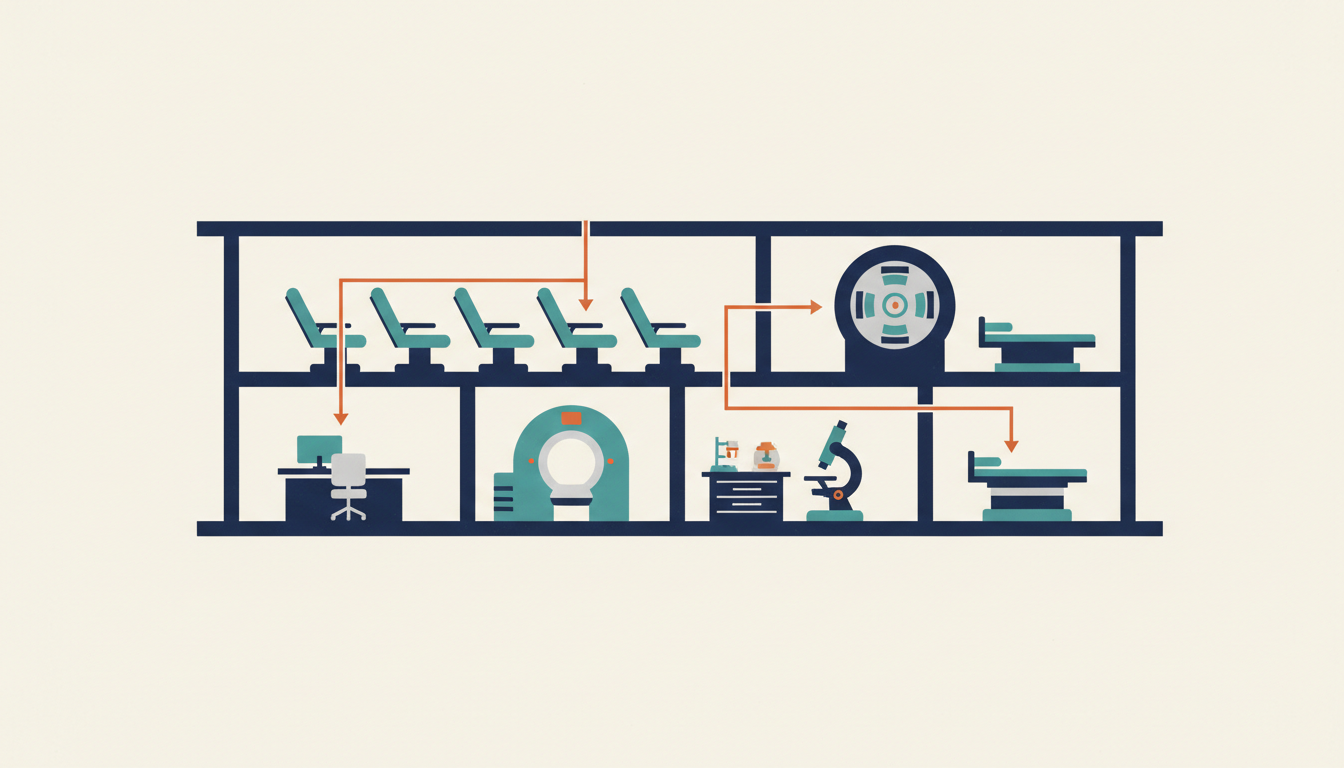
An oncology hospital is easy to picture as a collection of clinics: surgery on one floor, chemotherapy on another, radiotherapy in the basement, pathology somewhere out of sight. Each unit can be run well and the hospital can still fail its patients, because what decides the outcome in cancer care is not only how well each step is done but how smoothly the patient moves between them. This chapter makes that argument the centre of oncology management and builds a single framework around it.
The framework rests on four management domains that are usually taught separately: the patient journey, process management, bottleneck management and capacity management. They are linked in a simple causal chain. A capacity gap produces a bottleneck, a bottleneck produces a queue, the queue appears as waiting in the patient journey, and waiting shows up in clinical outcome. The shared intermediate output of all four domains is one number the manager can actually watch: the time from diagnosis to treatment.
Why waiting is not neutral in oncology
In most services a delay costs comfort. In oncology it can cost the outcome. In one cohort of women awaiting radiotherapy for cervical cancer, 9.0% died before treatment could begin, the median wait among those treated was 137 days, and the tumour progressed to a more advanced stage in 44.4% of those who waited more than 60 days (Dereje et al., 2021). In early-stage breast cancer, a 12-week delay between surgery and radiotherapy was associated with worse event-free survival (Raphael et al., 2020). The chapter’s first durable principle follows directly: a queue is a patient list, and queue length is a clinical-risk indicator.
The patient journey as a chain
The journey runs through access, referral, diagnosis, pathological confirmation, multidisciplinary evaluation, pre-treatment waiting, treatment, care transitions and follow-up. The chapter draws attention to links that rarely appear on management dashboards:
- Access and geography. About half of palliative radiotherapy patients are not treated at their nearest centre, and the excess travel falls disproportionately on rural and disadvantaged patients (Trommer et al., 2025). Uninsured and rural bladder cancer patients were markedly less likely to receive chemotherapy (Venkat et al., 2022).
- Iatrogenic delay. Some delay comes from the system’s own rules. When chemotherapy was held because of a low neutrophil count and the test was repeated, treatment could go ahead as planned in 31 of 32 patients (Waszczuk-Gajda et al., 2021).
- Pathology and molecular turnaround. Often the longest and least visible component. In advanced non-small cell lung cancer, all core biomarker results were ready at first consultation in only 20.3% of patients (median total turnaround 36.5 days for non-squamous specimens).
- The tumour board. The multidisciplinary tumour board (MDT) has three points of vulnerability: coverage (which patients reach it), preparation (whether the file is complete) and implementation (whether its decision reaches the patient). In one gastrointestinal board, 76% of decisions complied with guidelines, but only 64% were fully implemented within three months.
The managerial reframing is that the MDT is not a meeting but a measurable production process, with indicators such as board coverage rate, pre-board file completion, report-to-decision time and decision-implementation deviation.
Process management: measure before you improve
An unmeasured process hides its bottleneck, cannot justify its variation and cannot prove its improvements. Across facilities of the same radiation oncology service line, process efficiency ranged from about 60% to 82% (Patel et al., 2020), variation that case mix alone cannot explain. Time-driven activity-based costing (TDABC), which maps both the duration and the resource cost of each step, cut the median outpatient consultation cycle time by up to 21% (Weng et al., 2024). The chapter also challenges the assumed speed-safety trade-off: integrating technology into chemotherapy compounding lowered the compounding error rate by 63% (Marzal-Alfaro et al., 2020). Well-designed processes can become faster and safer together, provided the safety barriers are preserved.
Bottlenecks: the slowest link sets the pace
Drawing on the theory of constraints, the chapter reminds managers that improving steps outside the bottleneck does not speed up total flow; it only builds a larger pile in front of the constraint. The bottleneck is found where the longest queue and the highest utilisation accumulate. Two points deserve emphasis. First, the constraint moves: once consultation capacity is fixed, congestion may shift to simulation or plan approval, so bottleneck management is a continuous cycle, not a one-off project. Second, in oncology the constraint is frequently people rather than equipment. A linear accelerator can be bought in months; the radiation oncologist, physicist and technician who run it take years to train. With 59% of oncologists reporting burnout symptoms in the American Society of Clinical Oncology’s 2023 assessment, burnout is best read not as a welfare issue but as a capacity problem.
Capacity: one pool, shared demand
Capacity shortfalls are reflected in survival. In the Baltic states only 35-42% of cancer patients could receive radiotherapy, below the recommended 50%, and the mortality-to-incidence ratio was strongly and inversely related to radiotherapy capacity (r = -0.7) (Korobeinikova et al., 2026). The chapter’s key operational lesson is that the operating theatre, the chemotherapy chair and the radiotherapy machine share one patient pool. Expanding surgery raises adjuvant chemotherapy demand; expanding chemotherapy raises radiotherapy demand. In chemotherapy units the real problem is usually not the number of chairs but the midday peak in a day that is idle in the morning and afternoon; in theatres it is the minutes actually used rather than the number of rooms. These resources should therefore sit on one dashboard, reviewed at the same frequency.
Managing the time from diagnosis to treatment
Because access, process, bottleneck and capacity all lengthen it, the time from diagnosis to treatment is a system indicator that cannot be assigned to a single unit. It becomes manageable under three conditions: it is broken into components (referral to first consultation, consultation to biopsy, biopsy to pathology report, report to board decision, decision to treatment start); each component has a target and a threshold; and every case exceeding a threshold is treated as an exception whose root cause is investigated. Low-cost journey design helps: a same-day appointment offer for new radiation oncology referrals was taken up by 14% of planned patients and improved access indicators (Chen et al., 2024).
The Turkish context
Türkiye’s figures echo the international evidence. In a multicentre study of 1,031 breast cancer patients, total delay averaged 13.8 weeks, of which 10.5 weeks were system-related, and 42% of patients waited more than 12 weeks (Özmen et al., 2015). In tertiary hospitals in Ankara the median time from symptom to treatment was 135 days. The national Health Quality Standards (SKS) Hospital set, whose sixth version added chemotherapy services, pathology and indicator management sections, offers a ready institutional framework for monitoring these intervals.
Durable principles for the manager
- A queue is a patient list; queue length is a clinical-risk indicator.
- A bottleneck cannot be managed without being measured; improvement outside it does not accelerate flow.
- A capacity gap is a loss of survival, not a comfort problem.
- If speed is taken from safety, it is not a real gain.
- An access barrier is an invisible abandonment of treatment.
- Not every delay is a clinical necessity; part of it comes from the system’s own decisions.
- When one bottleneck is resolved another appears; bottleneck management never ends.
Questions to take back to your hospital
Can you break your own diagnosis-to-treatment time into five components with a measurable indicator for each? With what data would you prove where your bottleneck lies, and is that data already collected? If you add chemotherapy chairs, where will congestion appear next, and what will you do about it at the same time?
Source chapter: Kurutkan, M. N. (2026). Managing an oncology hospital as a system: Patient journey, process and capacity management (Chapter 1). Oncology Hospital Management Training Series, core text. Also available in Turkish.
References
Chen, A. M., Garcia, A. D., Alexandrescu, M., Truong, A., & Senthil, M. (2024). Effect of a Same-Day-Appointment Initiative on Access-Related Benchmarks in Radiation Oncology. Practical Radiation Oncology, 14(1), 12-19. https://doi.org/10.1016/j.prro.2023.08.010
Dereje, N., Addissie, A., Worku, A., Gebremariam, A., Kantelhardt, E. J., Assefa, M., & Jemal, A. (2021). Association between waiting time for radiotherapy initiation and disease progression among women with cervical cancer in Addis Ababa, Ethiopia. International Journal of Cancer, 149(6), 1284-1289. https://doi.org/10.1002/ijc.33689
Korobeinikova, E., Palskis, K., Dosanjh, M., Bray, F., Gershkevitsh, E., Balode, I., Bernans, A., Boka, G., Jarusevicius, L., Liepa, Z., Mezeckis, M., Plieskiene, A., Radzina, M., Skomskis, R., Smailyte, G., Stepina, S., & Venius, J. (2026). Radiotherapy and diagnostic capacity in relation to the changing cancer burden in the Baltic States. Acta Oncologica, 65, 355-362. https://doi.org/10.2340/ao.v65.45442
Marzal-Alfaro, M., Rodríguez-González, C. G., Escudero-Vilaplana, V., Revuelta-Herrero, J. L., González-Haba, E., Ibáñez-García, S., Iglesias-Peinado, I., Herranz-Alonso, A., & Sanjurjo Sáez, M. (2020). Risks and medication errors analysis to evaluate the impact of a chemotherapy compounding workflow management system on cancer patients’ safety. Health Informatics Journal, 26(3), 1995–2010. https://doi.org/10.1177/1460458219895434
Patel, S., Sutlief, S., Dennis, K., Parikh, S., & Turner, L. (2020). A service line approach: Using whiteboard analytics to improve time efficiency in radiation oncology. Medical Dosimetry, 45(4), 393-399. https://doi.org/10.1016/j.meddos.2020.07.004
Raphael, M. J., Saskin, R., & Singh, S. (2020). Association between waiting time for radiotherapy after surgery for early-stage breast cancer and survival outcomes in Ontario: A population-based outcomes study. Current Oncology, 27(2), e216–e221. https://doi.org/10.3747/co.27.5629
Trommer, M., Gillett, P., Franchini, F., Trapani, K., Hornby, C., Abraham, S., Herath, D., Gough, K., Donohoe, K., Tran, P., Foroudi, F., IJzerman, M., & Khor, R. (2025). Travel distance and potential disparities in palliative radiotherapy access for cancer patients in Victoria, Australia. Strahlentherapie und Onkologie, 201(12), 1296-1305. https://doi.org/10.1007/s00066-025-02418-8
Venkat, S., Lewicki, P. J., Khan, A. I., Gaffney, C., Borregales, L., & Scherr, D. S. (2022). Sociodemographic Disparities in Access to Chemotherapy for Bladder Cancer. Clinical Genitourinary Cancer, 20(2), E140-E150. https://doi.org/10.1016/j.clgc.2021.11.017
Waszczuk-Gajda, A., Kraj, L., Wozniak, K., Zurawinska-Grzelka, E., Hutch, R., Basak, G. W., & Jedrzejczak, W. W. (2021). Pseudoneutropenia as a factor-limiting access to chemotherapy for cancer patients: the effect of a simple meal. Supportive Care in Cancer, 29(7), 3767-3771. https://doi.org/10.1007/s00520-020-05896-x
Weng, J., Mesko, S., Chronowski, G., Lee, P., Choi, S., Das, P., Koong, A. C., French, K., Aloia, T., Ehlers, R., Elrod-Joplin, D., Kerr, A., Smith, R., Martinez, W., Bloom, E., Shah, S. J., Ning, M. S., Liao, Z., Herman, J., … Nguyen, Q. (2024). Optimizing Outpatient Radiation Oncology Consult Workflow by Using Time-Driven Activity-Based Costing: Efficiency and Financial Impacts. JCO Oncology Practice, 20(5). https://doi.org/10.1200/OP.23.00037
Key concepts in this article
Bottleneck Patient journey BurnoutConcepts link to the Glossary. Explore the knowledge graph →
Cite this page (APA 7)
Kurutkan, M. N. (2026, November 11). Managing an Oncology Hospital as a System: Patient Journey, Process, Bottleneck and Capacity. The Health Topics. https://healthtopic.org/topics/managing-an-oncology-hospital-as-a-system/