
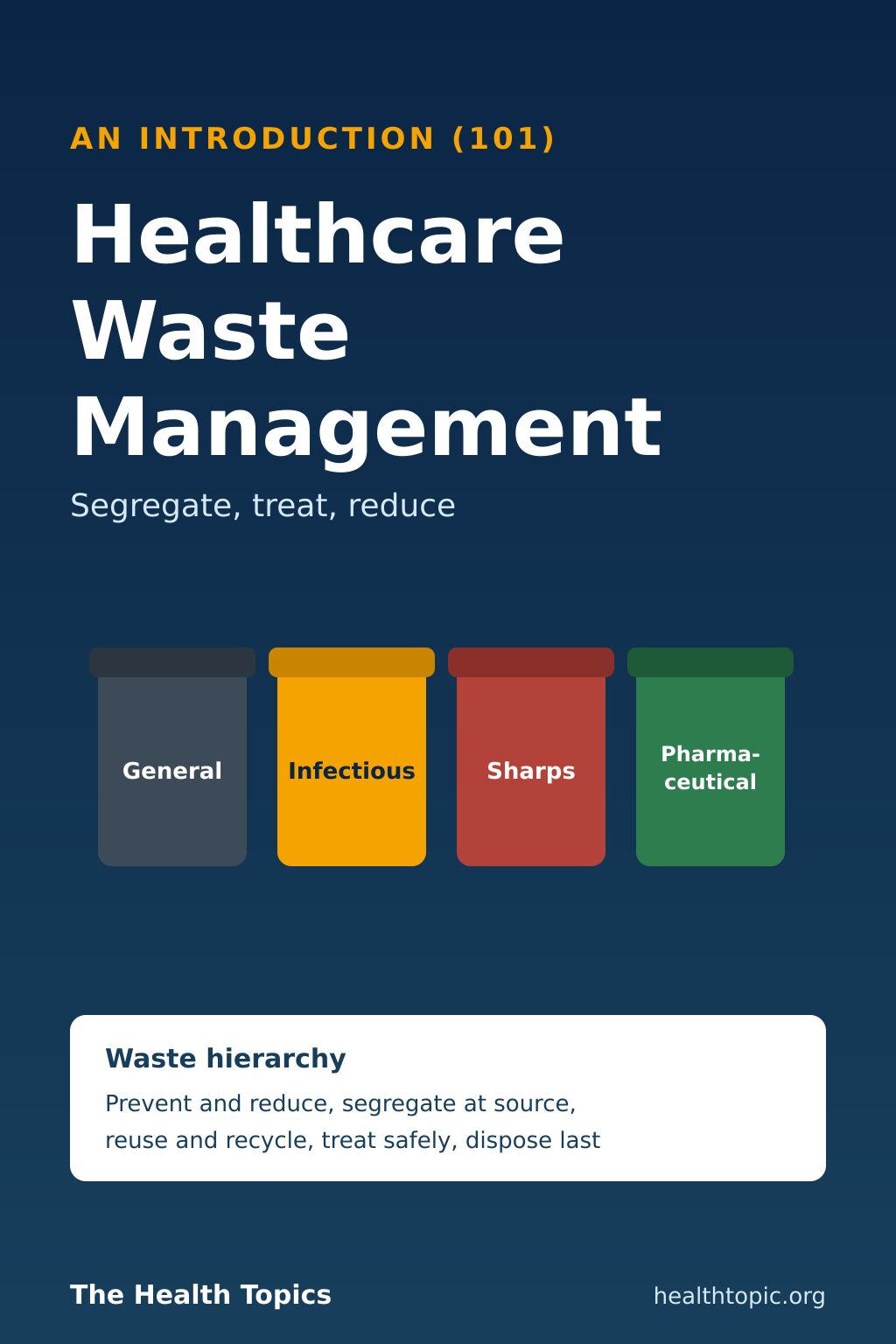
In brief: Healthcare waste management is the controlled handling of everything a health facility throws away, from separating items where they are produced to collection, storage, transport, treatment and final disposal (Askarian et al., 2010; Üçücüe & Yazici, 2009). Example: on a ward, a nurse drops a used needle into a puncture-proof sharps box and the needle’s packaging into the general bin; because most healthcare waste is household-like and only about 10% to 25% is hazardous, that simple choice decides much of the cost and the risk (Askarian et al., 2010). Reviews conclude that the main barriers are management failures, such as weak enforcement and poor segregation, rather than a lack of technology (Baaki et al., 2022; Yadav, 2026).
Healthcare waste management: an introduction (101)
This guide introduces healthcare waste management for students and practitioners of health management, nursing, medicine and public health: what healthcare waste is and is not, how it is classified and measured, what the evidence says about practice, risk and treatment, and what managers can do today. It is built on 1,329 records (1,200 research articles and 129 reviews) from the Web of Science Core Collection, published between 1983 and 2027, and every empirical statement is traced to one of those records. Hospital emissions, energy and green-hospital strategy are covered in our broader guide Green hospitals: an introduction (101); this guide focuses on waste.
Try it yourself: Sort ten everyday hospital items into the right waste category, choose a treatment route for five waste streams and see the trade-offs, and rate a facility on ten readiness questions to get a profile with suggested next steps.
Open the interactive module: Waste Lab
Learning objectives
After working through this guide, you should be able to:
- Define healthcare waste and state the elements most definitions share.
- Distinguish healthcare waste from municipal solid waste, hazardous industrial waste, hospital wastewater, pharmaceutical waste and general hospital waste.
- Classify waste items into hazardous and non-hazardous categories and explain why reported hazardous shares range so widely.
- Appraise studies of generation rates, staff knowledge and treatment choice by spotting problems of units, definitions, study design and heterogeneity.
- Plan improvements for a facility with a stepwise roadmap and a set of indicators.
Key concepts
- Healthcare waste. All waste generated at healthcare facilities, research centres and laboratories; mostly household-like, partly hazardous (Askarian et al., 2010).
- Hazardous (risk) waste. The infectious, pathological, sharp, pharmaceutical, genotoxic or radioactive fraction, each type needing its own handling (Ghasemi & Yusuff, 2016); chemical waste is added in other schemes (Bansod & Deshmukh, 2023).
- Segregation at source. Separating waste into categories where it is produced; the basic principle of safe management (Datta et al., 2018).
- Generation rate. Waste produced per unit of activity, usually kg per bed per day; 0.14 to 6.10 kg/bed/day between countries (Fadaei, 2023).
- Non-burn treatment. Autoclaving and microwaving disinfect waste without combustion but cannot treat pathological, radioactive, laboratory or chemotherapy wastes (Ghali et al., 2023).
- Waste hierarchy. Ordering options from reduction through segregation and safe treatment to final disposal (Leonard et al., 2026; Marinkovic et al., 2008).
- Knowledge, attitudes and practices (KAP). Surveys of what staff know, believe and do; the most studied outcome in intervention research (Ashtari et al., 2020).
- Circular economy. Keeping materials in use through reduction, reuse and recycling; healthcare lags because of a single-use mindset (Ranjbari et al., 2022).
Contents
- How this guide was produced
- Introduction: why healthcare waste management matters
- History and development
- Definitions and conceptual scheme
- Distinguishing healthcare waste from neighbouring concepts
- Types and classifications
- Theoretical frameworks and models
- Themes and bibliometric profile
- Healthcare waste management in Türkiye
- Debates and contradictions in the literature
- Measurement problems
- Research gaps and agenda
- Implications for practice today
- Summary, discussion questions, further reading and glossary
- Frequently asked questions and references
How this guide was produced
Database and date. Web of Science Core Collection, Advanced Search, all editions, searched on 17 November 2026. No language or publication year limits were applied; document types were limited to articles and reviews.
Query (title search, verbatim). TI=("healthcare waste*" OR "health care waste*" OR "health-care waste*" OR "medical waste*" OR "hospital waste*" OR "clinical waste*" OR "biomedical waste*" OR "bio-medical waste*" OR "infectious waste*" OR "pharmaceutical waste*" OR "sharps waste*" OR "health care facility waste*" OR "healthcare facility waste*") AND TI=(management OR segregat* OR dispos* OR practice* OR knowledge OR attitude* OR awareness OR policy OR policies OR regulat* OR legislat* OR generation OR minimi* OR reduc* OR recycl* OR "circular economy" OR sustainab* OR cost* OR review OR overview OR framework* OR risk* OR occupational OR handling OR collection OR "COVID-19" OR pandemic) NOT TI=(pyroly* OR gasification OR catalyst* OR "fly ash" OR "bottom ash" OR ash OR biochar OR adsorption OR concrete OR asphalt OR leaching OR "mechanical propert*") AND DT=("Article" OR "Review")
Search development. A first, broader version without the management-focus block (the second TI line) returned 3,648 records and was narrowed by adding that block.
Criteria. Included: generation, classification, handling, treatment and disposal of healthcare waste; law and policy; staff knowledge and practice; occupational and environmental risk; reduction and recycling; costs; COVID-19 waste; pharmaceutical and sharps waste. Excluded: non-healthcare waste; pure chemistry or engineering of treatment processes, including hospital wastewater characterisation; off-topic, editorial and retracted records.
Flow. 1,640 records identified; 0 duplicates; 1 retracted publication removed, leaving 1,639 records screened on title and abstract; 310 excluded (223 engineering or chemistry of treatment processes, including hospital wastewater characterisation; 57 not healthcare waste; 24 off-topic; 6 marginal); 1,329 included (1,200 articles, 129 reviews), published from 1983 to 2027 (2027 refers to issue dates of early-access papers).
Screening and extraction. Three AI-assisted screeners worked in parallel under a common protocol. The lead reviewer harmonised hospital wastewater decisions across batches (management, policy, compliance and risk-framework studies kept; characterisation and treatment-chemistry studies excluded) and resolved 8 unsure records. Evidence was extracted from abstracts into a structured template.
Limitations. Single database; title search only, so papers naming healthcare waste only in abstracts were missed; abstract-level reading, with numbers reported as abstracts state them and no independent quality appraisal; AI-assisted screening without full re-screening by the lead reviewer.
Introduction: why healthcare waste management matters
Follow one patient through a planned operation. By the end of the day the operating rooms may have produced up to 30% of the hospital’s waste, and more than 40% of that volume is recyclable (Cirstea et al., 2026). The same bins also hold blood-soaked swabs, used blades and drug vials. How these items are separated, stored, carried and treated is the work of healthcare waste management.
The stakes are concrete. Improper management has been held responsible for the transmission of more than 30 dangerous bloodborne pathogens (Yazie et al., 2019). Waste handlers have higher odds of hepatitis B infection, with a pooled odds ratio of 2.88 in nine studies (Arafa & Eshak, 2020), and a meta-analysis of 22 studies with about 9,000 waste workers estimated a pooled sharps injury prevalence of 34.1%, with only 31.1% vaccinated against hepatitis B (Oliveira et al., 2027). Incineration destroys pathogens and cuts volume by up to 95% to 96%, but biomedical waste incinerators contribute the largest share of national dioxin inventories in most developing countries (Ajay & Prathish, 2024).
Practice lags behind rules. Across 78 countries, only 38.9% of medical waste was segregated for proper management and only 41% of workers had in-service training (Singh et al., 2022); in resource-limited settings, inadequate segregation had a pooled prevalence of 68.4% and open dumping or burning was the most common disposal route (Woime, 2026). Some authors therefore treat healthcare waste first as a management problem of regulation, training, finance and infrastructure (Baaki et al., 2022).
History and development
From conventions to national rules. A bibliometric study traces a paradigm shift from the Basel Convention of 1989 to WHO guidance (Soyler et al., 2025). In the United States, the Environmental Protection Agency, acting under the 1990 Clean Air Act Amendments, proposed air emission standards for medical waste incineration in February 1995 (Lee & Huffman, 1996), and early papers reviewed infectious waste legislation in New York City and the Medical Waste Tracking Act (Farber, 1991; Troncone, 1990). The Stockholm Convention later drove monitoring of dioxin-like emissions from incinerators (Ajay & Prathish, 2024).
Emerging economies. India issued Biomedical Wastes Rules in 1998, with categories, colour-coded containers and treatment options (Patil & Shekdar, 2001), and revised them in 2016 (Datta et al., 2018), after which reporting, generation and treatment of biomedical waste roughly doubled while many states still lacked finance and monitoring (Sharma et al., 2023). China implemented national regulations in 2003 (Gai et al., 2010). In Korea, small incinerators without air pollution control were to close, and incineration was the only available option from late 2005 (Jang et al., 2006). Türkiye published its first regulation in 1993 and revised it in 2005 in line with EU directives (Birpinar et al., 2009).
Shifting priorities and outbreaks. Recycling peaked as a research theme in 2014, pyrolysis gained priority from 2016, and sustainability and circular economy grew from 2020 and 2021 (Soyler et al., 2025). SARS, H1N1 influenza and COVID-19 exposed insufficient emergency disposal capacity in many countries (Yang et al., 2024); in Wuhan, waste per 1,000 persons rose from 3.64 to 27.32 kg per day and disposal capacity was raised from 50 to 280.1 tons per day (Yang et al., 2021). The latest policy milestone in the corpus is the NHS clinical waste strategy of March 2023 (Leonard et al., 2026).
Definitions and conceptual scheme
Healthcare waste is also called medical, hospital, clinical or biomedical waste. A scoping review of 112 studies found no uniform nomenclature; terms broadly align with the WHO manual but vary enough to confuse workers (Hangulu, 2018). The table paraphrases eight definitions; the last column names the dimension each foregrounds.
| Source | Year | Discipline | Definition (paraphrased) | Emphasised dimension |
|---|---|---|---|---|
| Mühlich et al., 2003 | 2003 | Hospital infection control and waste regulation | Infectious hospital waste is defined differently across European regulations, and the definition chosen shapes segregation, disposal routes and their economic and ecological consequences | Regulatory definition of infectiousness |
| Üçücüe & Yazici, 2009 | 2009 | Environmental engineering | Waste generated by healthcare institutions that, being hazardous, needs controlled collection, temporary storage and permanent disposal | Source and hazard |
| Askarian et al., 2010 | 2010 | Infection control and quality management | All waste generated at healthcare facilities, research centres and laboratories, mostly household-like but partly hazardous to workers, patients, environment and public | Scope of sources and hazardous share |
| Windfeld & Brooks, 2015 | 2015 | Environmental engineering (review) | Waste from healthcare sources governed by legislation, whose infectious subset is poorly defined, so that non-infectious material is treated unnecessarily | Ambiguity of the infectious category |
| Datta et al., 2018 | 2018 | Medical microbiology | Safe and sustainable biomedical waste management is a social and legal responsibility based on segregation at source and waste reduction | Responsibility and source segregation |
| Govindan et al., 2021 | 2021 | Operations research | A specific kind of municipal solid waste divided into infectious and non-infectious categories, with COVID-19 waste in the hazardous infectious group | Infectious versus non-infectious split |
| Bolan et al., 2023 | 2023 | Environmental science and toxicology | All solid and liquid wastes from the treatment, diagnosis and immunisation of humans and animals, a significant share being infectious, hazardous, radioactive or toxic | Generating activities and hazardous constituents |
| Leonard et al., 2026 | 2026 | Infection prevention and control (UK and Ireland) | Correct handling of potentially hazardous clinical waste as part of an organisation’s duty of care to keep staff and patients safe and prevent the spread of infection | Infection prevention and duty of care |
The definitions share a common core: healthcare waste arises from healthcare and related activities, is mostly non-hazardous but contains a hazardous fraction, needs a controlled chain from segregation to disposal and is governed by legislation. They diverge on which sources count, from hospitals only to every place of diagnosis, treatment, research or immunisation, including animals (Awodele et al., 2016; Bolan et al., 2023); whether liquids are included (Bansod & Deshmukh, 2023; Bolan et al., 2023); how broadly “infectious” is defined (Mühlich et al., 2003; Windfeld & Brooks, 2015); whether it is a special kind of municipal waste (Govindan et al., 2021); whether pharmaceutical waste belongs inside (Agarwal et al., 2024); and whether the framing is technical hazard or legal and social duty (Capoor & Bhowmik, 2017; Leonard et al., 2026).
Distinguishing healthcare waste from neighbouring concepts
The key test: did the item arise from a healthcare activity, and does it carry a risk (infection, injury, toxicity or radiation) that requires handling outside the municipal system?
| Concept | What it is | Relation to healthcare waste |
|---|---|---|
| Municipal solid waste | Household and commercial refuse collected by local authorities | The boundary leaks: in India waste was often collected mixed and disposed of with municipal waste (Patil & Shekdar, 2001), and in a Turkish survey of 1,243 patients and relatives, 43.1% put infectious and 37% sharps waste produced at home into household waste (Irmak et al., 2026). |
| Hazardous industrial waste | Toxic or reactive waste from industry, handled under hazardous waste rules | The streams can share facilities, as at a combined incinerator in Izmit (Karademir, 2004); co-incinerating medical with hazardous waste had the highest environmental impact among emergency options (Zhao et al., 2021). |
| Hospital wastewater | Liquid effluent containing pharmaceutical residues, radioisotopes, detergents and pathogens (Jerie et al., 2024) | In Southern Africa, often managed with municipal wastewater (Jerie et al., 2024); conventional treatment removes only 50% to 70% of emerging contaminants (Parida et al., 2022). Only management studies were kept in this guide. |
| Pharmaceutical waste | Expired, unused, spilled or contaminated medicines and related items (Agarwal et al., 2024) | Arises in facilities, households and industry (Agarwal et al., 2024; Irmak et al., 2026); ASEAN states regulate it only under general healthcare waste laws (Sapkota & Pariatamby, 2025). |
| Electronic waste from medical devices | Discarded equipment containing batteries, metals and electronics | Not addressed directly in the extracted evidence; toxic elements in incinerated medical waste come partly from batteries (Bolan et al., 2023). |
| General (non-hazardous) hospital waste | Packaging, paper, food and other household-like waste from facilities | The largest fraction, 72% in Libyan facilities (Sawalem et al., 2009); kept apart it can be composted or recycled (Coker et al., 2009), mixed with risk waste it inflates infectious waste and cost (Tsakona et al., 2007). |
Types and classifications
Hazardous and non-hazardous fractions. The first division separates household-like waste (packaging, kitchen and green waste) from risk waste such as infectious waste, sharps and chemical-risk waste (Ghali et al., 2023). Askarian et al. (2010) put the risk-free share at 75% to 90%, leaving 10% to 25% hazardous. Field studies report a wider range: about 21% hazardous in Dhaka (Patwary et al., 2009), 26.78% in Samsun (Senel et al., 2015), 38.9% in Damanhour (Abd El-Salam, 2010), 41.31% in Addis Ababa (Debere et al., 2013) and 21% to 70% across 17 Ethiopian studies (Yazie et al., 2019), but only about 3% infectious in Ibadan (Coker et al., 2009). In Germany, 25% to 30% of about 210,000 tonnes of annual hospital waste is hazardous (Goh et al., 2026).
High shares often signal poor segregation: in a Greek hospital, inappropriate segregation inflated infectious waste quantities and costs (Tsakona et al., 2007). Data scope matters too: in Antalya, infectious waste made up 94.62% of recorded healthcare waste because only healthcare fractions entered the dataset (Coban et al., 2023). COVID-19 also unsettled the assumption that only 15% to 20% of healthcare waste is infectious (Capoor & Parida, 2021).
Categories of hazardous waste. Common schemes distinguish infectious, pathological, sharps, pharmaceutical, genotoxic and radioactive waste (Ghasemi & Yusuff, 2016), and broader lists add chemical, general and pressurised waste (Bansod & Deshmukh, 2023). Viet Nam separates high-risk infectious, non-infectious hazardous, recyclable and non-recyclable groups (Le et al., 2024). Categories are tied to colour coding: India’s 2016 rules have six schedules for categories, colour codes and containers, labels, transport labels, treatment standards and facilities (Bansod & Deshmukh, 2023). Even staff with adequate general awareness misclassify: in a university hospital microbiology laboratory, 15% of staff misclassified hazardous waste, especially expired pharmaceuticals and cytotoxic vials (Çetin, Hussein, et al., 2025).
Classification by generator. Studies also cover dental clinics (Kalkan et al., 2025), Ayurvedic hospitals, where 70% to 99% of solid waste is non-hazardous (Kularatne, 2024), veterinary practice, which often lacks regulatory focus (Sehrawat et al., 2026), midwifery clinics (Pratama et al., 2026) and patients’ homes (Irmak et al., 2026; Mohammadinia et al., 2024).
Theoretical frameworks and models
Five families of frameworks appear, grouped by the question they answer.
| Family | Frameworks | Typical question | Example from the corpus |
|---|---|---|---|
| Normative ordering | Waste hierarchy; hierarchy of controls | Which options come first? | Reduction of quantity and harm first, then sorting, pretreatment, safe transport, treatment and disposal (Marinkovic et al., 2008); hierarchy of controls combined with a circular model (Zhavairo & Jerie, 2026) |
| Environmental assessment | Life cycle assessment, life cycle costing and management | Which route harms the environment least? | Microwaving had the lowest impact for small generators (Soares et al., 2013); life cycle management combined with AHP in rural Southern Africa (Brent et al., 2007) |
| Behaviour and learning | Theory of planned behaviour; KAP model; human factors | Why do staff segregate correctly or not? | The theory of planned behaviour predicted waste actions of 566 NHS employees (Tudor et al., 2007); a human factors lens was applied, but formal human factors interventions were not consistently evaluated (Kayral et al., 2026) |
| Organisational management | TQM; lean; stakeholder and social network analysis; PESTEL; TOE | How should the organisation and partners be arranged? | TQM cut infectious waste in 29 wards (Askarian et al., 2010); social network analysis exposed communication bottlenecks around an incinerator (Caniato et al., 2014) |
| Decision and system models | MCDM; system dynamics; mathematical programming; queuing theory | Which technology, site, contractor or route? | Among 101 MCDM applications, technology selection was most common, with AHP, DEMATEL, best-worst method and fuzzy sets favoured (Chakraborty et al., 2025); system dynamics modelled bed numbers and the NIMBY syndrome (Chaerul et al., 2008) |
Sustainability and digital frameworks. The triple bottom line supplies criteria for siting disposal facilities (Chauhan & Singh, 2016), and with socio-technical theory it yields sustainability indicators for disposal techniques (Rani et al., 2026). Circular economy thinking meets the single-use mindset of infection control (Ranjbari et al., 2022). Blockchain applications span every stage from generation to recycling (Bamakan et al., 2022), whereas IoT applications cover storage, transport or disposal separately rather than the whole chain (Mohamed et al., 2023). Behavioural theory remains thin: a review of household medicine disposal called for behavioural frameworks and noted that the links between knowledge, attitudes and practice are poorly understood (Hiew & Low, 2024).
Themes and bibliometric profile
Growth, journals and countries. The corpus grew slowly and then rapidly: 45 records from 1983 to 1999, 109 from 2000 to 2009, 365 from 2010 to 2019 and 810 from 2020 to 2027, with a peak of 146 in 2025 (the 134 records of 2026 cover part of the year). COVID-19 drives much of the surge: 246 of the 810 records since 2020 mention COVID-19, a pandemic or an outbreak, against 4 of the 519 earlier records (Figure 5). The leading journals are Waste Management & Research (98), Waste Management (63), Sustainability (40), Journal of Material Cycles and Waste Management (27) and Journal of Cleaner Production (24). By country of affiliation, India (266), China (169), Iran (105) and Türkiye (81) lead, followed by the USA (61), Brazil (57), England (57), Ethiopia (47), Saudi Arabia (46) and Pakistan (44).
Themes. Coding each record to one primary theme gives the profile in Figure 6: knowledge, attitudes, practices and training lead (315), followed by decision models and logistics (209), general management (208) and COVID-19 waste (177).
Generation rates. Rates between countries range from 0.14 to 6.10 kg/bed/day (Fadaei, 2023); median hospital waste was 4.42 kg/bed/day in North America and 0.19 in Africa and Oceania, with total and hazardous waste falling in North America but hazardous waste rising in Asia and Europe (Mol et al., 2022). Patient numbers, beds and hospital type predicted quantities at facility level (Bdour et al., 2007). Across countries, life expectancy, human development, schooling and CO2 emissions were positively associated with rates (Minoglou et al., 2017), and a 78-country meta-analysis found plastics to be about 35% of medical waste (Singh et al., 2022). Countries with higher human development and life expectancy, in short, tend to report higher generation rates (Minoglou et al., 2017).
Segregation and handling. In Dhaka, waste segregated at the point of use was often remixed with general waste and dumped in city bins (Patwary et al., 2011); in 26 Iranian provincial capitals, 96% of centres used inappropriate reduction and separation methods (Dastpak et al., 2017); and only about 25% of countries in one review segregated medical waste (Fadaei, 2023). Even where all hospitals segregated, as in Myanmar, disposal was mostly open burning, incineration and dumping (Aung et al., 2019).
Knowledge, attitudes, practices and training. A meta-analysis of 27 educational and managerial interventions found a standardised mean difference of 3.04 on KAP outcomes, with gains also in waste amount and costs (Ashtari et al., 2020). Education and mandatory training within a waste plan cut infectious waste by more than 58% in a Saudi hospital (Almuneef & Memish, 2003). Across sub-Saharan Africa, only 49.74% of healthcare workers practised good waste management, and knowledge, training and guideline use were associated with better practice (Berihun et al., 2025). Yet a ChatGPT-supported course did not significantly change medical waste attitudes and behaviours (Kaya et al., 2025), and gains from a household medicine disposal intervention in Northern Cyprus partly faded by three months (Altinci & Tamirci, 2026). Coverage is low: only 57.4% of handlers in low- and middle-income countries had been trained (Satapathy et al., 2026).
Treatment and disposal. Incineration treats an estimated 60% to 75% of global medical waste (Nematollahi et al., 2025). It reduces volume by up to 90% and can recover energy, but without proper technology it creates harmful emissions and residues (Chisholm et al., 2021), and its ash releases toxic elements when landfilled (Bolan et al., 2023). Autoclaving cannot treat all categories and needs internal segregation (Ciplak & Kaskun, 2015). Plasma achieves 90% to 97% volume reduction but has high capital costs (Nematollahi et al., 2025), and a review found no scalable green solution for the world (Kenny & Priyadarshini, 2021).
Occupational and environmental risks. Among handlers in low- and middle-income countries, pooled needle and sharps injuries reached 26.4% and only 15.3% were immunised against hepatitis B (Satapathy et al., 2026). Workers in poorly managed facilities had 4.31 times the odds of needle-stick injury (Woime, 2026). Core risks are open burning and the trade in reused needles in the Global South and sharps mismanagement in both the Global South and North (Cook et al., 2023), and environmental pathways include heavy metals near dumping sites (Yadav, 2026) and antimicrobial resistance genes at waste sites (Abosse et al., 2024).
COVID-19. Generation rose by an average of 102.2% in five Iranian hospitals (Kalantary et al., 2021) and by more than 143% in less than a year in Nigeria (Etim et al., 2022). Wuhan nevertheless disposed of all medical waste within 24 hours despite a five-fold peak in demand (Chen et al., 2021), while most movable facilities had a low capacity of below 5 tonnes per day (Zhao et al., 2022). In Bangladesh, pandemic guidelines were formulated but not implemented (Barua & Hossain, 2021).
Pharmaceutical waste. Household bins and sewers dominate medicine disposal even in countries with take-back programmes (Rogowska & Zimmermann, 2022), and positive public attitudes contrast with inadequate practices (Hiew & Low, 2024). Romanian pharmacists sometimes refused take-back for lack of procedures, legislation and funding (Bungau et al., 2018).
Sustainability and costs. In Cornwall, minimisation and recycling could cut disposal quantities by 20% to 30% and costs by 25% to 35% (Tudor et al., 2005). About 25% of biomedical waste is recyclable plastic (Sahoo et al., 2024), yet Germany recycles or recovers only 17% of hospital waste (Goh et al., 2026). For small generators, treatment cost US$0.12 per kg by microwave, US$1.10 by autoclave and US$1.53 by lime (Soares et al., 2013); elsewhere, surgical procedures, outpatient numbers and distance from the city centre predicted costs (Barsbay, 2021).
Decision models and policy. Operations research addresses COVID-19 reverse logistics (Kargar et al., 2020; Yu et al., 2020), location-routing that minimises cost and exposure risk (Govindan et al., 2021) and electric vehicle collection (Erdem, 2022). Policy studies find weak implementation or fragmented legal frameworks: Croatian hospitals lacked education and funds to comply (Marinkovic et al., 2008), Spain had 13 differing regional regulations (Insa et al., 2010) and Ethiopia lacked specific legislation (Haylamicheal & Desalegne, 2012). Across 12 Asian countries, authors called for a change in mindset rather than complex technology (Ananth et al., 2010).
Healthcare waste management in Türkiye
Türkiye is among the most productive countries in this literature: 87 included records have at least one Turkish-affiliated author. Not all describe Türkiye; many are methodological decision-model studies without a Turkish case (Ecer et al., 2026; Garai et al., 2026; Kirisci et al., 2025), and one is set in Bangladesh (Sayeed et al., 2026). The account below uses only studies whose abstracts describe a Turkish setting.
Regulation and treatment. The first medical waste regulation of 1993 was changed in 2005 in line with EU directives (Birpinar et al., 2009); the revised regulation was published in Official Bulletin No. 25883 on 22 July 2005, and before it wastes were buried after calcification (Varinca et al., 2011). An Istanbul study fed directly into this revision (Alagöz & Kocasoy, 2008a). Earlier, in Thrace, medical wastes were disposed of with municipal and industrial solid wastes (Uysal & Tinmaz, 2004). In 2006 to 2009, a survey of 311 healthcare services reported full conformity, with separate containers in 82.6% and compliant storage depots in 88% (Eker et al., 2010). Sterilisation was used in no city in 2007 and in 15 cities by 2009, and it was projected that 56 cities would use it by 2012 while 15 would still rely on burial (Gören et al., 2011). Capacity lagged in Trabzon, where part of hospital waste was treated as domestic waste (Üçücüe & Yazici, 2009), and in the West Black Sea Region all waste went to an autoclave plant, conflicting with EU rules for categories autoclaves cannot treat (Ciplak & Kaskun, 2015). A national overview reported that about 67.2% of medical waste was landfilled after sterilisation (Baki, 2019).
Generation. Rates sit within the international range: 0.63 kg/bed/day in 192 Istanbul hospitals (Birpinar et al., 2009), 2.35 kg/bed/day in a survey of 311 services (Eker et al., 2010) and 2.47 to 2.89 kg/bed/day in Samsun (Senel et al., 2015). In Istanbul, private hospitals generated 1.85 kg/bed/day in 2007 against 0.67 in state hospitals (Yurtseven et al., 2010), and in Izmir waste correlated with district population and bed numbers (Soysal et al., 2010). During COVID-19, waste in a highly populated city rose by 48% on average (Hanedar et al., 2022). National generation is forecast to reach about 380 thousand tons in 2040, 92% of it combustible (Melikoglu, 2025), and prediction models exist for dental clinics (Kalkan et al., 2025) and private hospitals (Uysal et al., 2025).
Knowledge and training. Among 412 hospital personnel, 48.5% had adequate knowledge and doctors scored lowest (Uzunlulu et al., 2022). A 56-hour programme significantly improved the knowledge of 240 managers in Istanbul (Ozder et al., 2013). Among 158 school health nurses, 68.4% were untrained and 46.8% of institutions had no waste plan (Ekici et al., 2026), and in an operating room 76% of staff attended to segregation although many lacked formal education (Bektas et al., 2024). At home, only 7.7% of unused medicines in Istanbul were returned to pharmacies (Turkdogan et al., 2019). Three further studies by Turkish-affiliated teams imply but do not state a Turkish setting (Kaya et al., 2025; Sürme & Maras, 2022; Uskun et al., 2023); one of them developed a 24-item attitude and behaviour scale with a Cronbach’s alpha of 0.94 (Uskun et al., 2023).
Decision models. Turkish cases cover collection routing in Istanbul (Alagöz & Kocasoy, 2008b), off-site sterilisation as the preferred option (Özkan, 2013), disposal site selection in Istanbul (Samasti et al., 2024), sterilisation facility siting in Izmir (Yilmaz et al., 2026), safety scoring of collection, storage and transport (Eren & Tuzkaya, 2019), a life cycle assessment for Istanbul (Çetin, Yildiz, et al., 2025) and a blockchain-integrated network of 23 hospitals (Yesilkaya & Tirkolaee, 2027). Stakeholder training and market acceptance were failure factors for IoT and blockchain systems in Istanbul (Torkayesh et al., 2022).
What is missing. No study with a Turkish setting in the extracted evidence measured injuries, infections or vaccination among waste handlers, evaluated the health or environmental outcomes of the 2005 regulation, or assessed national system costs. Pharmaceutical waste is studied mainly in households, and primary care is largely absent.
Debates and contradictions in the literature
Six debates run through the corpus; in each, both positions are backed by studies.
1. Incineration or non-burn treatment? Incineration is favoured in Africa for volume reduction and energy recovery (Chisholm et al., 2021), and multi-criteria studies ranked it best in India during COVID-19 (Manupati et al., 2021) and in a university hospital in Adana (Kalan et al., 2025). Others argue that outdated incinerators should give way to autoclaving, steam sterilisation and pyrolysis (Khan et al., 2019) and that low-temperature incinerators should be banned (Ghali et al., 2023); a multi-criteria study that included incineration ranked autoclaving first and incineration last (Garai et al., 2026), another ranked autoclaving first among five non-incineration techniques (Ecer et al., 2026), and a second Adana study judged steam sterilisation most sustainable (Özkurt, 2026). Two studies of the same city thus reach opposite conclusions, so results depend on chosen criteria and weights.
2. Technology or management? Technology-oriented reviews see thermal treatment with energy recovery as most effective (Olabi et al., 2024) and expect AI sorting, robotics and IoT, combined with staff training and participatory design, to improve segregation accuracy by 40% (Goh et al., 2026). Management-oriented authors reply that the challenges are more managerial than technological (Baaki et al., 2022) and that prevention and segregation at source should come before downstream treatment, which may add hazards (Cirstea et al., 2025).
3. Infection control or circularity? A seven-country comparison recommended stopping recycling during pandemics (Daoud et al., 2024), whereas a review of 102 pandemic studies called for sustainable recycling of protective equipment plastics (Mondal et al., 2022) and another argued that circular practices can cut costs while maintaining infection control (Zikhathile et al., 2026).
4. Narrow or broad infectious categories? Vague legislation leads to over-classification, raising cost and environmental impact (Windfeld & Brooks, 2015), and European hospitals defined infectious waste in divergent ways (Mühlich et al., 2003). COVID-19 pushed the other way, challenging the notion that only 15% to 20% of waste is infectious (Capoor & Parida, 2021).
5. Does training work? Meta-analytic evidence says yes for KAP outcomes, but the studies were mostly uncontrolled pre-post designs with high heterogeneity (Ashtari et al., 2020), and some interventions showed no or fading effects (Altinci & Tamirci, 2026; Kaya et al., 2025).
6. How much digitalisation? Blockchain applications have been proposed for every stage of the chain (Bamakan et al., 2022), but a bilevel model of 23 Turkish hospitals found full deployment not always optimal: partial adoption by 34.8% of hospitals achieved 79.39% traceability (Yesilkaya & Tirkolaee, 2027).
| Axis | Position A | Position B |
|---|---|---|
| Treatment choice | Incineration is practical and can recover energy (Chisholm et al., 2021; Kalan et al., 2025) | Non-burn methods are safer and more sustainable (Ghali et al., 2023; Özkurt, 2026) |
| Source of improvement | Advanced thermal and digital technologies, with staff involvement (Goh et al., 2026; Olabi et al., 2024) | Management, enforcement and segregation at source (Baaki et al., 2022; Yadav, 2026) |
| Recycling in outbreaks | Stop recycling to protect infection control (Daoud et al., 2024) | Circular practices can coexist with infection control (Zikhathile et al., 2026) |
| Infectious category | Too broad, causing over-treatment (Windfeld & Brooks, 2015) | Too narrow for pandemic conditions (Capoor & Parida, 2021) |
| Training | Effective on KAP and waste outcomes (Ashtari et al., 2020) | Effects uncertain, fading or absent (Altinci & Tamirci, 2026; Kaya et al., 2025) |
| Digital traceability | Blockchain applications span the whole chain (Bamakan et al., 2022) | Partial adoption can be optimal (Yesilkaya & Tirkolaee, 2027) |
Measurement problems
Generation rates are not comparable. Rates vary widely mainly because researchers disagree on definitions and measurement methods (Ali et al., 2017). Units differ, from kilograms per bed or patient per day to per person per year, per surgical procedure and per laboratory test (Barsbay, 2021; Bdour et al., 2007; Varinca et al., 2011). Method changes the number: in one Greek hospital, weighing gave 880 kg of infectious waste per day and counting bags 650 kg (Tsakona et al., 2007). Variability is large even within one hospital category (Komilis et al., 2012), and a few abstracts print quantities ambiguously, such as “37 5 ton per day” (Patwary et al., 2009), so figures should be checked against full texts before reuse.
Questionnaires are rarely validated. Of 53 KAP studies on biomedical waste, only 19 presented their questionnaire and nine had validated it (Mannocci et al., 2020), although validated instruments such as a 24-item attitude and behaviour scale are emerging (Uskun et al., 2023).
Meta-analyses pool very different studies. I2 reached 96.8% for practice estimates in sub-Saharan Africa (Berihun et al., 2025) and 98.9% for sharps injuries among waste workers (Oliveira et al., 2027), and most studies in a hepatitis B meta-analysis were of poor to fair quality (Arafa & Eshak, 2020).
System and technology assessments lack standards. A WHO-based evaluation framework was proposed because none was standardised (Aung et al., 2019), sustainability assessments of hospital wastewater treatment are hard to compare (Boutros et al., 2025), and more reliable methods for assessing treatment technologies are needed (Hassan & Shareefdeen, 2022). Simple tools help: a checklist of legal requirements plus waste quantification corrected non-conformities in a Brazilian health centre (Moreira & Günther, 2013).
Research gaps and agenda
- Which standard protocol for measuring generation rates gives comparable results across facilities and countries? Gap: non-comparable rates (Ali et al., 2017) and the call for an inventory database (Singh et al., 2022).
- Do vaccination and PPE provision reduce sharps injuries and infections among waste handlers over time? Gap: fragmented evidence on handlers’ health (Huda et al., 2022) and a meta-analysis in which hepatitis B vaccination coverage was not associated with sharps injury prevalence (Oliveira et al., 2027).
- Do training interventions change segregation behaviour and waste outcomes over 12 months or more in controlled designs? Gap: uncontrolled pre-post studies (Ashtari et al., 2020) and fading effects (Altinci & Tamirci, 2026).
- How do healthcare workers interpret local waste categories, and how does this drive misclassification? Gap: terminology studies called for by a scoping review (Hangulu, 2018) and observed misclassification (Çetin, Hussein, et al., 2025).
- What are the real-world effects of circular practices on cost, emissions and infection control, measured with standard indicators? Gap: lack of real-world evaluations and circular indicators (Zikhathile et al., 2026).
- How strong is the link between healthcare waste disposal and antimicrobial resistance? Gap: knowledge gaps on this link (Abosse et al., 2024).
- Which behavioural models explain household medicine disposal, and which take-back designs work? Gap: need for behavioural frameworks (Hiew & Low, 2024) and for research on household pharmaceutical waste (Moleman et al., 2026).
- What have Türkiye’s 2005 regulation and the shift to sterilisation achieved for worker safety, environment and cost? Gap: no such evaluation with a Turkish setting in the extracted evidence.
Implications for practice today
Most gains come from organisation, segregation and people before new treatment plants: in a Saudi hospital, education, mandatory training, audits and a written policy cut waste by more than 58% and halved costs (Almuneef & Memish, 2003).
A roadmap for managers
- Measure the baseline. Audit waste flows (Tudor et al., 2005) and weigh by category, since weighing and bag counting can give very different figures (Tsakona et al., 2007).
- Assign responsibility and write a plan. Name a responsible manager, adopt a written plan (Akbolat et al., 2011; Moreira & Günther, 2013) and use certified contractors (Leonard et al., 2026).
- Segregate at the point of generation. Use clear definitions and colour-coded containers, and keep non-regulated waste out of regulated streams (Askarian et al., 2010; Bansod & Deshmukh, 2023; Lee et al., 2004).
- Train often, not once. Refresh training for all staff groups, including cleaning personnel (Gai et al., 2010); frequency, not experience, predicts compliance (Çetin, Hussein, et al., 2025).
- Protect handlers. Provide PPE and hepatitis B vaccination (Satapathy et al., 2026), and puncture-proof sharps containers.
- Choose treatment with transparent criteria. Know volumes and categories first (Ghasemi & Yusuff, 2016), check what each method cannot treat (Ghali et al., 2023) and compare options on explicit criteria (Chakraborty et al., 2025).
- Track and report. Use barcode tracking of containers and weights (Varinca et al., 2011) and review indicators yearly.
- Reduce and recycle where safe. Start in operating rooms (Cirstea et al., 2026) and use green teams (Sürme et al., 2025).
- Prepare for surges. Agree mobile or regional back-up capacity in advance (Yang et al., 2021).
| Area | Indicator | Why it matters |
|---|---|---|
| Generation | Total and hazardous waste in kg per occupied bed per day, by unit | The basic planning figure; reduction programmes have lowered it measurably (Askarian et al., 2010) |
| Segregation | Hazardous share of total waste; share of audited bags correctly segregated | In one hospital, poor segregation inflated infectious waste and cost (Tsakona et al., 2007) |
| Training | Share of staff, by group, trained in the past 12 months | Training frequency predicts compliance (Çetin, Hussein, et al., 2025) |
| Occupational safety | Sharps injuries per 100 handlers per year; hepatitis B vaccination coverage of handlers | Injuries and low vaccination are common among waste workers (Oliveira et al., 2027) |
| Storage and transport | Share of storage areas and vehicles meeting regulation; days waste is held before collection | In an occupational safety assessment, collection weighed well above storage and transport (Eren & Tuzkaya, 2019) |
| Treatment | Share of hazardous waste treated by an approved method; incinerator emission compliance | Open burning and poor incineration are core risks (Cook et al., 2023) |
| Recycling | Share of total waste recycled or recovered | Recycling rates can be low even in high-income systems (Goh et al., 2026) |
| Cost | Waste management cost per occupied bed day and per kg by stream | Cost depends on activity and location, not only on beds (Barsbay, 2021) |
Summary
- Healthcare waste is waste from healthcare and related activities; most of it is household-like, but a hazardous fraction requires a controlled chain from segregation to disposal.
- Definitions diverge on sources, liquids, the scope of “infectious” and the place of pharmaceutical waste; these choices drive cost and practice.
- Reported generation rates and hazardous shares vary widely, partly because units, methods and definitions differ.
- Segregation at source and regular training are the best-supported levers; training improves knowledge, but long-term behavioural effects are less certain.
- Waste workers face high rates of sharps injuries and low hepatitis B vaccination coverage.
- Incineration still dominates; studies disagree on whether incineration or non-burn methods are best, often because of different criteria.
- Türkiye moved from lime burial to sterilisation after its 2005 regulation, but outcome, worker safety and cost evaluations with a Turkish setting are missing.
Discussion questions
- Why do studies report hazardous or infectious shares from about 3% to 70% of healthcare waste? List at least three explanations from this guide.
- Is a used insulin needle at a patient’s home healthcare waste? Use the common core of the definitions to justify your answer.
- Two studies from the same city ranked incineration and steam sterilisation as the best option. How can both be methodologically sound, and what would you need to know to decide?
- Applied: you manage a 300-bed hospital whose hazardous waste share is 45%. Using the roadmap, write the first three actions you would take and the indicators you would track for a year.
- Applied: design a one-year training programme for nurses, cleaners and porters that could show an effect on segregation behaviour, not only on knowledge. What design and outcome measures would you use?
- Should recycling of plastic waste continue during an outbreak? Argue both positions using the evidence in the debates section.
Further reading
- Windfeld and Brooks (2015): why the infectious category is so hard to define.
- Hangulu (2018): terminology mapped against the WHO manual.
- Mol et al. (2022): generation rates by continent and over time.
- Ashtari et al. (2020): what interventions achieve, and how weak the designs are.
- Oliveira et al. (2027): the latest synthesis on sharps injuries among waste workers.
- Chakraborty et al. (2025): a map of 101 multi-criteria decision studies.
- Ranjbari et al. (2022): a bibliometric map with a circular economy agenda.
Glossary
| Term | Turkish | Short definition |
|---|---|---|
| Healthcare waste | Sağlık kuruluşu atığı (tıbbi atık) | All waste generated by healthcare facilities, research centres and laboratories |
| Hazardous (risk) waste | Tehlikeli (riskli) atık | The infectious, sharp, pathological, pharmaceutical, chemical, genotoxic or radioactive fraction |
| Infectious waste | Enfeksiyöz atık | Waste that contains or may contain infectious material, such as blood-soaked items or cultures |
| Sharps | Kesici ve delici atıklar | Needles, blades, scalpels and other items that can cut or puncture |
| Segregation at source | Kaynağında ayrıştırma | Separating waste into categories where it is produced |
| Generation rate | Atık üretim hızı | Waste produced per unit of activity, usually kg per bed per day |
| Autoclave (steam sterilisation) | Otoklav (buharlı sterilizasyon) | Treatment with pressurised steam that disinfects waste without combustion |
| Incineration | Yakma | High-temperature combustion that reduces volume and destroys pathogens but can emit dioxins |
| Take-back programme | İlaç geri toplama programı | A scheme for returning unused or expired medicines to pharmacies or collection points |
| Waste hierarchy | Atık hiyerarşisi | Ordering of options from prevention and reduction to treatment and disposal |
Frequently asked questions
What is healthcare waste? Waste from healthcare facilities, research centres and laboratories; about 10% to 25% is hazardous (Askarian et al., 2010).
How much waste does a hospital produce? About 0.14 to 6.10 kg per bed per day between countries (Fadaei, 2023).
Is incineration the best treatment? Not necessarily: it is a major dioxin source, while autoclaving and microwaving cannot treat every category (Ajay & Prathish, 2024; Ghali et al., 2023).
Why is segregation so important? Mixing inflates the hazardous fraction and its cost (Tsakona et al., 2007).
Who is most at risk? Waste workers, with frequent sharps injuries and low hepatitis B vaccination (Oliveira et al., 2027).
Related on this site: Green hospitals: an introduction (101) · Green hospitals: waste management and sustainability · Antimicrobial stewardship in hospitals: an introduction (101) · Medication selection, procurement and shortages: an introduction (101)
References
- Abd El-Salam, M. M. (2010). Hospital waste management in El-Beheira Governorate, Egypt. Journal of Environmental Management, 91(3), 618-629. https://doi.org/10.1016/j.jenvman.2009.08.012
- Abosse, J., Megersa, B., Zewge, F., & Eregno, F. E. (2024). Healthcare waste management and antimicrobial resistance: A critical review. Journal of Water and Health, 22(11), 2076-2093. https://doi.org/10.2166/wh.2024.232
- Agarwal, S., Saha, H., Kaushik, S., Patil, V. M., & Verma, S. (2024). Critical review of biomedical waste management for future pandemics: Pharmaceutical perspective. ACS Chemical Health & Safety, 31(6), 444-467. https://doi.org/10.1021/acs.chas.4c00067
- Ajay, S. V., & Prathish, K. P. (2024). Dioxins emissions from bio-medical waste incineration: A systematic review on emission factors, inventories, trends and health risk studies. Journal of Hazardous Materials, 465, 133384. https://doi.org/10.1016/j.jhazmat.2023.133384
- Akbolat, M., Dede, C., Isik, O., & Saglam, H. (2011). Medical waste management practices in Turkey: A case study in Sakarya. Pakistan Journal of Medical Sciences, 27(4), 892-895.
- Alagöz, A. Z., & Kocasoy, G. (2008a). Determination of the best appropriate management methods for the health-care wastes in Istanbul. Waste Management, 28(7), 1227-1235. https://doi.org/10.1016/j.wasman.2007.05.018
- Alagöz, A. Z., & Kocasoy, G. (2008b). Improvement and modification of the routing system for the health-care waste collection and transportation in Istanbul. Waste Management, 28(8), 1461-1471. https://doi.org/10.1016/j.wasman.2007.08.024
- Ali, M., Wang, W. P., Chaudhry, N., & Geng, Y. (2017). Hospital waste management in developing countries: A mini review. Waste Management & Research, 35(6), 581-592. https://doi.org/10.1177/0734242X17691344
- Almuneef, M., & Memish, Z. A. (2003). Effective medical waste management: It can be done. American Journal of Infection Control, 31(3), 188-192. https://doi.org/10.1067/mic.2003.43
- Altinci, Ç., & Tamirci, M. (2026). A longitudinal intervention study to improve public knowledge, behavior, and practices for sustainable pharmaceutical waste management. Sustainability, 18(19), 9831. https://doi.org/10.3390/su18199831
- Ananth, A. P., Prashanthini, V., & Visvanathan, C. (2010). Healthcare waste management in Asia. Waste Management, 30(1), 154-161. https://doi.org/10.1016/j.wasman.2009.07.018
- Arafa, A., & Eshak, E. S. (2020). Medical waste handling and hepatitis B virus infection: A meta-analysis. American Journal of Infection Control, 48(3), 316-319. https://doi.org/10.1016/j.ajic.2019.08.011
- Ashtari, A., Sadegh Tabrizi, J., Rezapour, R., Rashidian Maleki, M., & Azami-Aghdash, S. (2020). Health care waste management improvement interventions specifications and results: A systematic review and meta- analysis. Iranian Journal of Public Health, 49(9), 1611-1621.
- Askarian, M., Heidarpoor, P., & Assadian, O. (2010). A total quality management approach to healthcare waste management in Namazi Hospital, Iran. Waste Management, 30(11), 2321-2326. https://doi.org/10.1016/j.wasman.2010.06.020
- Aung, T. S., Luan, S. J., & Xu, Q. Y. (2019). Application of multi-criteria-decision approach for the analysis of medical waste management systems in Myanmar. Journal of Cleaner Production, 222, 733-745. https://doi.org/10.1016/j.jclepro.2019.03.049
- Awodele, O., Adewoye, A. A., & Oparah, A. C. (2016). Assessment of medical waste management in seven hospitals in Lagos, Nigeria. BMC Public Health, 16, 269. https://doi.org/10.1186/s12889-016-2916-1
- Baaki, T. K., Baharum, M. R., Pitt, M., & Davies, S. (2022). Associated factors of medical waste management practices in developing countries: A review. International Journal of Environment and Waste Management, 30(1), 104-124. https://doi.org/10.1504/IJEWM.2022.128106
- Baki, O. G. (2019). Medical waste management strategies in Turkey. Fresenius Environmental Bulletin, 28(11A), 8953-8960.
- Bamakan, S. M. H., Malekinejad, P., & Ziaeian, M. (2022). Towards blockchain-based hospital waste management systems; applications and future trends. Journal of Cleaner Production, 349, 131440. https://doi.org/10.1016/j.jclepro.2022.131440
- Bansod, H. S., & Deshmukh, P. (2023). Biomedical waste management and its importance: A systematic review. Cureus, 15(2). https://doi.org/10.7759/cureus.34589
- Barsbay, M. Ç. (2021). A data-driven approach to improving hospital waste management. International Journal of Healthcare Management, 14(4), 1410-1421. https://doi.org/10.1080/20479700.2020.1762057
- Barua, U., & Hossain, D. (2021). A review of the medical waste management system at Covid-19 situation in Bangladesh. Journal of Material Cycles and Waste Management, 23(6), 2087-2100. https://doi.org/10.1007/s10163-021-01291-8
- Bdour, A., Altrabsheh, B., Hadadin, N., & Al-Shareif, M. (2007). Assessment of medical wastes management practice: A case study of the northern part of Jordan. Waste Management, 27(6), 746-759. https://doi.org/10.1016/j.wasman.2006.03.004
- Bektas, Y., Güçlü, C. Y., & Meço, B. C. (2024). Evaluation of operating room staff awareness of environmental sustainability and medical waste management. Turkish Journal of Anaesthesiology and Reanimation, 52(4), 142-146. https://doi.org/10.4274/TJAR.2024.231490
- Berihun, G., Walle, Z., Desye, B., Daba, C., Geto, A. K., Kumlachew, L., & Berhanu, L. (2025). Healthcare waste management practices and associated factors among healthcare workers in Sub-Saharan Africa: A systematic review and meta-analysis. PLOS ONE, 20(10), e0334290. https://doi.org/10.1371/journal.pone.0334290
- Birpinar, M. E., Bilgili, M. S., & Erdogan, T. (2009). Medical waste management in Turkey: A case study of Istanbul. Waste Management, 29(1), 445-448. https://doi.org/10.1016/j.wasman.2008.03.015
- Bolan, S., Padhye, L. P., Kumar, M., Antoniadis, V., Sridharan, S., Tang, Y. Y., Singh, N., Hewawasam, C., Vithanage, M., Singh, L., Rinklebe, J., Song, H. C., Siddique, K. H. M., Kirkham, M. B., Wang, H. L., & Bolan, N. (2023). Review on distribution, fate, and management of potentially toxic elements in incinerated medical wastes. Environmental Pollution, 321, 121080. https://doi.org/10.1016/j.envpol.2023.121080
- Boutros, M., Puig, R., Bartoli, E., & El Bachawati, M. (2025). Sustainability assessment of hospital wastewater treatment techniques: A comprehensive review. Sustainability, 17(11), 4930. https://doi.org/10.3390/su17114930
- Brent, A. C., Rogers, D. E. C., Ramabitsa-Siimane, T. S. M., & Rohwer, M. B. (2007). Application of the analytical hierarchy process to establish health care waste management systems that minimise infection risks in developing countries. European Journal of Operational Research, 181(1), 403-424. https://doi.org/10.1016/j.ejor.2006.06.015
- Bungau, S., Tit, D. M., Fodor, K., Cioca, G., Agop, M., Iovan, C., Cseppento, D. C. N., Bumbu, A., & Bustea, C. (2018). Aspects regarding the pharmaceutical waste management in Romania. Sustainability, 10(8), 2788. https://doi.org/10.3390/su10082788
- Caniato, M., Vaccari, M., Visvanathan, C., & Zurbrügg, C. (2014). Using social network and stakeholder analysis to help evaluate infectious waste management: A step towards a holistic assessment. Waste Management, 34(5), 938-951. https://doi.org/10.1016/j.wasman.2014.02.011
- Capoor, M. R., & Bhowmik, K. T. (2017). Current perspectives on biomedical waste management: Rules, conventions and treatment technologies. Indian Journal of Medical Microbiology, 35(2), 157-164. https://doi.org/10.4103/ijmm.IJMM_17_138
- Capoor, M. R., & Parida, A. (2021). Current perspectives of biomedical waste management in context of COVID-19. Indian Journal of Medical Microbiology, 39(2), 171-178. https://doi.org/10.1016/j.ijmmb.2021.03.003
- Çetin, E., Hussein, A., & Günes-Durak, S. (2025). Advancing sustainable medical waste management: A case study on waste generation and classification in a university hospital microbiology laboratory. Sustainability, 17(10), 4325. https://doi.org/10.3390/su17104325
- Çetin, E., Yildiz, I. A. E., Yasar, C. Ö., & Yulistyorini, A. (2025). Life cycle assessment of medical waste management: Case study for Istanbul. Applied Sciences, 15(8), 4439. https://doi.org/10.3390/app15084439
- Chaerul, M., Tanaka, M., & Shekdar, A. V. (2008). A system dynamics approach for hospital waste management. Waste Management, 28(2), 442-449. https://doi.org/10.1016/j.wasman.2007.01.007
- Chakraborty, S., Raut, R. D., Rofin, T. M., & Chakraborty, S. (2025). A comprehensive review on applications of multi-criteria decision-making methods in healthcare waste management. Waste Management & Research, 43(9), 1335-1357. https://doi.org/10.1177/0734242X251320872
- Chauhan, A., & Singh, A. (2016). A hybrid multi-criteria decision making method approach for selecting a sustainable location of healthcare waste disposal facility. Journal of Cleaner Production, 139, 1001-1010. https://doi.org/10.1016/j.jclepro.2016.08.098
- Chen, C., Chen, J. A., Fang, R., Ye, F., Yang, Z. L., Wang, Z., Shi, F., & Tan, W. F. (2021). What medical waste management system may cope with COVID-19 pandemic: Lessons from Wuhan. Resources, Conservation and Recycling, 170, 105600. https://doi.org/10.1016/j.resconrec.2021.105600
- Chisholm, J. M., Zamani, R., Negm, A. M., Said, N., Daiem, M. M. A., Dibaj, M., & Akrami, M. (2021). Sustainable waste management of medical waste in African developing countries: A narrative review. Waste Management & Research, 39(9), 1149-1163. https://doi.org/10.1177/0734242X211029175
- Ciplak, N., & Kaskun, S. (2015). Healthcare waste management practice in the West Black Sea Region, Turkey: A comparative analysis with the developed and developing countries. Journal of the Air & Waste Management Association, 65(12), 1387-1394. https://doi.org/10.1080/10962247.2015.1076539
- Cirstea, I., Radu, A., Radu, A. F., Tit, D. M., Bungau, G. S., Gitea, D., & Uivaraseanu, B. (2026). Sustainable management of medical waste in surgical units: Operational challenges and policy perspectives. Healthcare, 14(7), 954. https://doi.org/10.3390/healthcare14070954
- Cirstea, I., Radu, A. F., Radu, A., Tit, D. M., & Bungau, G. S. (2025). Healthcare waste toxicity: From human exposure to toxic mechanisms and management strategies. Journal of Xenobiotics, 15(5), 155. https://doi.org/10.3390/jox15050155
- Coban, M., Karakas, F., & Coban, N. A. (2023). Quantitative analysis of healthcare waste generation and composition in Antalya, Turkey. Waste Management, 160, 80-89. https://doi.org/10.1016/j.wasman.2023.02.008
- Coker, A., Sangodoyin, A., Sridhar, M., Booth, C., Olomolaiye, P., & Hammond, F. (2009). Medical waste management in Ibadan, Nigeria: Obstacles and prospects. Waste Management, 29(2), 804-811. https://doi.org/10.1016/j.wasman.2008.06.040
- Cook, E., Woolridge, A., Stapp, P., Edmondson, S., & Velis, C. A. (2023). Medical and healthcare waste generation, storage, treatment and disposal: A systematic scoping review of risks to occupational and public health. Critical Reviews in Environmental Science and Technology, 53(15), 1452-1477. https://doi.org/10.1080/10643389.2022.2150495
- Daoud, A. O., Elattar, H., Abdelatif, G., Morsy, K. M., Peters, R. W., & Mostafa, M. K. (2024). Implications of the COVID-19 pandemic on the management of municipal solid waste and medical waste: A comparative review of selected countries. Biomass, 4(2), 555-573. https://doi.org/10.3390/biomass4020030
- Dastpak, H., Golbaz, S., & Farzadkia, M. (2017). Hospital waste minimisation, separation, treatment and disposal in Iran: A mini review study. Proceedings of the Institution of Civil Engineers: Waste and Resource Management, 170(3-4), 107-118. https://doi.org/10.1680/jwarm.17.00016
- Datta, P., Mohi, G. K., & Chander, J. (2018). Biomedical waste management in India: Critical appraisal. Journal of Laboratory Physicians, 10(1), 6-14. https://doi.org/10.4103/JLP.JLP_89_17
- Debere, M. K., Gelaye, K. A., Alamdo, A. G., & Trifa, Z. M. (2013). Assessment of the health care waste generation rates and its management system in hospitals of Addis Ababa, Ethiopia, 2011. BMC Public Health, 13, 28. https://doi.org/10.1186/1471-2458-13-28
- Ecer, F., Ögel, L. L. Y., Aytekin, A., & Ulutas, A. (2026). Evaluation of sustainable healthcare waste disposal techniques via an interval-valued p,q-rung orthopair fuzzy framework. Journal of Cleaner Production, 561, 148394. https://doi.org/10.1016/j.jclepro.2026.148394
- Eker, H. H., Bilgili, M. S., Sekman, E., & Top, S. (2010). Evaluation of the regulation changes in medical waste management in Turkey. Waste Management & Research, 28(11), 1034-1038. https://doi.org/10.1177/0734242X10366158
- Ekici, E., Özkol, O., & Gür, K. (2026). School health nurses’ attitudes and behaviors toward medical waste management. Journal of Education and Research in Nursing, 23(3), 167-171. https://doi.org/10.14744/jern.2026.03743
- Erdem, M. (2022). Designing a sustainable logistics network for hazardous medical waste collection a case study in COVID-19 pandemic. Journal of Cleaner Production, 376, 134192. https://doi.org/10.1016/j.jclepro.2022.134192
- Eren, E., & Tuzkaya, U. R. (2019). Occupational health and safety-oriented medical waste management: A case study of Istanbul. Waste Management & Research, 37(9), 876-884. https://doi.org/10.1177/0734242X19857802
- Etim, M. A., Omole, D. O., & Araoye, O. V. (2022). Impact of COVID-19 on medical waste management and disposal practices in Nigeria. Cogent Engineering, 9(1), 2038345. https://doi.org/10.1080/23311916.2022.2038345
- Fadaei, A. (2023). Comparison of medical waste management methods in different countries: A systematic review. Reviews on Environmental Health, 38(2), 339-348. https://doi.org/10.1515/reveh-2021-0170
- Farber, B. F. (1991). Disposal of medical waste: The New York experience under the Medical Tracking Act. Infection Control and Hospital Epidemiology, 12(4), 251-257. https://doi.org/10.2307/30147000
- Gai, R. Y., Xu, L. Z., Li, H. J., Zhou, C. C., He, J. J., Yoshihisa, S., Tang, W., & Chushi, K. (2010). Investigation of health care waste management in Binzhou district, China. Waste Management, 30(2), 246-250. https://doi.org/10.1016/j.wasman.2008.08.023
- Garai, T., Kahraman, C., & Pan, X. H. (2026). A γ-cut-based MCDM technique for assessment of biomedical waste management under generalized heptagonal fuzzy environment. International Journal of Fuzzy Systems. Advance online publication. https://doi.org/10.1007/s40815-025-02162-2
- Ghali, H., Ben Cheikh, A., Bhiri, S., Bouzgarrou, L., Ben Rejeb, M., Gargouri, I., & Latiri, H. S. (2023). Health and environmental impact of hospital wastes: Systematic review. Dubai Medical Journal, 6(2), 67-80. https://doi.org/10.1159/000529432
- Ghasemi, M. K., & Yusuff, R. B. M. (2016). Advantages and disadvantages of healthcare waste treatment and disposal alternatives: Malaysian scenario. Polish Journal of Environmental Studies, 25(1), 17-25.
- Goh, K. C., Kurniawan, T. A., Meidiana, C., Abdurakhmonov, O., Anouzla, A., Yong, W. H., Islam, M. T., Kern, A. O., Aziz, F., Onn, C. W., Othman, M. H. D., Zhang, D. D., Dai, W., Iqbal, M. A., Amjad, M., & Abass, K. S. (2026). Hospital waste management in Germany and the European Union during the Industry 5.0 era for carbon neutrality by 2050: A critical review. Waste Management & Research, 44(2), 116-132. https://doi.org/10.1177/0734242X251361726
- Gören, S., Demir, G., Yaman, C., & Yildiz, A. (2011). Medical waste management by geographical region in Turkey. Journal of Residuals Science & Technology, 8(3), 109-115.
- Govindan, K., Nasr, A. K., Mostafazadeh, P., & Mina, H. (2021). Medical waste management during coronavirus disease 2019 (COVID-19) outbreak: A mathematical programming model. Computers & Industrial Engineering, 162, 107668. https://doi.org/10.1016/j.cie.2021.107668
- Hanedar, A., Çifçi, D. I., Zafer, N., & Görgün, E. (2022). The impact of COVID-19 pandemic in medical waste amounts: A case study from a high-populated city of Turkey. Journal of Material Cycles and Waste Management, 24(5), 1760-1767. https://doi.org/10.1007/s10163-022-01428-3
- Hangulu, L. (2018). Nomenclature for healthcare waste in the healthcare sector and its alignment with the provisions made by the World Health Organization’s manual for healthcare waste management: A scoping review. Recycling, 3(4), 51. https://doi.org/10.3390/recycling3040051
- Hassan, M. F., & Shareefdeen, Z. (2022). Recent developments in sustainable management of healthcare waste and treatment technologies. Journal of Sustainable Development of Energy, Water and Environment Systems, 10(2), 1090384. https://doi.org/10.13044/j.sdewes.d9.0384
- Haylamicheal, I. D., & Desalegne, S. A. (2012). A review of legal framework applicable for the management of healthcare waste and current management practices in Ethiopia. Waste Management & Research, 30(6), 607-618. https://doi.org/10.1177/0734242X11419891
- Hiew, S. Y., & Low, B. Y. (2024). The knowledge, attitude, and practice of the public regarding household pharmaceutical waste disposal: A systematic review (2013-2023). International Journal of Pharmacy Practice, 32(2), 120-132. https://doi.org/10.1093/ijpp/riae001
- Huda, M. N., Hailemariam, T. G., Hossain, S. Z., Malo, J. S., Khan, S., Hadisuyatmana, S., Ferdous, A., Akombi-Inyang, B., Islam, R. M., & Renzaho, A. M. N. (2022). Medical waste management-related factors affecting health and experiences of health risks among medical waste handlers in low and middle-income countries: A systematic review protocol of qualitative studies. BMJ Open, 12(3), e056037. https://doi.org/10.1136/bmjopen-2021-056037
- Insa, E., Zamorano, M., & López, R. (2010). Critical review of medical waste legislation in Spain. Resources, Conservation and Recycling, 54(12), 1048-1059. https://doi.org/10.1016/j.resconrec.2010.06.005
- Irmak, A. Y., Ketenciler, A. P., & Metinoglu, M. (2026). Disposal of household healthcare waste: A cross-sectional analysis from Türkiye. Florence Nightingale Journal of Nursing, 34, 0313. https://doi.org/10.5152/FNJN.2026.25313
- Jang, Y. C., Lee, C., Yoon, O. S., & Kim, H. (2006). Medical waste management in Korea. Journal of Environmental Management, 80(2), 107-115. https://doi.org/10.1016/j.jenvman.2005.08.018
- Jerie, S., Mutekwa, T. V., Mudyazhezha, O. C., Shabani, T., & Shabani, T. (2024). Environmental and human health problems associated with hospital wastewater management in Zimbabwe. Current Environmental Health Reports, 11(3), 380-389. https://doi.org/10.1007/s40572-024-00452-9
- Kalan, O., Antmen, Z. F., & Akbaba, S. (2025). Selection of medical waste disposal method for a university hospital using hybrid multi-criteria decision-making methods: A case study in Adana province, Turkey. Sustainability, 17(24), 11378. https://doi.org/10.3390/su172411378
- Kalantary, R. R., Jamshidi, A., Mofrad, M. M. G., Jafari, A. J., Heidari, N., Fallahizadeh, S., Arani, M. H., & Torkashvand, J. (2021). Effect of COVID-19 pandemic on medical waste management: A case study. Journal of Environmental Health Science and Engineering, 19(1), 831-836. https://doi.org/10.1007/s40201-021-00650-9
- Kalkan, E., Budak, I., Kaya, G., & Aydin, E. G. (2025). Modeling of medical waste generation in dental clinics affiliated to the provincial health directorate in Kastamonu: PLS and gradient boosting approaches. Processes, 13(12), 3820. https://doi.org/10.3390/pr13123820
- Karademir, A. (2004). Health risk assessment of PCDD/F emissions from a hazardous and medical waste incinerator in Turkey. Environment International, 30(8), 1027-1038. https://doi.org/10.1016/j.envint.2004.05.008
- Kargar, S., Pourmehdi, M., & Paydar, M. M. (2020). Reverse logistics network design for medical waste management in the epidemic outbreak of the novel coronavirus (COVID-19). Science of the Total Environment, 746, 141183. https://doi.org/10.1016/j.scitotenv.2020.141183
- Kaya, N., Parlak, L., & Duru, P. (2025). The effect of ChatGPT on the development of medical waste attitudes, behaviors, and environmental awareness among university students: A quasi-experimental study. Evaluation and Program Planning, 111, 102595. https://doi.org/10.1016/j.evalprogplan.2025.102595
- Kayral, I. H., Manga, Y. B., Boz, S., Lachman, P., & Iqbal, U. (2026). Medical waste management within the Green Hospital approach: A systematic review of direct, contextual, and transferable evidence. International Journal for Quality in Health Care, 38(3), mzag103. https://doi.org/10.1093/intqhc/mzag103
- Kenny, C., & Priyadarshini, A. (2021). Review of current healthcare waste management methods and their effect on global health. Healthcare, 9(3), 284. https://doi.org/10.3390/healthcare9030284
- Khan, B. A., Cheng, L. S., Khan, A. A., & Ahmed, H. (2019). Healthcare waste management in Asian developing countries: A mini review. Waste Management & Research, 37(9), 863-875. https://doi.org/10.1177/0734242X19857470
- Kirisci, M., Kuzu, S., & Kablan, A. (2025). The handling of healthcare waste analysis with an interval-valued Fermatean fuzzy-based decision-making technique. Sustainable Futures, 9, 100581. https://doi.org/10.1016/j.sftr.2025.100581
- Komilis, D., Fouki, A., & Papadopoulos, D. (2012). Hazardous medical waste generation rates of different categories of health-care facilities. Waste Management, 32(7), 1434-1441. https://doi.org/10.1016/j.wasman.2012.02.015
- Kularatne, R. K. A. (2024). Biomedical waste generation at Ayurveda hospitals in South Asia: A mini review of the composition, quantities and characteristics. Waste Management & Research, 42(2), 95-110. https://doi.org/10.1177/0734242X231178225
- Le, T. H., Do, P. H., Nguyen, P. H., Do, V. K. H., & Nguyen, T. H. (2024). Assessment of medical waste generation rate in Viet Nam. Reviews on Environmental Health, 39(3), 577-583. https://doi.org/10.1515/reveh-2023-0022
- Lee, B. K., Ellenbecker, M. J., & Moure-Ersaso, R. (2004). Alternatives for treatment and disposal cost reduction of regulated medical wastes. Waste Management, 24(2), 143-151. https://doi.org/10.1016/j.wasman.2003.10.008
- Lee, C. C., & Huffman, G. L. (1996). Medical waste management incineration. Journal of Hazardous Materials, 48(1-3), 1-30. https://doi.org/10.1016/0304-3894(95)00153-0
- Leonard, M., Hanahoe, A., Cruz, H., & Prior, A. R. (2026). Clinical waste management. Infection Prevention in Practice, 8(4), 100573. https://doi.org/10.1016/j.infpip.2026.100573
- Mannocci, A., di Bella, O., Barbato, D., Castellani, F., La Torre, G., De Giusti, M., & Del Cimmuto, A. (2020). Assessing knowledge, attitude, and practice of healthcare personnel regarding biomedical waste management: A systematic review of available tools. Waste Management & Research, 38(7), 717-725. https://doi.org/10.1177/0734242X20922590
- Manupati, V. K., Ramkumar, M., Baba, V., & Agarwal, A. (2021). Selection of the best healthcare waste disposal techniques during and post COVID-19 pandemic era. Journal of Cleaner Production, 281, 125175. https://doi.org/10.1016/j.jclepro.2020.125175
- Marinkovic, N., Vitale, K., Holcer, N. J., Dzakula, A., & Pavic, T. (2008). Management of hazardous medical waste in Croatia. Waste Management, 28(6), 1049-1056. https://doi.org/10.1016/j.wasman.2007.01.021
- Melikoglu, M. (2025). Forecasting medical waste generation and estimating waste to energy potentials with associated greenhouse gas emissions: A holistic analysis. Sustainable Futures, 10, 100850. https://doi.org/10.1016/j.sftr.2025.100850
- Minoglou, M., Gerassimidou, S., & Komilis, D. (2017). Healthcare waste generation worldwide and its dependence on socio-economic and environmental factors. Sustainability, 9(2), 220. https://doi.org/10.3390/su9020220
- Mohamed, N. H., Khan, S., & Jagtap, S. (2023). Modernizing medical waste management: Unleashing the power of the Internet of Things (IoT). Sustainability, 15(13), 9909. https://doi.org/10.3390/su15139909
- Mohammadinia, L., Raei, K., & Gholami-Borujeni, F. (2024). Global household infectious waste management strategies: A systematic review. Waste Disposal & Sustainable Energy, 6(3), 371-384. https://doi.org/10.1007/s42768-024-00192-4
- Mol, M. P. G., Zolnikov, T. R., Neves, A. C., dos Santos, G. R., Tolentino, J. L. L., Barros, R. T. D., & Heller, L. (2022). Healthcare waste generation in hospitals per continent: A systematic review. Environmental Science and Pollution Research, 29(28), 42466-42475. https://doi.org/10.1007/s11356-022-19995-1
- Moleman, T., Mantel-Teeuwisse, A. K., Ravinetto, R., Suleman, F., Lates, J., & Aljadeeah, S. (2026). Exploring pharmaceutical waste management in Southern Africa: A scoping review. Journal of Pharmaceutical Policy and Practice, 19(1), 2700215. https://doi.org/10.1080/20523211.2026.2700215
- Mondal, R., Mishra, S., Pillai, J. K., & Sahoo, M. (2022). COVID 19 pandemic and biomedical waste management practices in healthcare system. Journal of Family Medicine and Primary Care, 11(2), 439-446. https://doi.org/10.4103/jfmpc.jfmpc_1139_21
- Moreira, A. M. M., & Günther, W. M. R. (2013). Assessment of medical waste management at a primary health-care center in Sao Paulo, Brazil. Waste Management, 33(1), 162-167. https://doi.org/10.1016/j.wasman.2012.09.018
- Mühlich, M., Scherrer, M., & Daschner, F. D. (2003). Comparison of infectious waste management in European hospitals. Journal of Hospital Infection, 55(4), 260-268. https://doi.org/10.1016/j.jhin.2003.08.017
- Nematollahi, H., Tuysserkani, M., & Nematollahi, A. (2025). Medical waste management in the modern healthcare era: A comprehensive review of technologies, environmental impact, and sustainable practices. Results in Engineering, 28, 107210. https://doi.org/10.1016/j.rineng.2025.107210
- Olabi, A. G., Shehata, N., Obaideen, K., Sayed, E. T., Mahmoud, M., Almallahi, M. N., & Abdelkareem, M. A. (2024). COVID-19: Medical waste management, impact on Sustainable Development Goals, and bibliometric analysis. Chemical Engineering & Technology, 47(1), 4-19. https://doi.org/10.1002/ceat.202300046
- Oliveira, J. C., Souza-Silva, G., de Oliveira, I. M., Prata, W. M., & Mol, M. P. G. (2027). Sharps injuries among healthcare waste workers: Implications for biosafety and occupational vaccination: A systematic review with meta-analysis. Safety Science, 207, 107536. https://doi.org/10.1016/j.ssci.2026.107536
- Ozder, A., Teker, B., Eker, H. H., Altindis, S., Kocaakman, M., & Karabay, O. (2013). Medical waste management training for healthcare managers: A necessity? Journal of Environmental Health Science and Engineering, 11, 20. https://doi.org/10.1186/2052-336X-11-20
- Özkan, A. (2013). Evaluation of healthcare waste treatment/disposal alternatives by using multi-criteria decision-making techniques. Waste Management & Research, 31(2), 141-149. https://doi.org/10.1177/0734242X12471578
- Özkurt, P. (2026). A scenario-robust intuitionistic fuzzy AHP-TOPSIS model for sustainable healthcare waste treatment selection: Evidence from Türkiye. Sustainability, 18(3), 1167. https://doi.org/10.3390/su18031167
- Parida, V. K., Sikarwar, D., Majumder, A., & Gupta, A. K. (2022). An assessment of hospital wastewater and biomedical waste generation, existing legislations, risk assessment, treatment processes, and scenario during COVID-19. Journal of Environmental Management, 308, 114609. https://doi.org/10.1016/j.jenvman.2022.114609
- Patil, A. D., & Shekdar, A. V. (2001). Health-care waste management in India. Journal of Environmental Management, 63(2), 211-220. https://doi.org/10.1006/jema.2001.0453
- Patwary, M. A., O’Hare, W. T., & Sarker, M. H. (2011). Assessment of occupational and environmental safety associated with medical waste disposal in developing countries: A qualitative approach. Safety Science, 49(8-9), 1200-1207. https://doi.org/10.1016/j.ssci.2011.04.001
- Patwary, M. A., O’Hare, W. T., Street, G., Elahi, K. M., Hossain, S. S., & Sarker, M. H. (2009). Quantitative assessment of medical waste generation in the capital city of Bangladesh. Waste Management, 29(8), 2392-2397. https://doi.org/10.1016/j.wasman.2009.03.021
- Pratama, A. W., Nisa, A., Dewi, E. R., Ambarsari, N. D., Tsabitah, N. F., Diyana, F., & Sari, V. R. (2026). Medical waste management in independent midwifery clinics: A discussion paper on the implications for planetary health and maternal and newborn health in Indonesia. Midwifery, 157, 104744. https://doi.org/10.1016/j.midw.2026.104744
- Rani, P., Mishra, A. R., Alrasheedi, A. F., Cavallaro, F., Alshamrani, A. M., & Pamucar, D. S. (2026). Assessing the sustainable health-care waste disposal techniques using a hybrid interval-valued intuitionistic fuzzy operational competitiveness rating model. Clean Technologies and Environmental Policy, 28(7), 191. https://doi.org/10.1007/s10098-026-03533-5
- Ranjbari, M., Esfandabadi, Z. S., Shevchenko, T., Chassagnon-Haned, N., Peng, W. X., Tabatabaei, M., & Aghbashlo, M. (2022). Mapping healthcare waste management research: Past evolution, current challenges, and future perspectives towards a circular economy transition. Journal of Hazardous Materials, 422, 126724. https://doi.org/10.1016/j.jhazmat.2021.126724
- Rogowska, J., & Zimmermann, A. (2022). Household pharmaceutical waste disposal as a global problem: A review. International Journal of Environmental Research and Public Health, 19(23), 15798. https://doi.org/10.3390/ijerph192315798
- Sahoo, S., Rathod, W., Vardikar, H., Biswal, M., Mohanty, S., & Nayak, S. K. (2024). Biomedical waste plastic: Bacteria, disinfection and recycling technologies: A comprehensive review. International Journal of Environmental Science and Technology, 21(1), 1141-1158. https://doi.org/10.1007/s13762-023-04975-w
- Samasti, M., Türkan, Y. S., Güler, M., Ciner, M. N., & Namli, E. (2024). Site selection of medical waste disposal facilities using the interval-valued neutrosophic fuzzy EDAS method: The case study of Istanbul. Sustainability, 16(7), 2881. https://doi.org/10.3390/su16072881
- Sapkota, B., & Pariatamby, A. (2025). Pharmaceutical waste management legislations: Where do ASEAN countries stand in harmonization? A review of regulatory documents. Waste Management, 195, 107-128. https://doi.org/10.1016/j.wasman.2025.01.039
- Satapathy, P., Gaidhane, A. M., Vadia, N., Menon, S. V., Chennakesavulu, K., Panigrahi, R., Sah, S., Samantaray, K., Rao, S. G., Goh, K. W., Mehta, R., Shabil, M., Singh, M., Mawejje, E., & Bushi, G. (2026). Occupational hazard among biomedical waste handlers in low-resource settings: A systematic review and meta-analysis. Health Science Reports, 9(3), e72083. https://doi.org/10.1002/hsr2.72083
- Sawalem, M., Selic, E., & Herbell, J. D. (2009). Hospital waste management in Libya: A case study. Waste Management, 29(4), 1370-1375. https://doi.org/10.1016/j.wasman.2008.08.028
- Sayeed, M. A., Jainul, M. A., Jakaria, M., Hoq, M. I., Hasan, M. M. U., & Ullah, M. S. (2026). Current scenario of pharmaceutical waste management in Chattogram district, Southern Bangladesh: A comprehensive cross-sectional study. Health Science Reports, 9(5), e72456. https://doi.org/10.1002/hsr2.72456
- Sehrawat, V., Kumar, M., Aderao, G. N., Channabasappa, N. K., Kumar, N., Patel, S. K., Chaudhary, D., Dangi, A., Gupta, A., Sain, M., Kareningappa, K. K., & Agrawal, A. (2026). Biomedical waste management in veterinary medicine and its impact on the environment: A comprehensive review. Waste Management & Research. Advance online publication. https://doi.org/10.1177/0734242X261476430
- Senel, G., Çoruh, S., & Ergun, O. N. (2015). Survey of hospital waste management of selected hospitals in Samsun, Turkey. Environmental Engineering and Management Journal, 14(10), 2427-2433.
- Sharma, D., Rai, P. K., Sharma, V. P., & Singh, A. (2023). Burden and scenario of biomedical waste management in India. Biomedical and Biotechnology Research Journal, 7(3), 335-339. https://doi.org/10.4103/bbrj.bbrj_180_23
- Singh, N., Ogunseitan, O. A., & Tang, Y. Y. (2022). Medical waste: Current challenges and future opportunities for sustainable management. Critical Reviews in Environmental Science and Technology, 52(11), 2000-2022. https://doi.org/10.1080/10643389.2021.1885325
- Soares, S. R., Finotti, A. R., da Silva, V. P., & Alvarenga, R. A. F. (2013). Applications of life cycle assessment and cost analysis in health care waste management. Waste Management, 33(1), 175-183. https://doi.org/10.1016/j.wasman.2012.09.021
- Soyler, A., Burmaoglu, S., & Kidak, L. B. (2025). The evolutionary path of medical waste management research: Insights from co-citation and co-word analysis. Waste Management & Research, 43(1), 3-15. https://doi.org/10.1177/0734242X241227378
- Soysal, A., Simsek, H., Soysal, D., & Alyu, F. (2010). Management of health-care waste in Izmir, Turkey. Annali dell’Istituto Superiore di Sanità, 46(3), 299-302. https://doi.org/10.4415/ANN_10_03_13
- Sürme, Y., & Maras, G. (2022). Recycling, responsible consumption and nursing: A qualitative study of surgical nurses’ recycling and medical waste management. Journal of Nursing Management, 30(8), 4514-4522. https://doi.org/10.1111/jonm.13891
- Sürme, Y., Maras, G., & Akbuga, G. A. (2025). Environmental sustainability, medical waste management, energy and medicine consumption of the surgical intensive care nurses: A qualitative study. Nursing in Critical Care, 30(1), 27-36. https://doi.org/10.1111/nicc.13150
- Torkayesh, A. E., Deveci, M., Torkayesh, S. E., & Tirkolaee, E. B. (2022). Analyzing failures in adoption of smart technologies for medical waste management systems: A type-2 neutrosophic-based approach. Environmental Science and Pollution Research, 29(53), 79688-79701. https://doi.org/10.1007/s11356-021-16228-9
- Troncone, M. T. (1990). A history of infectious waste legislation and regulation and their impact on hospitals in New York City. New York State Journal of Medicine, 90(8), 400-405.
- Tsakona, M., Anagnostopoulou, E., & Gidarakos, E. (2007). Hospital waste management and toxicity evaluation: A case study. Waste Management, 27(7), 912-920. https://doi.org/10.1016/j.wasman.2006.04.019
- Tudor, T. L., Barr, S. W., & Gilg, A. W. (2007). Linking intended behaviour and actions: A case study of healthcare waste management in the Cornwall NHS. Resources, Conservation and Recycling, 51(1), 1-23. https://doi.org/10.1016/j.resconrec.2006.06.009
- Tudor, T. L., Noonan, C. L., & Jenkin, L. E. T. (2005). Healthcare waste management: A case study from the National Health Service in Cornwall, United Kingdom. Waste Management, 25(6), 606-615. https://doi.org/10.1016/j.wasman.2004.10.004
- Turkdogan, F. I., Sonisik, T., & Dalgic, G. (2019). Determining pharmaceutical waste generation capacity in Istanbul and the habits relating to pharmaceutical waste disposal. Fresenius Environmental Bulletin, 28(2), 931-936.
- Üçücüe, O., & Yazici, E. (2009). Hospital waste management in Trabzon. Sigma Journal of Engineering and Natural Sciences, 27(1), 49-59.
- Uskun, E., Akçam, F. Z., & Öztop, R. (2023). Development of attitude and behavior scale towards medical wastes: A methodological study. Flora İnfeksiyon Hastalıkları ve Klinik Mikrobiyoloji Dergisi, 28(2), 238-252. https://doi.org/10.5578/flora.20239923
- Uysal, F., & Tinmaz, E. (2004). Medical waste management in trachea region of Turkey: Suggested remedial action. Waste Management & Research, 22(5), 403-407. https://doi.org/10.1177/0734242X04045690
- Uysal, I., Altin, F. G., & Özcan, F. (2025). Predicting medical waste amounts and costs using machine learning and XAI for sustainable waste management in healthcare. International Journal of Environmental Science and Technology, 23(1), 21. https://doi.org/10.1007/s13762-025-06895-3
- Uzunlulu, G., Uzunlulu, M., Gencer, A., Özdogru, F., & Seven, S. (2022). Knowledge on medical waste management among health care personnel: A report from Turkey. Cyprus Journal of Medical Sciences, 7(4), 552-558. https://doi.org/10.4274/cjms.2020.1107
- Varinca, K. B., Esmen, C., & Gönüllü, M. T. (2011). Performance evaluation of Bursa City (Turkey) medical waste management system. Sigma Journal of Engineering and Natural Sciences, 3(1), 176-184.
- Windfeld, E. S., & Brooks, M. S. L. (2015). Medical waste management: A review. Journal of Environmental Management, 163, 98-108. https://doi.org/10.1016/j.jenvman.2015.08.013
- Woime, A. W. (2026). Medical waste disposal practices and their health consequences in resource-limited settings: A systematic review and meta-analysis. BMC Public Health, 26(1), 1116. https://doi.org/10.1186/s12889-026-26722-9
- Yadav, R. (2026). Analysis of soil and water pollution produced by improper medical waste disposal and its impacts. Environmental Monitoring and Assessment, 198(5), 416. https://doi.org/10.1007/s10661-026-15242-z
- Yang, L., Yu, X., Wu, X. L., Wang, J., Yan, X. K., Jiang, S., & Chen, Z. Q. (2021). Emergency response to the explosive growth of health care wastes during COVID-19 pandemic in Wuhan, China. Resources, Conservation and Recycling, 164, 105074. https://doi.org/10.1016/j.resconrec.2020.105074
- Yang, T., Du, Y. A., Sun, M. Z., Meng, J. J., & Li, Y. Y. (2024). Risk management for whole-process safe disposal of medical waste: Progress and challenges. Risk Management and Healthcare Policy, 17, 1503-1522. https://doi.org/10.2147/RMHP.S464268
- Yazie, T. D., Tebeje, M. G., & Chufa, K. A. (2019). Healthcare waste management current status and potential challenges in Ethiopia: A systematic review. BMC Research Notes, 12, 285. https://doi.org/10.1186/s13104-019-4316-y
- Yesilkaya, M., & Tirkolaee, E. B. (2027). Blockchain-integrated bilevel optimization for traceable healthcare waste management. Waste Management, 228, 115950. https://doi.org/10.1016/j.wasman.2026.115950
- Yilmaz, B., Oturakçi, M., Ekinci, E., Eliiyi, U., & Eliiyi, D. T. (2026). Sustainable site selection for medical waste sterilisation: A GIS-based fuzzy VIKOR and hospital proximity index approach. Euro-Mediterranean Journal for Environmental Integration, 11(5), 173. https://doi.org/10.1007/s41207-026-01128-6
- Yu, H., Sun, X., Solvang, W. D., & Zhao, X. (2020). Reverse logistics network design for effective management of medical waste in epidemic outbreaks: Insights from the coronavirus disease 2019 (COVID-19) outbreak in Wuhan (China). International Journal of Environmental Research and Public Health, 17(5), 1770. https://doi.org/10.3390/ijerph17051770
- Yurtseven, E., Erdogan, M. S., Erginoz, E., Vehid, S., Koksal, S., & Kaypmaz, A. (2010). Quantitative assessment of medical waste generation in the hospitals of Istanbul, Turkey. Environmental Engineering and Management Journal, 9(6), 833-837.
- Zhao, H. L., Liu, H. Q., Wei, G. X., Wang, H. T., Zhu, Y. W., Zhang, R., & Yang, Y. (2021). Comparative life cycle assessment of emergency disposal scenarios for medical waste during the COVID-19 pandemic in China. Waste Management, 126, 388-399. https://doi.org/10.1016/j.wasman.2021.03.034
- Zhao, H. L., Liu, H. Q., Wei, G. X., Zhang, N., Qiao, H. Y., Gong, Y. Y., Yu, X. N., Zhou, J. H., & Wu, Y. H. (2022). A review on emergency disposal and management of medical waste during the COVID-19 pandemic in China. Science of the Total Environment, 810, 152302. https://doi.org/10.1016/j.scitotenv.2021.152302
- Zhavairo, T., & Jerie, S. (2026). Medical waste management and recycling in Zimbabwe. Environmental Quality Management, 35(3), e70315. https://doi.org/10.1002/tqem.70315
- Zikhathile, T., Atagana, H., Bwapwa, J., & Mutanda, T. (2026). Circular economy integration in healthcare waste management, a zero-waste paradigm: A review. Recycling, 11(5), 83. https://doi.org/10.3390/recycling11050083
Source verification and use of AI. Author names, publication years and DOIs in the reference list were checked against the Web of Science records of the included studies, and titles, journals, volumes and pages were taken from the same records. Every claim attributed to a source was checked against that source’s title and abstract; full texts were not reviewed, so numbers are reported as the abstracts state them. Two records have no abstract in Web of Science (Farber, 1991; Troncone, 1990) and were checked at title level only. Journal names were normalised by removing Web of Science disambiguation suffixes. AI tools were used to support title and abstract screening, to extract evidence from abstracts into a structured template, to draft the text and to generate the figures. Responsibility for the content rests with the author, Prof. Dr. Mehmet Nurullah Kurutkan.
Data and supplementary material. The full list of the 1,329 included records, the screening log with exclusion reasons and the source verification report are provided in the supplementary file “HCWM_101_supplementary.xlsx”, available from the author on request.
Cite this page (APA 7)
Kurutkan, M. N. (2026, November 17). Healthcare Waste Management: An Introduction (101). The Health Topics. https://healthtopic.org/topics/healthcare-waste-management-an-introduction-101/