
Organisational learning · Patient safety · Health systems · Conceptual review
Mehmet Nurullah Kurutkan, Professor of Health Management, Düzce University, Faculty of Business
At a glance
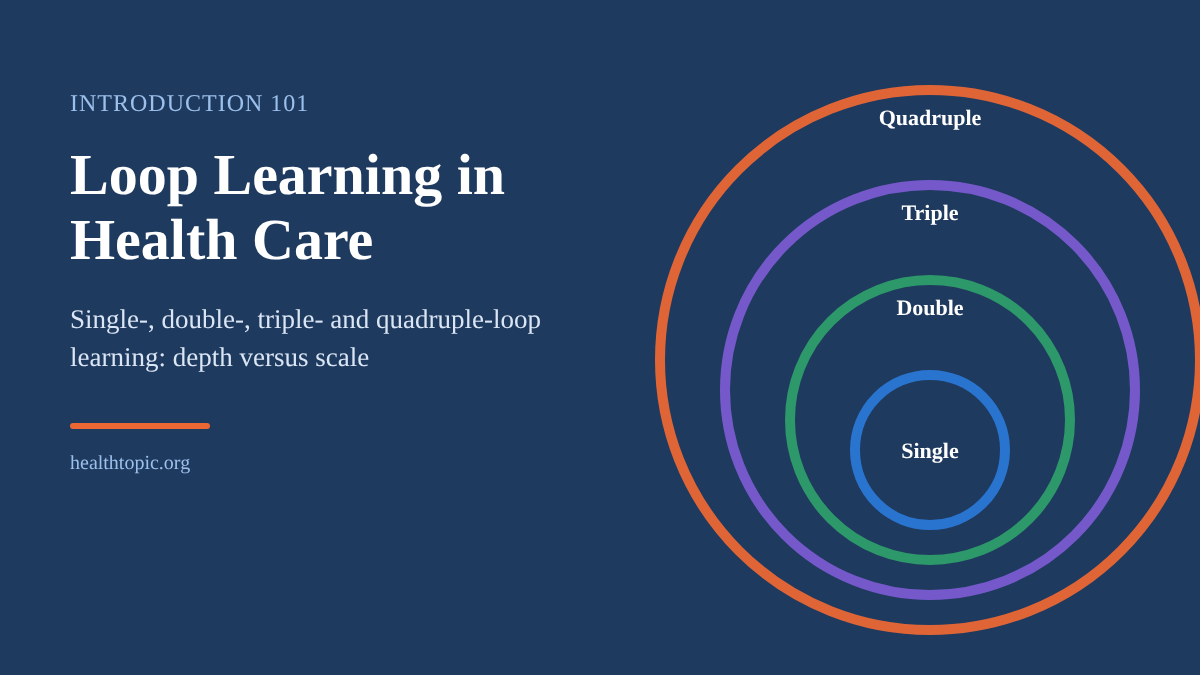
Health care organisations are told to “learn from error”, but learning comes in different depths. This text explains single-loop, double-loop, triple-loop and quadruple-loop learning, traces where each idea comes from, shows how health services research uses them, and proposes a simple way to keep the concepts apart: separating the depth of learning from the scale at which it happens.
Evidence base: 38 Web of Science records on loop learning in health care, read in full abstract, together with the canonical works of organisational learning theory. Reading time: about 35 minutes. Prior knowledge required: none.
Learning objectives
After working through this text, the reader should be able to:
- define single-loop and double-loop learning and explain the role of governing variables;
- trace the different origins of the term triple-loop learning and recognise which meaning a given study uses;
- explain quadruple-loop learning as learning that crosses personal, local, national and international levels;
- distinguish the depth of learning from the scale of the learning unit;
- diagnose which loop a patient safety or quality improvement activity actually reaches.
Key concepts
- Single-loop learning: detecting and correcting errors so that actions match existing goals, norms and rules
- Double-loop learning: questioning and changing the governing variables (goals, norms, assumptions) behind those actions
- Triple-loop learning: changing how an organisation learns, or the values, identity and power relations that frame its goals; the meaning varies by author
- Deutero-learning: learning about the context and process of learning itself (Bateson’s “learning to learn”)
- Quadruple-loop learning: learning that travels from the individual through the local unit to national and international levels
- Governing variables: the values and assumptions that an actor tries to keep within acceptable limits
- Learning health system: a health system that routinely turns experience and data into improvement at all levels
Contents: How this text was produced · 1. Introduction · 2. Origins of the loop metaphor · 3. Single-loop learning · 4. Double-loop learning · 5. Triple-loop learning · 6. Quadruple-loop and system learning · 7. Depth and scale: an integrative framework · 8. Moving between loops · 9. Debates and conceptual problems · 10. The situation in Türkiye · 11. Implications for practice · Summary · Discussion questions · Further reading · Glossary · References · Source verification and AI use statement
How this text was produced
Box 1. Method
Database: Web of Science Core Collection. Search: three blocks combined as (#1 OR #3) AND #2, where #1 names the loops explicitly (single, double, triple and quadruple loop learning, with hyphenated and ordinal variants), #2 sets the health care context (health care, hospital, primary care, patient safety, clinical governance, clinical incidents and related terms) and #3 captures learning levels without the word loop (deutero-learning, first to fourth order learning, learning how to learn and meta-learning near organisational learning or patient safety). All fields searched with TS=; no year, language or document type limits.
Screening: the search returned 46 records. Eight were excluded after reading the abstracts because they were not about organisational learning in health care (Figure 1). The remaining 38 records were read for how each defines and uses the loops. No bibliometric analysis was performed; the records serve as conceptual evidence.
Limitations: single database; abstracts rather than full texts; the canonical theory is taken from the original books and articles cited in the reference list.
(#1 OR #3) AND #246 records
organisational, team or system learning in health care
tourism and hospitality education (the wildcard hospital* also matches “hospitality”); elite sport leadership; construction industry feedback; individual nurse on-the-job learning; patient learning from tablets; general soft systems methodology review; business process modelling; individual e-mentoring design
1. Introduction
When a patient receives the wrong unit of blood, a hospital can respond in very different ways. It can reprimand the nurse and remind staff of the checking procedure. It can ask why a procedure that depends on human vigilance under time pressure was considered safe in the first place. It can ask why its own way of handling errors produces reminders rather than redesign. And it can pass what it has learned to national bodies so that every hospital changes. Each of these responses is a form of learning, but they are not the same learning. Organisational learning theory names them with a family of terms: single-loop, double-loop, triple-loop and, in the patient safety literature, quadruple-loop learning.
These terms matter in health care for a practical reason. Health systems have invested heavily in incident reporting, root cause analysis, morbidity and mortality conferences, audits and accreditation. The repeated finding is that these mechanisms produce local fixes far more often than changes in the assumptions and structures that generate errors. A systematic review of incident reporting systems found some evidence of single-loop learning but insubstantial evidence of double-loop learning, that is, of cultural change or change in mind-set (Stavropoulou et al., 2015). The language of loops gives managers and researchers a way to say precisely what kind of learning is missing.
The same language is also a source of confusion. “Double-loop” is used both for a change in governing assumptions and, loosely, for any improvement that feels deep. “Triple-loop” has at least three separate meanings in the management literature (Tosey et al., 2012), and health care studies use all of them, sometimes without saying which. “Quadruple-loop” refers to levels of the health system rather than to a further step in depth (Runciman et al., 2006). This text sets out each concept, shows how health services research applies it, and proposes a two-axis framework that keeps depth and scale apart.
2. Origins of the loop metaphor
2.1 Cybernetics and Bateson’s levels of learning
The loop is a cybernetic image. A thermostat detects a deviation from a set temperature and acts to remove it; this is a feedback loop. Ashby (1952) described adaptive systems with two feedback loops: a fast one that corrects behaviour within given limits and a slower one that changes the parameters of the first when the system keeps failing. Argyris and Schön later took this two-loop architecture as the template for single-loop and double-loop learning (Argyris & Schön, 1978).
The anthropologist Gregory Bateson (1972) proposed a hierarchy of learning levels. Learning 0 is a fixed response; Learning I is change in the response within a set of alternatives (classical conditioning, trial and error); Learning II is change in the set of alternatives itself, which Bateson also called deutero-learning, learning to learn; Learning III is change in the system of sets, a rare and sometimes destabilising reorganisation of the self; Learning IV would be change in Learning III and was, for Bateson, probably beyond any living organism. This ladder is the second root of the loop vocabulary, and much later confusion comes from mapping Bateson’s levels onto Argyris and Schön’s loops in different ways (Tosey et al., 2012; Visser, 2007).
(deutero)Change in the set of alternatives from which a response is chosen; learning about the context of learning, “learning to learn”. Argyris and Schön use deutero-learning for an organisation learning how to carry out single- and double-loop learning.
2.2 Argyris and Schön: theories of action
Chris Argyris and Donald Schön built their account of organisational learning on the idea of a theory of action. Every actor, individual or organisational, holds an espoused theory, the account given when asked why one acts as one does, and a theory-in-use, the theory that can actually be inferred from behaviour (Argyris & Schön, 1974). The two often diverge: a hospital may espouse a just culture while its theory-in-use, visible in how managers react to incident reports, is to find the person responsible.
A theory-in-use contains governing variables, such as goals, values, norms and assumptions that the actor tries to keep within acceptable limits, action strategies chosen to keep them there, and consequences. Learning occurs when a mismatch between intended and actual consequences is detected and corrected. If the correction changes only the action strategy, leaving the governing variables untouched, the learning is single-loop. If the governing variables themselves are questioned and changed, the learning is double-loop (Argyris, 1977; Argyris & Schön, 1978). Figure 3 shows the two loops.
Argyris and Schön argued that most organisations are good at single-loop learning and poor at double-loop learning, because the theories-in-use of their members follow what they called Model I: achieve the purpose as I define it, win and do not lose, suppress negative feelings, and be rational. Model I produces defensive routines, actions that protect people from embarrassment or threat but also prevent them from identifying the causes of the embarrassment or threat (Argyris, 1990). Double-loop learning requires Model II, whose governing values are valid information, free and informed choice, and internal commitment to the choice (Table 1).
| Feature | Model I (inhibits double-loop learning) | Model II (enables double-loop learning) |
|---|---|---|
| Governing values | Define and achieve my goal; win, do not lose; suppress negative feelings; appear rational | Valid information; free and informed choice; internal commitment |
| Typical strategies | Control the task unilaterally; protect self and others; keep assumptions private | Share control; make reasoning explicit and testable; invite inquiry into one’s own views |
| Consequences | Defensive routines, self-sealing processes, little public testing of ideas | Minimal defensiveness, testable claims, more effective problem solving |
| In a ward after an adverse event | Senior staff decide what happened; the conversation focuses on who failed; doubts about workload or design are not voiced | The team pools observations, states hypotheses about system causes, and agrees what evidence would test them |
Source: governing values and strategies from Argyris and Schön (1974) and Argyris (1990); health care illustrations by the author.
Argyris and Schön also used Bateson’s term deutero-learning for an organisation that learns how to learn, that is, inquires into its own previous episodes of single- and double-loop learning to discover what facilitated or inhibited them (Argyris & Schön, 1978). Senge’s (1990) “learning organisation” popularised the vocabulary for managers, and Schön’s (1983) work on the reflective practitioner made reflection in and on action a standard idea in the health professions.
2.3 Levels of learners and depths of learning
A second distinction runs through the literature: who learns. Crossan et al. (1999) described organisational learning as a movement across individual, group and organisational levels through intuiting, interpreting, integrating and institutionalising. Health care writers make the same point. Rushmer et al. (2004) distinguish individual, collective and organisational learning in general practice and argue that individual and collective learning are easier to achieve because systems for personal development already exist. Mikkelsen and Holm (2007) argue that most formal learning in health care happens at the individual level at the start of a career, while errors arise in teams and organisations. This distinction between the level of the learner and the depth of learning is the key to the framework in Section 7.
3. Single-loop learning in health care
3.1 What it looks like
Single-loop learning detects and corrects errors so that actions conform to existing goals and rules. In health care it is everywhere: a missing signature is added, a staff member is retrained, a checklist item is added, an alarm threshold is adjusted, a patient is called back. Nutley and Davies (2001) describe this as the adaptive use of knowledge that helps organisations achieve incremental improvement to existing practice, and note that the NHS had emphasised codified knowledge such as guidelines and National Service Frameworks, which supports adaptive learning well.
Single-loop learning is not a failure in itself. Standardisation is one of the main safety strategies in health care, and a hospital that cannot reliably correct deviations from its protocols is unsafe. A study of balanced scorecard implementation in a 290-bed community hospital found that single-loop learning improved the efficiency of strategic management and strengthened existing routines, but could not develop new capabilities, partly because employees lacked the authority to change the rules they followed (Li et al., 2021). The study also describes single-loop learning flowing downward from vision and goals while double-loop learning moves upward from sub-units, a useful picture of how the two loops can coexist.
3.2 Quick fixing and workarounds
The characteristic weakness of single-loop learning in hospitals is the quick fix. A grounded theory study of hospital process improvement identified five improvement behaviours: Quick Fixing, Initiating, Conforming, Expediting and Enhancing (Mazur et al., 2012). Only the last clearly changes the system; the others restore work locally. Tucker and Edmondson (2003) showed the same pattern in nursing: when supplies, information or equipment failed, nurses solved the problem for the patient in front of them and moved on, so the organisation never learned of the failure. Figure 4 places these behaviours on a continuum from restoring work to changing the system.
3.3 The pathological side: vulnerable system syndrome
Reason et al. (2001) identified a cluster of organisational pathologies, the vulnerable system syndrome, that makes some systems more liable to adverse events. It has three interacting and self-perpetuating elements: blaming front-line individuals, denying the existence of systemic error-provoking weaknesses, and the blinkered pursuit of productive and financial indicators. They argue that single-loop learning fuels and sustains the syndrome, while double-loop learning is needed to break free from it. Figure 5 shows why: each element keeps attention on the action level and away from the governing variables.
A study of anaesthesia departments makes a similar diagnosis: experience from other industries shows that learning strategies tend to focus on single-loop learning, with relatively little double-loop learning and virtually no meta-learning, and medicine has largely ignored learning theory (Schüpfer et al., 2007).
4. Double-loop learning in health care
4.1 Changing mental models
Double-loop learning in health care means questioning the assumptions behind practice: that errors are individual failings, that the physician’s view defines the problem, that a care pathway belongs to one department, that throughput and safety trade off. The clearest empirical illustration in the corpus is a study of Førde Hospital in Norway, which redesigned the elective surgery pathway and achieved a sustained reduction in cancellations (Hovlid et al., 2012). Clinicians and leaders shared information about their daily work and related it to the whole pathway, developing a deeper understanding of how the parts of the clinical system depend on each other. The authors interpret this change in mental models as double-loop learning and argue that because deeper system properties changed, the improvement was more likely to be sustained.
Other studies show the same link between double-loop learning and sustainability. In aesthetic surgery practices, sustained hypothermia prevention was associated with a continuous improvement culture in which double-loop learning, problem solving, error management and organisational routines were key elements (Adams et al., 2011). Nurses who engaged in double-loop learning reconceptualised care rather than merely perpetuating existing patterns of care delivery (Clarke & Wilcockson, 2001). Implementing value-based health care in a Swedish university hospital produced both single-loop and double-loop learning, with explicit top management decisions helping and the team leaders’ lack of a management mandate obstructing the process (Nilsson et al., 2018). In a Swedish region, a multilevel action learning approach to continuous improvement required double-loop learning in systems understanding, strategic focus, methods and change process knowledge (Nyström et al., 2018).
4.2 Incident reporting: the double-loop promise and its limits
Incident reporting systems are the most visible learning mechanism in patient safety, and the loop vocabulary has been used to evaluate them. Stavropoulou et al. (2015) reviewed 43 studies and found some evidence of single-loop learning, such as changes to clinical settings and processes, but little evidence of improved outcomes or of change in the latent managerial factors behind errors, and insubstantial evidence of double-loop learning. They concluded that systems could be more effective if the criteria for what counts as an incident were explicit, if clinical teams rather than central departments owned them, and if they were part of wider safety programmes.
A process view helps locate where learning breaks down. In a qualitative study of 40 clinicians in high- and low-performing hospitals, the major barriers were found not before or during reporting but in the post-reporting stages, and they were social rather than technical; without local managers’ engagement in integrating changes into practice, active learning took place in neither hospital (Tabrizi & Masri, 2021). When a system is deliberately redesigned around feedback and workplace improvement, results can be better: a redesigned reporting system in a 624-bed Singapore nursing home, built explicitly for double-loop learning, improved nurses’ knowledge, confidence and awareness of safety issues (Goh et al., 2021). French experience feedback committees (CREX) offer a structured local loop: a multiprofessional committee meets monthly, chooses a priority incident, assigns a pilot to investigate it with a systemic method, and follows the agreed actions (François et al., 2013). Figure 6 summarises where each loop can occur in the reporting cycle.
4.3 Team-level reflexive mechanisms
Much double-loop learning in health care is designed to happen in teams. Four mechanisms recur in the literature (Figure 7). Morbidity and mortality conferences that recognise system-wide trends and treat errors as organisational problems showed evidence of double-loop learning and used organisational memory strategies to retain knowledge (Batthish et al., 2024). Briefing and debriefing sessions adapted from the Israel Air Force for surgical teams aimed at double-loop learning by stressing status-free transparency and systems-based analysis (Vashdi et al., 2007). Simulation programmes must support both single-loop and double-loop learning experiences; the SimZones model sorts simulations from solitary practice to authentic native teams working on team and system development, and carries debriefing into real care (Roussin & Weinstock, 2017). Cross-functional operating room scheduling teams that set common goals, used performance indicators and practised single-loop and double-loop learning improved continuity of care (Bitter et al., 2013).
4.4 Transferring, translating and implementing knowledge
Double-loop learning also appears in the literature on moving knowledge between settings. A conceptual framework on best practice transfer between health care facilities proposes that double-loop learning suits copying and transferring best practice, while deutero-learning suits translating it into a new context; the more complex the organisation, the more tacit the practice and the more learning capability is required (Guzman et al., 2015). In implementation science, the PRIDI cycle places a rapid inner implementation loop inside outer loops of emerging goals, interventions, evidence and context, so that stakeholders reconsider plans as the landscape changes, a structure the authors explicitly base on double-loop learning (Nooraie et al., 2021). Communities of practice in Ontario’s seniors’ health system often developed a double-loop learning process suited to adaptive challenges and wicked problems, leading the authors to propose “action-to-knowledge” alongside knowledge-to-action (Conklin et al., 2024).
4.5 Why double-loop learning is hard
The corpus repeatedly points to the same barriers: hierarchy and professional boundaries, managers who do not engage after reporting, lack of authority to change rules, and a culture of blame (Li et al., 2021; Reason et al., 2001; Tabrizi & Masri, 2021). These are exactly the conditions Argyris described under Model I. Edmondson’s (1999) concept of team psychological safety, a shared belief that the team is safe for interpersonal risk taking, explains why: questioning governing variables exposes the person who asks. A clinician primer on learning organisations notes that the concept has a poor empirical basis but still offers a useful diagnostic framework, and identifies clinical practice improvement and root cause analysis programmes as meeting the criteria for organisational learning (O’Connor & Kotze, 2008).
5. Triple-loop learning: one label, several meanings
5.1 Three genealogies
Argyris and Schön did not use the term triple-loop learning. It was introduced later by several authors who meant different things by it. Tosey et al. (2012) reviewed these origins and found no single, coherent concept. Three main lines can be distinguished (Figure 8).
Learning to learn. Swieringa and Wierdsma (1992) describe single-loop learning as changing rules, double-loop learning as changing insights, and triple-loop learning as changing the essential principles on which an organisation is founded; Romme and van Witteloostuijn (1999) link triple-loop learning to the collective awareness of how the organisation learns. This line often treats triple-loop learning as equivalent to deutero-learning. Visser (2007) argues that this equation misreads Bateson: deutero-learning in Bateson’s sense is a tacit learning about the context of learning that accompanies all learning, not a third, higher step.
Purpose and identity. Torbert’s action inquiry and Snell and Chak (1998) associate triple-loop learning with transformation of the actor’s frame, values and sense of purpose, and with awareness in the moment of how one’s attention, strategy and outcomes fit together.
Power and legitimacy. Flood and Romm (1996) define triple-loop learning in terms of diversity management: alongside “are we doing things right?” and “are we doing the right things?” it asks whether rightness is buttressed by might, and might by rightness. It is about whose knowledge counts and who decides.
5.2 How health care studies use triple-loop learning
All three meanings appear in the health care corpus, as do two further uses (Table 2).
| Study | Setting | What “triple loop” means | Genealogy |
|---|---|---|---|
| Mikkelsen & Holm, 2007 | Clinical microsystems, patient safety | Meta-learning: extending understanding of how to learn individually and in groups | Learning to learn |
| Rushmer et al., 2004 | General practice as a learning practice | Routines that make learning an integral part of what the practice does | Learning to learn |
| Brennan & Abimbola, 2024 | WHO after and intra action reviews | “Are we learning right?” | Learning to learn |
| Nordin et al., 2017 | Value-based measurement in diabetes care | Questioning care processes and incorporating stakeholder value into the organisation’s strategy | Purpose and identity |
| Athul et al., 2026 | Medical physiology textbooks | Transforming the cultural and institutional contexts that sustain exclusion | Purpose and identity, power |
| Moore, 2007; Kwon et al., 2025 | Work-based learning; health systems science curricula | Inclusion of historically excluded voices (patients, nurses, social workers) and structural accountability | Power and legitimacy |
| François et al., 2013 | Experience feedback committees | Three levels of reporting systems: medical unit, hospital, country | Scale, not depth |
| Millimouno et al., 2023; Donohoe, 2023 | Guinea outbreak response; reflective practice environments | Highest level of a learning framework, used with single and double loop | Usually learning to learn |
Source: produced by the author from the abstracts of the cited studies.
Two observations follow. First, health care authors rarely state which genealogy they follow, so the same label can describe a new learning routine in a general practice, a change in professional identity and the inclusion of patients in curriculum design. Second, at least one study uses “triple loop” to mean three organisational levels (unit, hospital, country), which is a statement about scale rather than depth (François et al., 2013). Rowe and Boyce (2009) show that deutero-learning can also be negative: in one allied health case under the classical medical model, pathological deutero-learning produced a fractured, self-absorbed work culture, while a second case with integrated decentralisation produced positive deutero-learning. Learning to learn is not automatically good; organisations can also learn not to learn.
5.3 Making learning itself a practice
Several studies try to institutionalise higher-order learning. The learning practice model asks general practices to establish routines covering single-, double- and triple-loop learning and notes that there are few processes for spreading a practice’s learning to the wider health service (Rushmer et al., 2004). Mikkelsen and Holm (2007) describe a systematic team learning process after a transfusion error that links professional knowledge with improvement knowledge. Donohoe (2023) proposes a reflective organisational learning framework for building reflective practice environments after the COVID-19 pandemic through single, double and triple-loop learning. Nutley and Davies (2001) argued early that the NHS needed to move beyond adaptive learning towards generative learning and meta-learning, which would require attention to cultural values and structural mechanisms.
6. Quadruple-loop learning and learning beyond the organisation
6.1 Runciman’s four loops
The patient safety literature added a fourth loop with a different logic. In proposing an integrated framework for safety, quality and risk management based on a universal patient safety classification, Runciman et al. (2006) argued that any incident management system is valueless unless it improves safety, and proposed quadruple-loop learning at personal, local, national and international levels. The loops here are nested scales: what an individual learns should feed the unit’s learning, which should feed national guidance, which should feed international standards through bodies such as the World Health Organization (Figure 9).
This idea is closely related to responsive regulation. Healy and Braithwaite (2006) argue for regulation that escalates from persuasion and self-regulation to stronger sanctions only when needed, and in which regulators learn from the experience of the organisations they oversee. When an accreditation body or a ministry changes its standards because hospitals’ incident data reveal a recurring hazard, the system as a whole has learned. The World Health Organization’s Global Patient Safety Action Plan 2021 to 2030 turns this into a policy aim by asking countries to build learning systems that share information and lessons at every level (World Health Organization, 2021).
6.2 Learning health systems
Since around 2020 the loop vocabulary has been absorbed into the learning health systems framework, particularly in global health. Sheikh and Abimbola (2021) describe health system learning along three dimensions: the level at which learning happens (individual, organisational, system), the loop of learning (single, double, triple), and the means of learning (through information, deliberation and action). Several studies in the corpus apply this framework directly (Figure 10).
The findings are consistent. Guinea’s health system learned from outbreaks between 2014 and 2021 through information, deliberation and action, and the lessons were incorporated through single-, double- and triple-loop learning, but the advanced forms (learning through action, double-loop and triple-loop) remained limited (Millimouno et al., 2023). Paired WHO after action and intra action reviews showed single-loop learning in all reports, often embedded within double-loop learning, and triple-loop learning in after action reviews but less in intra action reviews; participants, focus, follow-through time and system pressure shaped which loop occurred (Brennan & Abimbola, 2024). In KwaZulu-Natal, scaling up integrated mental health case finding produced mainly individual-level, single-loop learning, through information sharing and deliberation at participatory workshops (van Rensburg et al., 2024). In Mozambique, mortality data supported emerging double-loop learning at the central ministry, through reprioritisation and resource reallocation, but mainly single-loop learning at subnational level; centralised budgets and decision-making limited local autonomy and new ways of learning (Magaço et al., 2026).
6.3 Crisis, resilience and national learning
The COVID-19 pandemic made system learning a public question. A content analysis of government media releases in New South Wales and Ontario found that resilience was framed mainly reactively and identified a need to capitalise on opportunities for double-loop learning suited to complex systems (Smaggus et al., 2022). The rural China Health XI project offers a pre-pandemic contrast: a hybrid of top-down supervision and bottom-up adaptation helped counties that at first struggled to take initiative eventually change their mind-sets and develop double-loop learning capabilities beyond the project’s objectives (van de Klundert et al., 2020). National learning, in other words, needs both central structures and local discretion.
7. Depth and scale: an integrative framework
The material above suggests that the loop vocabulary mixes two dimensions. One is depth: what is changed by learning, from actions, to governing variables, to the way learning itself happens and the values and power relations that frame it. The other is scale: who learns, from an individual or team, to an organisation, to a national system, to the international community. Argyris and Schön’s two loops, and the three genealogies of the third loop, are mostly about depth. Runciman’s four loops, François’s three levels and the “levels” dimension of learning health systems are about scale. Treating them as one ladder causes the confusion seen in Table 2.
Figure 11 crosses the two dimensions and places examples from the corpus in the cells. The figure is interpretive: placements are based on how each study describes its main finding, and many studies touch more than one cell.
The framework has three uses. It forces a study or a manager to state two things rather than one: how deep a change is and at what level it happens. It shows that “quadruple-loop” and “triple-loop” in the sense of François et al. (2013) belong on the horizontal axis, so a national guideline change can be single-loop (a new procedure) or double-loop (a new assumption). And it shows where evidence is thin: deep learning at system and international level is mostly proposed rather than observed.
7.1 A worked example
Figure 12 applies the framework to a single type of event: the transfusion of an unmatched blood unit, the case with which Mikkelsen and Holm (2007) open their paper. The responses at each loop are illustrative.
8. Moving between loops
If deeper loops are desirable, what moves an organisation from one to the next? The studies converge on a small set of conditions (Figure 13).
Safety to speak. Without psychological safety, mismatches are not reported and governing variables are not questioned (Edmondson, 1999; Vashdi et al., 2007). Ownership and feedback. Reporting systems owned by clinical teams and embedded in wider programmes are more likely to produce learning (Stavropoulou et al., 2015); learning stalls after reporting when managers do not act (Tabrizi & Masri, 2021). Authority. People cannot double-loop learn about rules they have no power to change (Li et al., 2021); centralised budgets and decisions limit local learning (Magaço et al., 2026). A system view. Seeing the whole pathway changes mental models (Hovlid et al., 2012). Inclusion. Triple-loop learning in the power sense requires bringing in patients and staff in sentinel roles (Kwon et al., 2025). Structure and leadership. Organisational structure shapes whether deutero-learning is positive or pathological (Rowe & Boyce, 2009), and county leadership was essential to align top-down and bottom-up processes in rural China (van de Klundert et al., 2020).
9. Debates and conceptual problems
Conceptual inflation. “Double-loop” has become a label of approval. Many papers state that an intervention “facilitates double-loop learning” without showing which governing variable changed. A strict reading of Argyris and Schön asks for evidence that a goal, norm or assumption was revised, not only that a process improved. The incident reporting review shows how rarely such evidence is found (Stavropoulou et al., 2015). The concept also travels into adjacent problems, such as physician burnout, where it serves as a heuristic for proposing organisational rather than individual remedies (Tanios et al., 2022).
Which third loop? Because triple-loop learning has several genealogies (Tosey et al., 2012), studies cannot be compared unless they state their definition. Equating it with deutero-learning is contested (Visser, 2007). Health care authors should state whether they mean learning to learn, transformation of purpose and identity, or the politics of whose knowledge counts.
Depth or scale? Quadruple-loop learning (Runciman et al., 2006) and level-based uses of triple-loop learning (François et al., 2013) describe scale. Mixing these with depth-based definitions implies, wrongly, that a national alert is automatically deeper than a ward-level redesign. The framework in Section 7 is one way to avoid this.
Is deeper always better? Single-loop learning maintains reliable standard work, which is central to safety. Constant questioning of governing variables would be destabilising in a resuscitation room. The question is less “how deep?” than “is the depth of learning matched to the problem?” Repeated recurrence of the same incident is a signal that single-loop correction is no longer enough.
Measurement. Few studies measure loops directly. Most infer the loop from interviews or documents, and the corpus is dominated by qualitative case studies and conceptual papers. Indicators such as the share of incident actions that change design rather than retrain staff, or the number of standards revised following aggregated reports, could make the loops observable.
Learning that is not good. Organisations can learn to avoid learning. Pathological deutero-learning (Rowe & Boyce, 2009) and the vulnerable system syndrome (Reason et al., 2001) show that the same mechanisms that build learning capacity can entrench defensive routines.
10. The situation in Türkiye
None of the 38 records concerns Türkiye, so the following is an application of the framework rather than a summary of evidence. The Ministry of Health’s quality standards for hospitals (Sağlıkta Kalite Standartları, SKS) require hospitals to operate an incident reporting system, analyse reported events and near misses, and take improvement actions (Sağlık Bakanlığı, 2020). In loop terms, the standards secure the conditions for single-loop learning at hospital level and, through the requirement for root cause analysis and improvement, create an opening for double-loop learning. The national dimension of Runciman’s quadruple loop depends on whether data aggregated by the Ministry lead back to revised standards, alerts and guidance, and whether hospitals can see that their reports changed something. The centralised structure of the Turkish system resembles the settings in which national learning was strong but local discretion limited (Magaço et al., 2026; van de Klundert et al., 2020). Studies that trace a reported hazard from the ward to the standard and back would be a valuable contribution.
11. Implications for practice
For quality and patient safety units, the loop vocabulary is most useful as a set of diagnostic questions applied to each improvement action (Figure 14).
Practical steps follow from Section 8: give incident reporting to clinical teams with explicit criteria and fast feedback (Stavropoulou et al., 2015); make managers responsible for the post-reporting stage (Tabrizi & Masri, 2021); use morbidity and mortality conferences and debriefings to discuss system trends rather than individual fault (Batthish et al., 2024; Vashdi et al., 2007); periodically review the organisation’s own learning episodes, which is what Argyris and Schön meant by deutero-learning; and for regulators and accreditation bodies, show hospitals how their reports changed the standards, so that the quadruple loop is visible from the ward.
Summary
- Single-loop learning changes actions within existing goals and rules; double-loop learning changes the goals, norms and assumptions themselves.
- Health care is good at single-loop correction and weak at double-loop learning, mainly because of blame, hierarchy, lack of authority and weak follow-through after reporting.
- Triple-loop learning has at least three meanings: learning to learn, transformation of purpose and identity, and questioning power and legitimacy. Studies should say which one they use.
- Quadruple-loop learning describes scale (personal, local, national, international), not a fourth step of depth.
- Separating depth from scale clarifies the concepts and shows where evidence is thin: deep learning at system and international level.
Discussion questions
- Choose a recent incident in your organisation. Which loop did the response reach, and what would a response one loop deeper have looked like?
- Why might an incident reporting system produce single-loop learning only?
- Which meaning of triple-loop learning is most useful for health care management, and why?
- Is quadruple-loop learning a deeper form of learning or a wider one? Defend your answer.
- What indicators could show that a hospital has learned in the double loop?
Further reading
- (Argyris & Schön, 1978): the foundational account of single-loop, double-loop and deutero-learning.
- (Tosey et al., 2012): a critical review of where triple-loop learning comes from.
- (Reason et al., 2001): why single-loop learning sustains vulnerable systems.
- (Stavropoulou et al., 2015): what incident reporting systems do and do not achieve.
- (Runciman et al., 2006): the origin of quadruple-loop learning in patient safety.
- (Sheikh & Abimbola, 2021): learning health systems and their three dimensions.
Glossary
| Turkish | English | Short definition |
|---|---|---|
| Tek döngülü öğrenme | Single-loop learning | Correcting actions within existing goals and rules |
| Çift döngülü öğrenme | Double-loop learning | Changing the goals, norms and assumptions behind actions |
| Üç döngülü öğrenme | Triple-loop learning | Changing how learning happens, or its values and power relations |
| Dört döngülü öğrenme | Quadruple-loop learning | Learning across personal, local, national and international levels |
| Deutero-öğrenme | Deutero-learning | Learning about the process and context of learning |
| Yönetici değişkenler | Governing variables | Values and assumptions kept within acceptable limits |
| Savunulan kuram / Kullanımdaki kuram | Espoused theory / Theory-in-use | What we say guides action / what actually guides it |
| Savunmacı rutinler | Defensive routines | Actions that avoid threat but block learning |
| Öğrenen sağlık sistemi | Learning health system | A system that routinely turns experience into improvement |
References
Adams, E. S., Sobek, D. K., & Eaves, F. (2011). A Cross-Case Comparison of Hypothermia Prevention Methods and Continuous Improvement Culture Between Aesthetic Plastic Surgery Sites. Aesthetic Surgery Journal, 31(1), 122-134. https://doi.org/10.1177/1090820X10391211
Argyris, C. (1977). Double loop learning in organizations. Harvard Business Review, 55(5), 115-125.
Argyris, C. (1990). Overcoming organizational defenses: Facilitating organizational learning. Allyn and Bacon.
Argyris, C., & Schön, D. A. (1974). Theory in practice: Increasing professional effectiveness. Jossey-Bass.
Argyris, C., & Schön, D. A. (1978). Organizational learning: A theory of action perspective. Addison-Wesley.
Ashby, W. R. (1952). Design for a brain. Chapman and Hall.
Athul, K. M., Tripathi, S., Shakya, S., Chandra, A., & Singh, S. (2026). Bias in the basics: a multiloop framework for auditing foundational medical texts through an equity lens. Advances in Physiology Education, 50(1), 101-105. https://doi.org/10.1152/advan.00152.2025
Bateson, G. (1972). Steps to an ecology of mind. Chandler.
Batthish, M., Kuper, A., Fine, C., Laxer, R. M., & Baker, G. R. (2024). Organizational Learning in the Morbidity and Mortality Conference. Journal for Healthcare Quality, 46(2), 100-108. https://doi.org/10.1097/JHQ.0000000000000416
Bitter, J., van Veen-Berkx, E., Gooszen, H. G., & van Amelsvoort, P. (2013). Multidisciplinary teamwork is an important issue to healthcare professionals. Team Performance Management, 19(5-6), 263. https://doi.org/10.1108/TPM-11-2012-0041
Brennan, E., & Abimbola, S. (2024). A conceptual learning analysis of paired after action and intra action reviews for health emergencies. Learning Health Systems, 8(4). https://doi.org/10.1002/lrh2.10447
Clarke, C. I., & Wilcockson, J. (2001). Professional and organizational learning: analysing the relationship with the development of practice. Journal of Advanced Nursing, 34(2), 264-272. https://doi.org/10.1046/j.1365-2648.2001.01753.x
Conklin, J., Kothari, A., Stolee, P., Chambers, L., & Leclair, K. (2024). Moving Knowledge into Action Through Communities of Practice: Multiple Case Studies of Successful System Change to Improve the Health of Older Adults. SAGE Open, 14(2_SUPPL), Article 21582440241281644. https://doi.org/10.1177/21582440241281644
Crossan, M. M., Lane, H. W., & White, R. E. (1999). An organizational learning framework: From intuition to institution. Academy of Management Review, 24(3), 522-537. https://doi.org/10.5465/amr.1999.2202135
Donohoe, A. (2023). Reimagining reflective practice and reflective practice environments in a post pandemic world: A discussion paper. Reflective Practice, 24(4), 509-523. https://doi.org/10.1080/14623943.2023.2210074
Edmondson, A. (1999). Psychological safety and learning behavior in work teams. Administrative Science Quarterly, 44(2), 350-383. https://doi.org/10.2307/2666999
Flood, R. L., & Romm, N. R. A. (1996). Diversity management: Triple loop learning. Wiley.
François, P., Sellier, E., Imburchia, F., & Mallaret, M. R. (2013). Experience feedback committee: A method for patient safety improvement. Revue d’Épidémiologie et de Santé Publique, 61(2), 155-161. https://doi.org/10.1016/j.respe.2012.09.001
Goh, H. S., Tan, V., Chang, J., Lee, C. N., & Zhang, H. (2021). Implementing the Clinical Occurrence Reporting and Learning System A Double-Loop Learning Incident Reporting System in Long-term Care. Journal of Nursing Care Quality, 36(4), E63-E68. https://doi.org/10.1097/NCQ.0000000000000555
Guzman, G., Fitzgerald, J. A., Fulop, L., Hayes, K., Poropat, A., Avery, M., Campbell, S., Fisher, R., Gapp, R., Herington, C., McPhail, R., & Vecchio, N. (2015). How best practices are copied, transferred, or translated between health care facilities A conceptual framework. Health Care Management Review, 40(3), 193-202. https://doi.org/10.1097/HMR.0000000000000023
Healy, J., & Braithwaite, J. (2006). Designing safer health care through responsive regulation. Medical Journal of Australia, 184(S10), S56-S59. https://doi.org/10.5694/j.1326-5377.2006.tb00364.x
Hovlid, E., Bukve, O., Haug, K., Aslaksen, A. B., & von Plessen, C. (2012). Sustainability of healthcare improvement: what can we learn from learning theory? BMC Health Services Research, 12, Article 235. https://doi.org/10.1186/1472-6963-12-235
Kwon, C. K., Lee, A. S., An, S., & Brandt, M. C. (2025). Triple-loop learning as a framework for advancing health systems science in medical education: a transformational change approach. European Journal of Training and Development, 49(3/4), 330-345. https://doi.org/10.1108/EJTD-03-2024-0039
Li, C. H., Yang, W. G., & Shih, I. T. (2021). Exploration on the gap of single- and double-loop learning of balanced scorecard and organizational performance in a health organization. Heliyon, 7(12), Article e08553. https://doi.org/10.1016/j.heliyon.2021.e08553
Magaço, A., Tediosi, F., Mandomando, I., Winkler, M. S., Munguambe, K., & Muñoz, D. C. (2026). The value of mortality data to advance learning and decision-making dynamics in Mozambique’s health system. Archives of Public Health, 84(1), Article 243. https://doi.org/10.1186/s13690-026-02044-5
Mazur, L. M., McCreery, J. K., & Chen, S. J. (2012). Quality Improvement in Hospitals: Identifying and Understanding Behaviors. Journal of Healthcare Engineering, 3(4), 621-647. https://doi.org/10.1260/2040-2295.3.4.621
Mikkelsen, J., & Holm, H. A. (2007). Contextual Learning to Improve Health Care and Patient Safety. Education for Health, 20(3), 124.
Millimouno, T. M., Meessen, B., van de Put, W., Garcia, M., Camara, B. S., Christou, A., Delvaux, T., Sidibé, S., Beavogui, A. H., & Delamou, A. (2023). How has Guinea learnt from the response to outbreaks? A learning health system analysis. BMJ Global Health, 8(2), Article e010996. https://doi.org/10.1136/bmjgh-2022-010996
Moore, L. J. (2007). Ethical and organisational tensions for work-based learners. Journal of Workplace Learning, 19(3), 161. https://doi.org/10.1108/13665620710735639
Nilsson, K., Bååthe, F., Andersson, A. E., & Sandoff, M. (2018). The need to succeed – learning experiences resulting from the implementation of value-based healthcare. Leadership in Health Services, 31(1), 2-16. https://doi.org/10.1108/LHS-08-2016-0039
Nooraie, R. Y., Shelton, R. C., Fiscella, K., Kwan, B. M., & McMahon, J. M. (2021). The pragmatic, rapid, and iterative dissemination and implementation (PRIDI) cycle: adapting to the dynamic nature of public health emergencies (and beyond). Health Research Policy and Systems, 19(1), Article 110. https://doi.org/10.1186/s12961-021-00764-4
Nordin, P., Kork, A. A., & Koskela, I. (2017). Value-based healthcare measurement as a context for organizational learning Adding a strategic edge to assess health outcome? Leadership in Health Services, 30(2), 159-170. https://doi.org/10.1108/LHS-10-2016-0053
Nutley, S. M., & Davies, H. T. O. (2001). Developing organizational learning in the NHS. Medical Education, 35(1), 35-42. https://doi.org/10.1046/j.1365-2923.2001.00834.x
Nyström, M. E., Höög, E., Garvare, R., Bäck, M. A., Terris, D. D., & Hansson, J. (2018). Exploring the potential of a multi-level approach to improve capability for continuous organizational improvement and learning in a Swedish healthcare region. BMC Health Services Research, 18, Article 376. https://doi.org/10.1186/s12913-018-3129-3
O’Connor, N., & Kotze, B. (2008). ‘Learning Organizations’: a clinician’s primer. Australasian Psychiatry, 16(3), 173-178. https://doi.org/10.1080/10398560801888639
Reason, J. T., Carthey, J., & de Leval, M. R. (2001). Diagnosing vulnerable system syndrome: an essential prerequisite to effective risk management. Quality in Health Care, 10(Suppl. 2), ii21-ii25.
Romme, A. G. L., & van Witteloostuijn, A. (1999). Circular organizing and triple loop learning. Journal of Organizational Change Management, 12(5), 439-454. https://doi.org/10.1108/09534819910289110
Roussin, C. J., & Weinstock, P. (2017). SimZones: An Organizational Innovation for Simulation Programs and Centers. Academic Medicine, 92(8), 1114-1120. https://doi.org/10.1097/ACM.0000000000001746
Rowe, P. A., & Boyce, R. A. (2009). Deutero-learning: implications for managing public health change. The Learning Organization, 16(4), 298. https://doi.org/10.1108/09696470910960392
Runciman, W. B., Williamson, J. A. H., Deakin, A., Benveniste, K. A., Bannon, K., & Hibbert, P. D. (2006). An integrated framework for safety, quality and risk management: an information and incident management system based on a universal patient safety classification. Quality & Safety in Health Care, 15(Suppl. 1), i82-i90. https://doi.org/10.1136/qshc.2005.017467
Rushmer, R., Kelly, D., Lough, M., Wilkinson, J. E., & Davies, H. T. O. (2004). Introducing the learning practice – II. Becoming a learning practice. Journal of Evaluation in Clinical Practice, 10(3), 387-398. https://doi.org/10.1111/j.1365-2753.2004.00465.x
Sağlık Bakanlığı. (2020). Sağlıkta kalite standartları: Hastane (Sürüm 6.1). Sağlık Hizmetleri Genel Müdürlüğü, Sağlıkta Kalite, Akreditasyon ve Çalışan Hakları Dairesi Başkanlığı.
Schön, D. A. (1983). The reflective practitioner: How professionals think in action. Basic Books.
Schüpfer, G., Gfrörer, R., & Schleppers, A. (2007). Anaesthetists learn -: do institutions also learn?: Importance of institutional learning and corporate culture in clinics. Anaesthesist, 56(10), 983-991. https://doi.org/10.1007/s00101-007-1265-y
Senge, P. M. (1990). The fifth discipline: The art and practice of the learning organization. Doubleday.
Sheikh, K., & Abimbola, S. (Eds.). (2021). Learning health systems: Pathways to progress. Flagship report of the Alliance for Health Policy and Systems Research. World Health Organization.
Smaggus, A., Long, J. E. C., Ellis, L. A., Clay-Williams, R., & Braithwaite, J. (2022). Government Actions and Their Relation to Resilience in Healthcare During the COVID-19 Pandemic in New South Wales, Australia and Ontario, Canada. International Journal of Health Policy and Management, 11(9), 1682-1694. https://doi.org/10.34172/ijhpm.2021.67
Snell, R., & Chak, A. M.-K. (1998). The learning organization: Learning and empowerment for whom? Management Learning, 29(3), 337-364. https://doi.org/10.1177/1350507698293005
Stavropoulou, C., Doherty, C., & Tosey, P. (2015). How Effective Are Incident-Reporting Systems for Improving Patient Safety? A Systematic Literature Review. Milbank Quarterly, 93(4), 826-866. https://doi.org/10.1111/1468-0009.12166
Swieringa, J., & Wierdsma, A. (1992). Becoming a learning organization: Beyond the learning curve. Addison-Wesley.
Tabrizi, N. M., & Masri, F. (2021). Towards safer healthcare: qualitative insights from a process view of organisational learning from failure. BMJ Open, 11(8), Article e048036. https://doi.org/10.1136/bmjopen-2020-048036
Tanios, M., Haberman, D., Bouchard, J., Motherwell, M., & Patel, J. (2022). Analyses of burn-out among medical professionals and suggested solutions-a narrative review. Journal of Hospital Management and Health Policy, 6, Article 7. https://doi.org/10.21037/jhmhp-20-153
Tosey, P., Visser, M., & Saunders, M. N. K. (2012). The origins and conceptualizations of ‘triple-loop’ learning: A critical review. Management Learning, 43(3), 291-307. https://doi.org/10.1177/1350507611426239
Tucker, A. L., & Edmondson, A. C. (2003). Why hospitals don’t learn from failures: Organizational and psychological dynamics that inhibit system change. California Management Review, 45(2), 55-72. https://doi.org/10.2307/41166165
van de Klundert, J., de Korne, D., Yuan, S. S., Wang, F., & van Wijngaarden, J. (2020). ‘Hybrid’ top down bottom up health system innovation in rural China: A qualitative analysis. PLOS One, 15(10), Article e0239307. https://doi.org/10.1371/journal.pone.0239307
van Rensburg, A. J., Hongo, N., Mthethwa, L., Grant, M., Kathree, T., Luvuno, Z., Leung, A., Bhana, A., Rao, D. P., & Petersen, I. (2024). A learning health systems approach to scaling up an evidence-based intervention for integrated primary mental healthcare case finding and referral in South Africa. BMJ Global Health, 9(10), Article e015165. https://doi.org/10.1136/bmjgh-2024-015165
Vashdi, D. R., Bamberger, P. A., Erez, M., & Weiss-Meilik, A. (2007). Briefing-debriefing: Using a reflexive organizational learning model from the military to enhance the performance of surgical teams. Human Resource Management, 46(1), 115-142. https://doi.org/10.1002/hrm.20148
Visser, M. (2007). Deutero-learning in organizations: A review and a reformulation. Academy of Management Review, 32(2), 659-667. https://doi.org/10.5465/amr.2007.24351883
World Health Organization. (2021). Global patient safety action plan 2021-2030: Towards eliminating avoidable harm in health care. World Health Organization.
Source verification and AI use statement
Source verification. References to the 38 health care studies were generated programmatically from their Web of Science records, so authors, year, title, journal and DOI match the records; every in-text citation was cross-checked by code against the reference list. Claims about these studies were checked against their abstracts; full texts were not read. Canonical works of organisational learning theory and policy documents were cited from their published editions.
AI use statement. Claude (Anthropic) was used to screen the Web of Science records, draft the text and produce the figures under the author’s instructions. The author is responsible for the final content.
Data. The list of the 38 included and 8 excluded records, with exclusion reasons, is available from the author on request.
Cite this page (APA 7)
Kurutkan, M. N. (2026, November 26). Single-, Double-, Triple- and Quadruple-Loop Learning in Health Care: Introduction 101. The Health Topics. https://healthtopic.org/topics/loop-learning-in-health-care-introduction-101/