
Quality measurement · Indicator sets · Retirement and incentive withdrawal · Scoping review
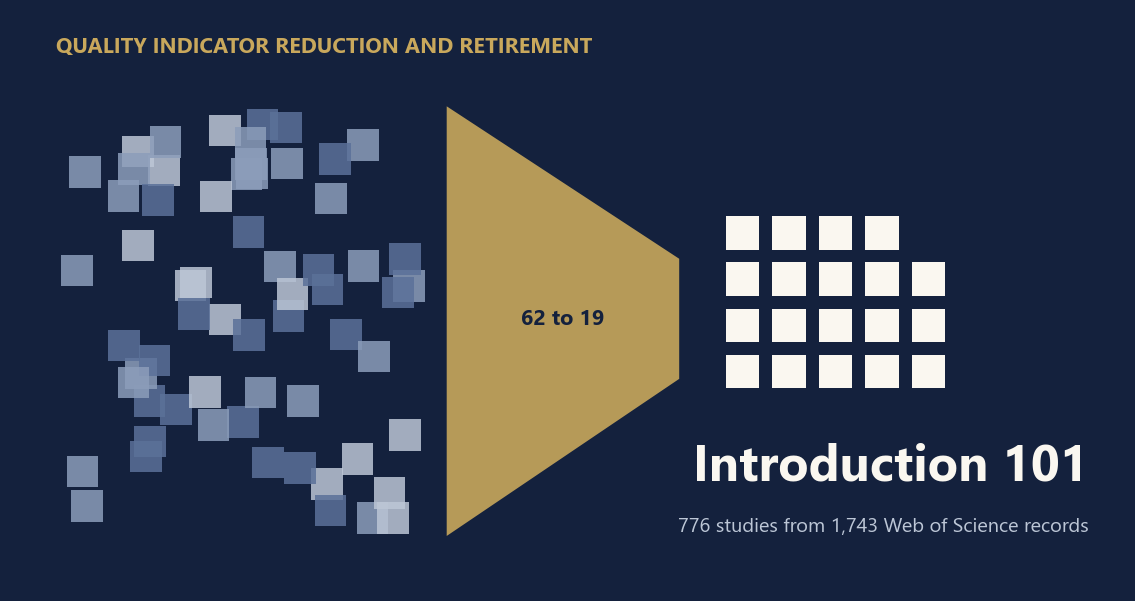
Health care organisations keep adding quality indicators and rarely take any away. Each quality indicator was added for a good reason, yet together they create measurement burden, overlap and noise. This chapter maps how existing indicators are selected into a core indicator set, consolidated, suspended and retired, and what happens to care afterwards.
What the chapter covers
- The evidence base: 776 studies coded from 1,743 Web of Science Core Collection records, with a reproducible search strategy.
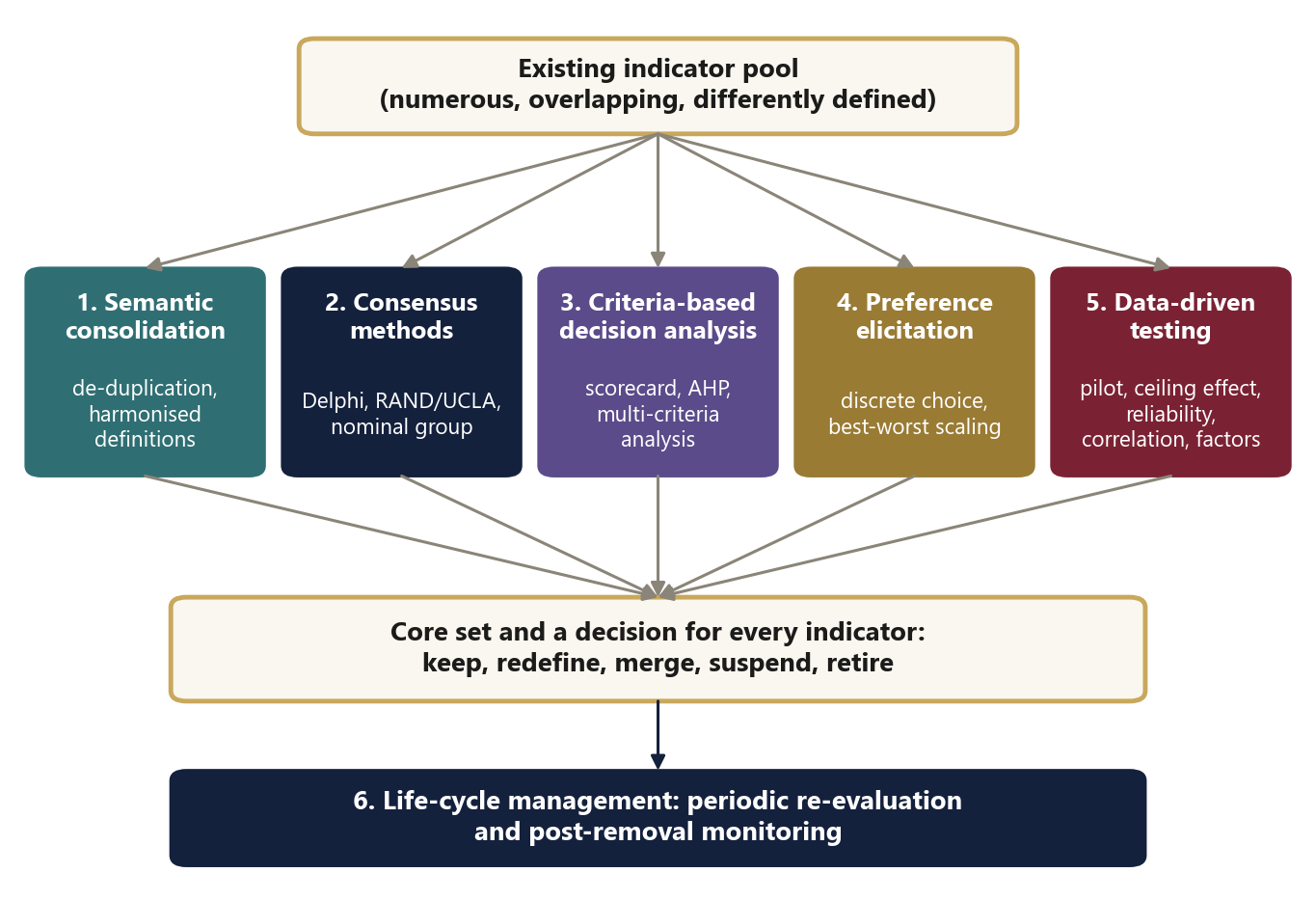
- Six families of techniques: semantic consolidation, consensus methods such as the Delphi method, criteria-based decision analysis, preference elicitation, data-driven testing and life-cycle management, with their strengths and weaknesses.
- How the tools are built step by step, and the design decisions each one requires.
- What reduction achieves: across 230 studies a selection process keeps a median of 33% of its candidates.
- Measure retirement and incentive withdrawal in pay for performance schemes: after removal, 7 studies report a decline in performance, 6 sustained performance and 3 mixed results.
- A seven-step reduction protocol for an organisation, discussion questions, a glossary and further reading.
Read the full chapter Explore the interactive atlas
Glossary: Quality indicator · Core indicator set · Measurement burden · Measure retirement
The coding of abstracts was AI-assisted and done by a single coder; details are in the source verification note of the chapter.
Cite this page (APA 7)
Kurutkan, M. N. (2026, November 27). Quality Indicator Reduction and Retirement: Introduction 101. The Health Topics. https://healthtopic.org/topics/quality-indicator-reduction-and-retirement-introduction-101/