
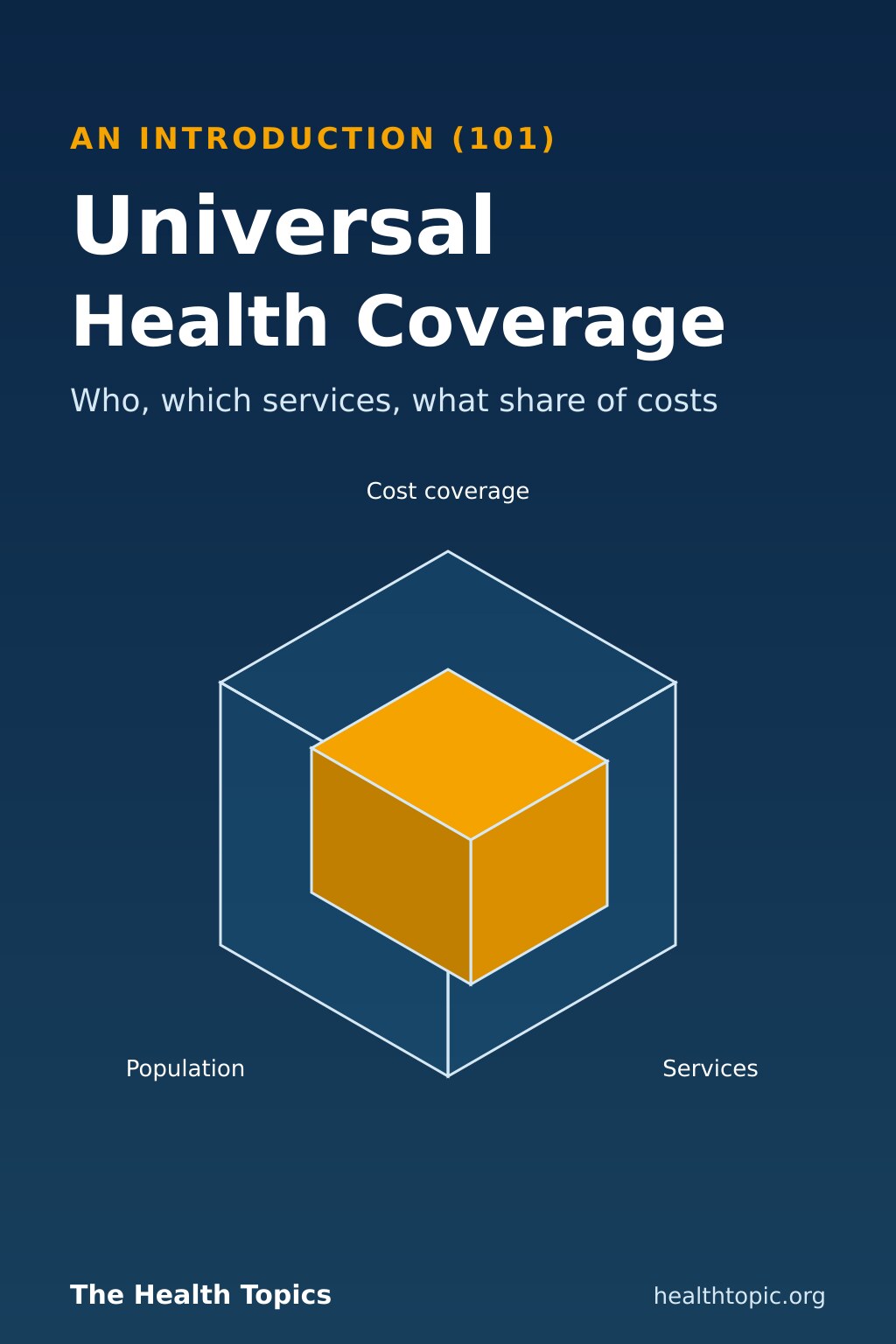
In brief: Universal health coverage (UHC) means that all people who need promotive, preventive, curative, rehabilitative and palliative services receive them without undue financial hardship (Boerma et al., 2014). Example: in Thailand, a reform that extended insurance to the whole population while changing how care was supplied reduced out-of-pocket spending by 28% on average and raised the use of inpatient and ambulatory care (Limwattananon et al., 2015). Yet enrolment is not coverage: across 42 lower- and middle-income countries, 13% of insured respondents had ineffective insurance, most often because they had to borrow or sell belongings to pay for care (El-Sayed et al., 2018).
Universal health coverage: an introduction (101)
This guide introduces universal health coverage for students and practitioners of health management, health policy and public health. It is built on 586 records (466 articles and 120 reviews) from the Web of Science Core Collection, published from 1991 to 2026, and every empirical statement is traced to one of them. It covers definitions and the UHC cube, measurement, financing and insurance routes, primary health care, equity, country experiences, the politics of reform, Türkiye and the main debates. Financial protection is treated in depth in the companion guide Catastrophic health expenditure: an introduction (101), so it is summarised here.
Try it yourself: Move the three axes of the UHC cube (who is covered, which services, what share of costs), choose the right indicator for everyday monitoring questions, and run a quick country check of the path to universal health coverage.
Open the interactive module: UHC Lab
Learning objectives
By the end of this guide you should be able to:
- Define UHC, its three coverage dimensions (population, services, costs) and its goals (equity, quality, financial protection).
- Distinguish UHC from universal health care, insurance coverage, financial protection, primary health care, health for all, social health protection and single-payer systems.
- Explain and critique the main measures, from the SDG indicators to effective coverage.
- Compare financing and insurance routes, separating positive, null and mixed findings.
- Analyse UHC reform as a political process and draft a monitoring roadmap.
Key concepts
- Universal health coverage. The desired outcome of health system performance in which everyone who needs services receives them, with good quality and without undue financial hardship (Boerma et al., 2014).
- The UHC cube. The World Health Organization (WHO) diagram whose axes are the services covered by pooled funds, the population covered and the proportion of costs covered (Roberts et al., 2015).
- Financial protection. Affordability of care for everyone, measured by unmet need and by impoverishing and catastrophic out-of-pocket spending (Thomson et al., 2024). SDG indicator 3.8.2 rests on catastrophic expenditure (Grépin et al., 2020): the share of the population whose household health spending exceeds 10% or 25% of total household expenditure or income.
- Service coverage index (SDG 3.8.1). A 0 to 100 summary of 16 tracer indicators of essential services (Hogan et al., 2018).
- Effective coverage. A performance measure that combines need, use and quality (Nguhiu et al., 2017).
- Pooling. Accumulating and managing prepaid funds so that risks are shared; reforms include compulsory coverage and merging pools (Mathauer et al., 2020).
- Strategic purchasing. Actively buying priority services through benefit specification, contracting, provider payment and performance monitoring (Cashin & Gatome-Munyua, 2022).
- Progressive universalism. Moving towards UHC while prioritising high-need groups, as advocated by the 2013 Lancet Commission on Investing in Health (Witter et al., 2017).
Contents
- How this guide was produced; introduction; history and development
- Definitions and neighbouring concepts
- Measuring universal health coverage
- Financing and insurance routes
- Primary health care, equity and country experiences
- Politics and reform processes; themes and bibliometric profile
- Universal health coverage in Türkiye
- Debates, research gaps and implications for practice
- Summary, discussion questions, further reading, glossary, frequently asked questions and references
How this guide was produced
Database and date. Web of Science Core Collection, Advanced Search, 17 November 2026; no language or year limits; articles and reviews.
Query (verbatim). TI=("universal health coverage" OR "universal health care coverage" OR "universal coverage") AND TI=(concept* OR definition* OR framework* OR measur* OR index OR progress OR "primary health care" OR "primary care" OR insurance OR financing OR reform* OR equity OR policy OR review) AND DT=("Article" OR "Review")
Search development. The first block keeps universal coverage in the title; the second requires a title term on concepts, measurement, financing, insurance, primary care, reform, equity or policy. A single search was sufficient; financial protection has its own guide on this site.
Criteria. Included: records that define, measure, analyse, compare, evaluate or critique universal health coverage, universal coverage reforms, or the role of insurance, financing or primary health care in achieving UHC, in any country, including reviews. Excluded: records in which UHC was mentioned only in passing, protocols without results, other meanings of “universal coverage”, and editorial items without substance.
Flow. See Figure 1: 627 identified, 2 duplicates removed, no retracted publications, 625 screened, 39 excluded (22 with UHC mentioned only in passing, 13 protocols, 3 other meanings of “universal coverage” such as bednets or pensions, 1 marginal item), 586 included.
Screening and extraction. One AI-assisted screener applied the criteria to titles and abstracts; the lead reviewer resolved 3 unsure records. Evidence was then extracted from the abstracts of a subset of 294 included records into a structured template; numbers from this subset are not corpus-wide counts.
Lessons from screening. “Universal coverage” also names targets outside health systems, such as bednets or pensions. Several 2014 country reports on UHC monitoring had no abstract and contributed only their titles.
Limitations. Single database; title search, which misses records that discuss UHC without naming it in the title; abstract-level reading without quality appraisal; AI-assisted screening by a single screener; English-language bias of Web of Science. Bibliometric theme counts are keyword matches and overlap.
Introduction: why universal health coverage matters
The inclusion of UHC as SDG target 3.8 cemented it as a key global health priority (Barasa et al., 2018), and 193 countries committed to introducing it by 2030 (Farsaci et al., 2025). UHC rose on the global agenda amid disenchantment with vertical, disease-specific programmes (Fox & Reich, 2015). It is not only a goal for poor countries: because every country seeks equity in service use, quality and financial protection, the pursuit of UHC is relevant to all (Kutzin, 2013).
The distance to travel is large. On a Global Burden of Disease (GBD) index of effective coverage, global performance rose from 45.8 in 1990 to 60.3 in 2019, but countries ranged from 95 or higher (Japan, Iceland) to below 25 (Somalia, Central African Republic) (Lozano et al., 2020). The global health workforce shortage was put at 15 million in 2020, with a 6.5-fold density gap between high-income and low-income countries (Boniol et al., 2022). Out-of-pocket payments caused financial hardship and unmet need in every one of 40 European countries studied (Thomson et al., 2024). For health managers, UHC shapes which services enter the essential package, described as the first step towards UHC (Mohamed et al., 2022), and how providers are paid, a key UHC policy tool (Tan et al., 2019).
History and development
From health for all to the SDGs. Since the Declaration of Alma-Ata, universal coverage has been at the heart of international health (Blanchet et al., 2012). Ranabhat et al. (2023) describe three eras: a primary health care (PHC) era under “health for all”, a Millennium Development Goal era that markedly reduced maternal and child mortality, and an SDG era after 2015 that reframed UHC as service and financial assurance; along the way, they argue, UHC shifted from health for all towards strategic health insurance.
National milestones. Sweden achieved UHC in 1955 (Fredriksson, 2024), and France has grounded care in universalism through compulsory social insurance since 1945 (Nay et al., 2016). Japan reached universal medical insurance in 1961 (Nakatani, 2019) and, by its fiftieth year, good population health at low cost with greater equity (Shibuya et al., 2011). South Korea extended social health insurance from large-firm workers in 1977 to the whole population in 1989 (Kwon, 2009). In Latin America, reforms from the 1990s produced an approach based on equity and solidarity, with Brazil and Cuba introducing tax-financed universal systems (Atun et al., 2015). Thailand’s “30 baht for all diseases” policy emerged in 2001 (Pannarunothai et al., 2004), Ghana introduced national health insurance in 2003 (Aikins et al., 2021), Mexico’s Seguro Popular marked its twentieth anniversary in 2023 after being closed in January 2020 (Knaul et al., 2023), Türkiye’s General Health Insurance began in 2008 (Yasar & Ugurluoglu, 2011), China launched major reform in 2009 (Yip et al., 2019), and Indonesia introduced its UHC system in 2014 (Agustina et al., 2019).
A global measurement agenda. The World Health Report 2010 defined health financing for universal coverage (Kutzin, 2013), and the 2013 Lancet Commission on Investing in Health advocated progressive universalism (Witter et al., 2017). The UN selected an index of essential service coverage as SDG indicator 3.8.1, with baseline values for 2015 (Hogan et al., 2018), and catastrophic health expenditure as the basis of the financial protection indicator (Grépin et al., 2020). Forty years after Alma-Ata, WHO reaffirmed its commitment to PHC, a renewal that some authors argue is being co-opted by a neoliberal agenda through its application to UHC reforms (Abadía-Barrero & Bugbee, 2019).
Definitions: what universal health coverage means
A widely used formulation is that all people receive the services they need, of good quality, without financial hardship (Boerma et al., 2014; Mathauer et al., 2020). Beyond that core, definitions differ in emphasis (Table 1).
| Source | Year | Discipline | Definition (paraphrased) | Emphasised dimension |
|---|---|---|---|---|
| Boerma et al., 2014 | 2014 | Health systems monitoring | Outcome of health system performance: all who need services receive them without undue hardship; quality essential services and financial protection for the entire population | Services and financial protection |
| Kutzin, 2013 | 2013 | Health financing policy | UHC embodies equity in service use, quality and financial protection, judged for the population, not for a scheme’s members | Equity, quality, protection |
| Wagstaff et al., 2015 | 2015 | Health economics | Everyone, irrespective of ability to pay, gets needed services without undue hardship; rights and enrolment do not show this | Need and ability to pay |
| Roberts et al., 2015 | 2015 | Health policy and reform | The WHO cube: services covered by pooled funds, population covered, proportion of costs covered | Three coverage axes |
| van den Heever, 2012 | 2012 | Insurance regulation (South Africa) | Horizontal extension through public systems and subsidies; vertical deepening through private systems that mobilise revenue from earners | Breadth and depth |
| Shan et al., 2017 | 2017 | Insurance management (China) | Population coverage, range of services and extent of costs covered, so high enrolment alone is not UHC | Beyond enrolment |
| Nguhiu et al., 2017 | 2017 | Health services research (Kenya) | Effective coverage combines need, use and quality | Quality |
| Kuipers et al., 2022 | 2022 | Global health and human rights | Key interventions for all at affordable cost, a practical expression of health equity and the right to health | Rights and equity |
Table 1. Selected definitions in the corpus. Discipline is assigned by the author from each source’s journal and approach.
What they share and where they diverge. Across Table 1, the definitions take the whole population as the unit and protection from hardship as the guarantee, and treat UHC as a direction of travel; as one study puts it, no country has a single way to achieve it (Doshmangir et al., 2021). They diverge, first, on the unit of analysis, since a scheme can serve its members while the system moves away from UHC (Kutzin, 2013); second, on what counts as covered: enrolment, legal entitlement or services that produce health gain (Lozano et al., 2020; Wagstaff et al., 2015); third, on equity, which policy documents rarely define, making its use rather rhetorical (Paul et al., 2019); and fourth, on scope, since UHC commitments seldom engage with determinants such as poverty, gender inequality, housing and education (Collins et al., 2023). A lack of common understanding of UHC was a frequently reported barrier (Endalamaw et al., 2022).
Distinguishing UHC from neighbouring concepts
A frequent confusion is between being insured and being covered: China reported over 96% insurance coverage, yet about 45% of 1,277 insurance managers believed there was a long way to go to UHC (Shan et al., 2017). Table 2 and Figure 4 set out the differences.
| Concept | What it centres on | Evidence from the corpus |
|---|---|---|
| Universal health coverage | An outcome: needed, good-quality services without undue hardship | Service coverage and financial protection for the entire population (Boerma et al., 2014) |
| Universal health care | A national system entitling all residents to care | Japan’s universal coverage achieved good population health at low cost (Shibuya et al., 2011) |
| Health insurance coverage | Enrolment in a scheme | 13% of the insured in 42 countries had ineffective insurance (El-Sayed et al., 2018) |
| Financial protection | Affordability, measured by unmet need and impoverishing or catastrophic spending | Central to UHC (Thomson et al., 2024); see the companion guide on catastrophic health expenditure |
| Primary health care | Community empowerment, integrated services and multisectoral action (Chadha et al., 2026) | UHC depends on a strong PHC system (Sacks et al., 2020); UHC is “along the PHC and not against it” (Sajadi & Majdzadeh, 2019) |
| Health for all | The PHC-era goal associated with Alma-Ata | UHC is a platform for attaining Health for All (Otchere et al., 2026); one review describes a shift towards strategic insurance (Ranabhat et al., 2023) |
| Social health protection | Protection against the wider costs of illness, including lost income | For tuberculosis, social protection must also cover non-medical costs and lost income (Pedrazzoli et al., 2019) |
| Single-payer system | One public purchaser pooling funds for the population | Indonesia’s scheme, covering 203 million people, is the largest single-payer scheme in the world (Agustina et al., 2019) |
Table 2. Universal health coverage and seven neighbouring concepts.
Measuring universal health coverage
The global framework. Thirteen country case studies and five technical reviews supported monitoring two components, service coverage and financial protection, with a focus on equity, embedded in routine health sector monitoring; gaps in data availability and quality were critical in most countries (Boerma et al., 2014).
SDG 3.8.1: the service coverage index. The index combines 16 tracer indicators, four each for reproductive, maternal, newborn and child health (RMNCH), infectious diseases, non-communicable diseases (NCDs), and service capacity and access, using geometric means (Hogan et al., 2018). At the 2015 baseline, the median across 183 countries was 65 out of 100 (range 22 to 86), and across 52 countries coverage was 1% to 66% lower in the poorest quintile than nationally (Hogan et al., 2018). National averages hide gaps: Ethiopia’s 2015 index of 34.3% ranged from 52.2% in Addis Ababa to 10% in Afar (Eregata et al., 2019).
SDG 3.8.2: financial protection. The official indicator is the proportion of the population with large household expenditure on health as a share of total household expenditure or income (10% and 25% thresholds). A RACER assessment found that this catastrophic expenditure indicator has properties that severely limit its usefulness for global monitoring (Grépin et al., 2020). With a different measure, the WHO definition of out-of-pocket payments above 40% of capacity to pay, catastrophic spending in 40 European countries in 2019 ranged from under 1% to 20% of households, with a median of 6% (Thomson et al., 2024). Estimates move with method: in Myanmar in 2013, catastrophic spending at the 40% capacity-to-pay threshold was 7% with the standard WHO approach and 41% with a modified one (Myint et al., 2019).
Composite indices. An index applied to twenty Latin American countries found that none achieved a perfect score and all but one improved from 1990 to 2013 (Wagstaff et al., 2015). Across 24 countries, scores rose by about 5 points on average, but through more people receiving key interventions rather than fewer facing out-of-pocket payments (Wagstaff et al., 2016). Kenya’s summary index rose from 43.94% in 2003 to 51.55% in 2013 as service coverage increased, even though financial risk protection fell (Barasa et al., 2018).
Effective coverage. Counting contacts overstates benefit. In Kenya, effective coverage of eight maternal and child health interventions rose from 26.7% in 2003 to 50.9% in 2014 (Nguhiu et al., 2017). Across 20 countries, median cataract surgical coverage was 53.7% but effective coverage, counting only good visual outcomes, was 36.7% (Ramke et al., 2017). A GBD index of 23 effective coverage indicators performed better on validity tests than the WHO index used for SDG 3.8.1 and was associated with pooled health spending (r = 0.79) (Lozano et al., 2020).
Blind spots. The WHO cube shows national averages and hides disparities, so a disaggregated “Step Pyramid” was proposed (Roberts et al., 2015); equity-oriented monitoring should report absolute and relative inequality alongside the national average (Hosseinpoor et al., 2014). The global framework was built around younger populations (Jebeli et al., 2021), and self-reported unmet need among adults aged 60 and over ranged from under 2% to over 50% across 83 countries, likely an underestimate (Kowal et al., 2023). An index for neglected tropical diseases was lower than the UHC index in 81 of 113 countries (Fitzpatrick et al., 2018), and reviews found a global lack of evidence on UHC-related quality measures (Yanful et al., 2023).
Financing and insurance routes to UHC
Three functions, one system. Revenue raising, pooling and purchasing are the three financing functions vital for UHC; pooling allows redistribution even without new revenue, but fragmented pools block it (Mathauer et al., 2020). What matters is not how a scheme treats its members but how it moves the whole population towards UHC (Kutzin, 2013). Designs below are reported as their authors describe them.
Raising revenue. In 89 low- and middle-income countries from 1995 to 2011, each extra US$100 per capita of tax revenue was associated with US$9.86 more government health spending; the association held for taxes on capital gains, profits and income (US$16.7) but not for consumption taxes (-US$4.37; 95% CI -12.9 to 4.11), which were associated with higher infant and under-5 mortality (Reeves et al., 2015). Historical UHC index performance was significantly associated with pooled resources per capita (Dieleman et al., 2018).
Positive findings. In Thailand, general tax was the most progressive source of finance, and the already low incidence of catastrophic spending and impoverishment fell further after universal coverage (Prakongsai et al., 2009); a difference-in-differences study estimated a 28% fall in out-of-pocket spending with more inpatient and ambulatory use (Limwattananon et al., 2015). South Korea’s mandatory social health insurance mobilised resources, extended coverage rapidly and contained expenditure (Kwon, 2009). In Massachusetts, uninsurance among working-age adults fell from 13% to 7% in about a year (Long, 2008). A meta-analysis of 23 Ethiopian studies found that community-based insurance reduced catastrophic expenditure by 79.4% (OR 4.99, 95% CI 1.27 to 19.67), though population coverage was only 40.1% (Bayked et al., 2023).
Null or weak findings. In nationally representative surveys from Ethiopia, Kenya, South Africa, India and Laos, public insurance was associated with lower odds of health-care use than private insurance (adjusted OR 0.60), results were highly heterogeneous, and public insurance appeared only weakly associated with access (Odipo et al., 2024). A review of 31 Chinese studies found no evidence that private insurance ensured financial protection (Wu et al., 2020), and rises in voluntary insurance across low- and middle-income countries were not consistently linked with falling out-of-pocket payments (Pettigrew & Mathauer, 2016).
Mixed findings. In nine West African studies, two-thirds found national insurance protective against catastrophic spending, yet eight found insured households still incurring it (Odonkor et al., 2023). In Chhattisgarh, India, the insured were less likely to pay out of pocket, but 95.1% of insured private sector users and 66.0% of insured public sector users still paid (Nandi et al., 2017). In Cambodia, health equity funds were associated with lower out-of-pocket spending per illness at public providers, yet 6.9% of fund households versus 5.5% of others had catastrophic expenses in 2017 (Jithitikulchai et al., 2021). A South African scheme for government employees improved outpatient access for lower-paid staff but created inequities between benefit options (Goudge et al., 2018).
Negative findings. In China from 2008 to 2018, the resident insurance schemes and out-of-pocket payments redistributed from the poor to the rich, while direct taxes were pro-poor and the employee scheme became pro-poor after 2013; the authors call for reform of flat-rate contributions (Chen et al., 2020). Ghana’s insurance premium was vertically and horizontally inequitable (Amporfu, 2013), and contributions from people outside the formal sector were regressive in Ghana and Tanzania (Mills et al., 2012). After 12 years, voluntary community-based insurance in Lao PDR still had very low coverage, concentrated among the better off, with adverse selection (Alkenbrack et al., 2013).
Design levers. Fragmentation recurs: Chinese benefit packages vary across schemes, causing systematic inequity (He & Wu, 2017). In Europe, 16 of 17 countries covering less than 99% of the population base entitlement on social insurance contributions, median catastrophic spending is three times lower where coverage exceeds 99%, and protecting low-income people from user charges goes with lower catastrophic spending, though the authors call causal conclusions tentative (Thomson et al., 2024). Purchasing matters: Kenyan insurance reforms showed weak purchasing and pro-urban, pro-private contracting (Mbau et al., 2020), and Thai capitation meant to move staff to rural areas was diluted by professional opposition and by local budgets channelled to curative care (Hughes et al., 2010). Health technology assessment helped lower drug prices for Thailand’s essential medicines list (Tanvejsilp et al., 2019).
Primary health care as the foundation of UHC
UHC depends on a strong PHC system that reaches communities and households, with community members as leaders rather than passive recipients (Sacks et al., 2020). A realist review of 42 studies from the countries with the greatest gains in the service coverage index from 2000 to 2021 found that reforms gave more attention to contact than to effective coverage; PHC reforms improved coverage and financial protection but fell short in reaching marginalised groups, reducing financial barriers and improving quality (Chadha et al., 2026).
Country illustrations. In Thailand, district-level primary care served as a “pro-poor hub” translating universal coverage into equity outcomes, supported by mandatory rural service for new graduates (Prakongsai et al., 2009). In Iran, PHC was delivered through the National Health Network; over the 30 years after the Islamic Revolution, about 2 million under-5 deaths were estimated to have been avoided after adjusting for economic status (Sajadi & Majdzadeh, 2019). Ethiopia increased service coverage through PHC but still faces inequity of access, inadequate quality and high out-of-pocket spending (Assefa et al., 2020). Most countries with a high service coverage index pay primary care physicians through a mix of mechanisms, mostly capitation plus pay-for-performance (Rafiei et al., 2022), and one article argues that paid, trained and supervised community health workers are the fastest route to UHC (Perry et al., 2026).
Where PHC reforms disappointed. A scoping review found that PHC reforms in Greece between 2010 and 2018 did not significantly improve population coverage, service coverage or financial protection, despite some positive steps such as community-based multidisciplinary teams (Myloneros & Sakellariou, 2021). In Australia, although the PHC system supports equity of access to primary medical care, a focus on episodic care and mixed public and private insurance in PHC detracted from equity of access according to need and from NCD care (Fisher et al., 2022). In Europe, catastrophic spending is largely driven by out-of-pocket payments for outpatient medicines, medical products and dental care, all of which should be part of primary care (Thomson et al., 2024).
Equity within universal coverage
Equity seems inherent to UHC but is not a natural consequence of it (Paul et al., 2019), and without explicit attention to gender, movement towards UHC may even widen gender inequity (Witter et al., 2017).
Who is left out. In 45 African studies, rural residents, informal workers, men, people with less education and the poor were less likely to be covered by publicly funded insurance; overall the evidence on equity was mixed, and community-based schemes appeared more equitable in coverage and use (Anjorin et al., 2022). Indonesia has a “missing middle” of lower enrolment in the second and third wealth quintiles (Agustina et al., 2019), and in rural Ghana enrolment rose with household expenditure even among premium-exempt adults aged 70 and over (Van der Wielen et al., 2018). In South Africa, a policy analysis concluded that the Immigration Act and the 2019 National Health Insurance Bill make migrants’ legal status the most significant determinant of access to care (White & Rispel, 2021), and among people with disabilities in Afghanistan, perceived availability of care fell from 69% in 2005 to 44% in 2013 (Trani et al., 2017).
Who benefits from spending. In Bangladesh, the poorest group, with 21.8% of the need, received 12.7% of benefits, while the richest, with 18.0% of the need, received 32.8%; private providers contributed 95.9% of the inequity (Khan et al., 2017). In Ghana, South Africa and Tanzania, out-of-pocket payments were regressive and service benefits favoured richer people although lower-income groups bore more illness (Mills et al., 2012). In Cambodia, about 32% of public health centre benefits reached the poorest quintile (Asante et al., 2019).
Where gaps narrowed. In Chile, unmet need fell from 30.0% in 2000 to 17.6% in 2009 and gaps by income, education and residence disappeared, coinciding with, but not directly attributable to, the AUGE guarantees (Frenz et al., 2014). In Kenya, the richest-to-poorest ratio of effective coverage fell from 2.41 to 1.65 between 2003 and 2014, although maternal health services remained highly inequitable and effective coverage stayed low for most interventions (Nguhiu et al., 2017).
Country experiences
Table 3 lists reforms and findings as the abstracts report them; designs differ, so rows are not directly comparable.
| Country | Reform | Finding | Citation |
|---|---|---|---|
| Thailand | Universal coverage with supply-side reform | Out-of-pocket spending fell by 28% on average and 42% at the 95th percentile; service use rose | Limwattananon et al., 2015 |
| Türkiye | Health Transformation Program, 2003 to 2013 | Insurance coverage of the poorest rose from 2.4 million in 2003 to 10.2 million in 2011; maternal and child mortality fell | Atun et al., 2013 |
| Mexico | Seguro Popular, closed January 2020 | Population health and financial protection improved as it aged; the authors posit that its dismantling left the system more vulnerable during COVID-19 | Knaul et al., 2023 |
| Chile | AUGE explicit health guarantees | Unmet need fell from 30.0% to 17.6% (2000 to 2009); not directly attributable to AUGE | Frenz et al., 2014 |
| China | Health-care reform from 2009 | Government funding quadrupled; progress in equal access and financial protection; gaps in quality and NCD control | Yip et al., 2019 |
| Indonesia | Single-payer UHC system, 2014 | Covers 203 million people; improved equity and access; “missing middle” | Agustina et al., 2019 |
| Ghana | National Health Insurance Scheme, 2003 | Inequitable premium collection; stakeholders report that the scheme cannot meet its financial obligations | Aikins et al., 2021; Amporfu, 2013 |
| Kenya | Progress on SDG 3.8, 2003 to 2013 | UHC index rose from 43.94% to 51.55%; financial risk protection fell from 69.82% to 63.78% | Barasa et al., 2018 |
| Rwanda | Community-based health insurance | Covers more than three-quarters of the population | Chemouni, 2018 |
| India | Ayushman Arogya Mandir (from 2018) | Narrative review: service coverage index from 57 in 2015 to 63 in 2021; out-of-pocket expenditure from 60.6% in 2014/15 to 39.4% in 2021/22 | Gulati et al., 2026 |
| Greece | PHC reforms, 2010 to 2018 | Scoping review: no significant improvement in coverage or financial protection, despite some positive steps | Myloneros & Sakellariou, 2021 |
| United States (Massachusetts) | 2006 near-universal coverage law | Uninsurance among working-age adults fell from 13% to 7% | Long, 2008 |
Table 3. Country experiences of UHC reform in the extracted records.
Politics and reform processes
A political project. Fox and Reich (2015) analyse UHC reform across four policy stages (agenda setting, design, adoption, implementation) and four variables (interests, institutions, ideas, ideology). A review using this lens concluded that UHC uptake is primarily political rather than technical, and that country cases relied on pragmatic and market-based mechanisms built on existing institutions (Rizvi et al., 2020).
What enables reform. Across eight countries, income, economic structure, population distribution, administrative ability, solidarity and government stewardship shaped the transition to universal coverage through social insurance (Carrin & James, 2005). In Türkiye, economic growth, political stability, a transformation team, rapid policy translation and simultaneous demand-side and supply-side changes were reported as enablers (Atun et al., 2013). In Thailand, continued political and financial commitment despite rivalry was key (Tangcharoensathien et al., 2013), and a network of reformist bureaucrats institutionalised universal care despite professional dissent, a process called “developmental capture” (Harris, 2015). A realist review found that cohesion across financing, governance and service delivery facilitates reform (Farsaci et al., 2025).
Power and ideas shape design. In Rwanda, community-based insurance was chosen because it fitted the ruling coalition’s ideology (Chemouni, 2018); in Ethiopia, ideas of self-reliance secured elite commitment to community-based insurance, which reached 11 million people, while social insurance for formal workers stalled as the ruling coalition fragmented after 2012 (Lavers, 2019). Ghana’s insurance scheme answered a political promise to remove user fees (Novignon et al., 2021). In Türkiye, private options in the 2008 reform came from business lobbying and pro-market ministry leadership rather than international coercion (Dorlach & Yegen, 2023).
Why reforms stall or reverse. In Nigeria, a primary care initiative ended when external funding elapsed in 2021, and implementation of the 2014 National Health Act remained incomplete nine years later (Croke & Ogbuoji, 2024). Knaul et al. (2023) posit that dismantling Seguro Popular made the Mexican system more vulnerable during the pandemic and shows how exposed evidence-based policy is to polarisation and populism, and Thailand’s reforms were reappraised after the 2006 military coup (Hughes & Leethongdee, 2007). In Senegal, a study of user-fee removal for people aged 60 and over argues that fragmentation serves to form and control subjects and may be an inherent feature of UHC (Mladovsky, 2020).
Themes and bibliometric profile
The corpus grew quickly after 2010 (Figure 5): 7 records before 2000, 14 from 2000 to 2009, 219 from 2010 to 2019 and 346 from 2020 to 2026 (2026 covers part of the year). Leading journals were Health Policy and Planning (29), BMJ Global Health (22), International Journal for Equity in Health (21), PLOS ONE (21), BMC Health Services Research (20) and The Lancet (19). By author affiliation, the leading countries were the United Kingdom (132), the United States (130), Australia (63), India (55), Switzerland (54), South Africa (47), China (43) and Thailand (41); affiliation shows where authors work, not where studies took place.
Keyword matches (Figure 6) centre on equity (318 records), health financing (263) and health insurance (250), followed by low- and middle-income countries (186), financial protection or catastrophic spending (174), reform (164), primary health care (103), the health workforce (88), SDG framing (72), the service coverage index or SDG 3.8.1 (59), benefit packages, priority setting or health technology assessment (47) and COVID-19 (32). Counts overlap because a record can match several groups.
Universal health coverage in Türkiye
Türkiye is thinly represented: 4 included records have a Türkiye affiliation and 5 mention Turkey or Türkiye. Three abstracts analyse Türkiye directly; two list it among compared countries without a Türkiye-specific finding (Ardakani & Bayati, 2025; Rafiei et al., 2022); and the fourth affiliated record ranks the E7 economies on UHC performance without reporting a Türkiye-specific result in its abstract (Shi et al., 2019).
The success account. Atun et al. (2013) report that the Health Transformation Program (2003 to 2013) rapidly expanded insurance and access, especially for the poorest. Five insurance schemes were consolidated into a unified General Health Insurance scheme with harmonised and expanded benefits; insurance coverage of the poorest groups rose from 2.4 million people in 2003 to 10.2 million in 2011; and maternal, under-5, infant and neonatal mortality fell greatly, especially in disadvantaged groups, alongside fairer financing and higher user satisfaction (Atun et al., 2013).
The coverage-gap account. Yasar and Ugurluoglu (2011) argue that the General Health Insurance System, implemented from 1 October 2008, struggles to provide universal coverage: the informal economy, unemployment, inequitable income distribution, poverty and contribution conditions limit its breadth, while out-of-pocket payments higher than in European and OECD countries, plus additional user fees, narrow its depth. They suggest radical arrangements or a switch to a tax-based system.
The political economy account. Dorlach and Yegen (2023) show that the 2008 reform coupled coverage expansion with private options in provision and financing, later branded a global “success story”, and that these options fuelled the growth of private hospital and insurance markets and entrenched partial privatisation.
What is missing. The corpus has no Türkiye-specific estimate of the SDG service coverage index or of effective coverage, no Türkiye study of catastrophic or impoverishing spending (see the companion guide), no evaluation of the family medicine model as a route to UHC, no equity analysis by region, income or migrant status, and no outcome evaluation after 2013. The three accounts use different methods and periods and should be read side by side.
Debates and contradictions in the literature
1. Insurance-based versus tax-based routes. A narrative review of 24 sources found tax-based financing and subsidised insurance more consistently associated with coverage expansion and financial protection, with social health insurance contributing to equity only where enrolment is mandatory and premiums for the poor and informal workers are subsidised (Bashir et al., 2026). Thailand chose general taxation partly because collecting premiums from informal workers was neither politically palatable nor technically feasible (Tangcharoensathien et al., 2013), and most Kenyan study participants preferred tax funding to a contributory scheme (Mulupi et al., 2013). On the other side, an Indian review argues that private insurance can play a significant role in spreading UHC (Thomas, 2016), whereas a Chinese review concludes that its role was limited (Wu et al., 2020), and a South African analysis holds that private markets are inevitable, so the choice is between functional and dysfunctional regulation (van den Heever, 2012). Even Rwanda’s success leaves open whether pure voluntary community-based insurance suits poor countries (Chemouni, 2018).
2. Breadth versus depth. Vietnam’s benefit package was considered generous, yet 19% of the population was uninsured in 2016, and the authors recommend improving population coverage rather than further expanding the package (Le et al., 2020). Pakistan developed a comprehensive package that insufficient budgets constrain (Shaikh, 2026), and Kenyan stakeholders differed materially on priorities for population, services and cost-sharing (Oraro-Lawrence & Wyss, 2020).
3. Coverage versus effective coverage. In Indonesia, insurance coverage was highest where services, and thus use, were lowest (Pratiwi et al., 2021), and in Ghana high insurance enrolment coexists with gaps in breast cancer screening and treatment (Lyden et al., 2026). Financing reform alone cannot guarantee progress, because service readiness, workforce and governance decide whether financial coverage becomes effective coverage (Bashir et al., 2026).
4. UHC and primary health care. One view holds that UHC is “along the PHC and not against it” (Sajadi & Majdzadeh, 2019); another argues that WHO’s renewed interest in PHC is being co-opted by a neoliberal agenda through UHC reforms (Abadía-Barrero & Bugbee, 2019). Concerns also remain about the feasibility of the PHC route in low-resource countries (Assefa et al., 2020).
5. Equity trade-offs. Political trade-offs may leave less powerful groups, including women and children, without priority (Witter et al., 2017). Kenya’s parallel scheme for public officers may entrench a two-tier system (Olpengs et al., 2026), wide insurance coverage in China coincided with growing pro-rich inequity in the level of care used (Flato & Zhang, 2016), and in Thailand universal coverage raised demand on public providers while government-backed marketing to foreign patients and higher private-sector pay drew doctors away from rural public facilities (Pachanee & Wibulpolprasert, 2006).
Research gaps and agenda
- Data for monitoring: gaps in data availability and quality are critical in most countries (Boerma et al., 2014), and few subnational studies exist in low-income countries (Eregata et al., 2019).
- Quality: monitoring quality of care within UHC, including equity, is poorly developed (Yanful et al., 2023).
- Financial protection indicators: alternatives to the official indicator need research (Grépin et al., 2020).
- Financing models: evidence on which model best suits low- and middle-income countries is inadequate (Domapielle, 2021).
- PHC mechanisms: evidence on how PHC reforms influence UHC outcomes is limited and concentrated in a few countries (Chadha et al., 2026).
- Neglected groups: frameworks for ageing populations are needed (Jebeli et al., 2021), and UHC for migrants and refugees has received insufficient attention (White & Rispel, 2021).
- Politics and implementation: case studies say little about specific interests (Rizvi et al., 2020).
Implications for practice
A roadmap for health managers and policy teams:
- Judge coverage by use and protection, not enrolment (El-Sayed et al., 2018; Shan et al., 2017).
- Monitor service coverage and financial protection together, since gains in one can hide losses in the other (Barasa et al., 2018).
- Disaggregate every indicator by wealth, residence and sex, reporting absolute and relative gaps (Hosseinpoor et al., 2014).
- Add quality through effective coverage measures (Nguhiu et al., 2017; Ramke et al., 2017).
- Reduce fragmentation and purchase strategically through pooling reforms (Mathauer et al., 2020) and by mapping purchasing across all schemes (Cashin & Gatome-Munyua, 2022).
- Protect low-income groups from user charges and outpatient medicine costs (Thomson et al., 2024).
- Build on primary care, with payment mixes such as capitation plus pay-for-performance (Rafiei et al., 2022) and deliberate outreach to marginalised groups (Chadha et al., 2026).
- Plan for politics, mapping interests, institutions, ideas and ideology (Fox & Reich, 2015) and insulating reforms from political volatility (Knaul et al., 2023).
| Indicator | Definition | Typical source | Caveat |
|---|---|---|---|
| Service coverage index (SDG 3.8.1) | Geometric mean of 16 tracer indicators, 0 to 100 (Hogan et al., 2018) | UN estimates, national surveys | Hides subnational gaps (Eregata et al., 2019) |
| Large household expenditure on health (SDG 3.8.2) | Based on catastrophic expenditure (Grépin et al., 2020): proportion of the population with household health spending above 10% or 25% of total household expenditure or income | Household budget surveys | Limited usefulness for global monitoring (Grépin et al., 2020) |
| Unmet need | Self-reported need for care that was not met (Kowal et al., 2023) | Household and ageing surveys | Likely underestimated (Kowal et al., 2023) |
| Effective coverage | Coverage combining need, use and quality (Nguhiu et al., 2017) | Surveys, facility assessments | Data demanding; RMNCH monitoring still faces major data gaps (Boerma et al., 2018) |
| Ineffective insurance | Insured but borrowing or selling to pay, or with untreated chronic conditions (El-Sayed et al., 2018) | Health surveys | Cross-country estimates date from 2002 to 2004 (El-Sayed et al., 2018) |
| Benefit incidence | Distribution of health spending benefits relative to need (Khan et al., 2017) | Surveys, health accounts | Private providers can drive most of the inequity (Khan et al., 2017) |
Table 4. Indicators for monitoring progress towards UHC.
Summary
- UHC means everyone gets needed, good-quality services without undue financial hardship; the WHO cube frames it by population, services and share of costs.
- Enrolment is not coverage: rights and scheme membership can suggest UHC is reached while people still go without care or pay heavily.
- Progress is measured by SDG indicators 3.8.1 and 3.8.2, composite indices and, increasingly, effective coverage that adds quality.
- Financing evidence is design-dependent and often mixed; voluntary, fragmented arrangements show weaker or regressive results.
- Primary health care is the main delivery platform, but PHC reforms have often fallen short for marginalised groups; equity is never automatic.
- UHC reform is political, and Türkiye’s experience rests on three contrasting studies with no recent outcome evidence.
Discussion questions
- Why might a country with 96% insurance enrolment still be far from UHC? Use two axes of the UHC cube.
- What does the SDG service coverage index reward, and what can it hide compared with an effective coverage index?
- Should a ministry enrol the last 15% of the population or add outpatient medicines to the package first? Which evidence would you use?
- Is primary health care the foundation of UHC, or has UHC narrowed the vision of health for all?
- Apply the four stages and four variables of the Fox and Reich framework to a reform you know.
- What would a new study need to measure to settle the disagreements between the three Türkiye studies?
Further reading
- Kutzin (2013): a system-level view of health financing for universal coverage.
- Boerma et al. (2014): the global framework for monitoring service coverage and financial protection.
- Hogan et al. (2018): how the SDG 3.8.1 service coverage index was built.
- Lozano et al. (2020): the GBD effective coverage index for 204 countries and territories.
- Roberts et al. (2015): the UHC cube and the Step Pyramid.
- Mathauer et al. (2020): options for pooling reform.
- Fox and Reich (2015): a framework for the politics of UHC reform.
Glossary
| Term | Turkish | Short definition |
|---|---|---|
| Universal health coverage | Evrensel sağlık kapsamı | Everyone receives needed, good-quality services without undue financial hardship |
| Financial protection | Finansal koruma | Being able to afford needed care without hardship |
| Service coverage | Hizmet kapsamı | The extent to which people who need essential services receive them |
| Primary health care | Birinci basamak sağlık hizmeti | First-contact, community-based, integrated care |
| General health insurance | Genel sağlık sigortası | Türkiye’s unified contributory scheme, implemented from October 2008 |
| Basic benefit package | Temel teminat paketi | The services a scheme or government guarantees to cover |
| Effective coverage | Etkili kapsam | Coverage that counts only care meeting need with enough quality |
| Equity | Hakkaniyet | Fairness in access, use, financing and outcomes |
| Pooling | Risk havuzu oluşturma | Sharing prepaid funds so that risks are spread across members |
| Out-of-pocket payment | Cepten ödeme | A direct, unreimbursed payment for care at the point of use |
Frequently asked questions
What is universal health coverage? An outcome in which all people who need health services receive them, with good quality, without undue financial hardship (Boerma et al., 2014).
Is UHC the same as universal health insurance? No. Insurance is one route, and many insured people still face ineffective insurance (El-Sayed et al., 2018).
How is progress measured? Through the SDG service coverage index (3.8.1) and the proportion of the population with large household expenditure on health (3.8.2) (Grépin et al., 2020; Hogan et al., 2018), complemented by effective coverage indices (Lozano et al., 2020).
Which financing route works best? There is no single model; one review found tax-based financing and subsidised insurance with mandatory inclusion and large risk pools more consistently associated with progress (Bashir et al., 2026).
Why does primary health care matter? UHC depends on a strong PHC system that reaches communities (Sacks et al., 2020), although PHC reforms have often fallen short for marginalised groups (Chadha et al., 2026).
Related on this site: Catastrophic health expenditure: an introduction (101) · Global health topics: an introduction (101) · Universal health coverage (glossary) · Health insurance (glossary) · Health financing (glossary)
References
- Abadía-Barrero, C. E., & Bugbee, M. (2019). Primary health care for universal health coverage? Contributions for a critical anthropological agenda. Medical Anthropology, 38(5), 427-435. https://doi.org/10.1080/01459740.2019.1620744
- Agustina, R., Dartanto, T., Sitompul, R., Susiloretni, K. A., Suparmi, Achadi, E. L., Taher, A., Wirawan, F., Sungkar, S., Sudarmono, P., Shankar, A. H., & Thabrany, H. (2019). Universal health coverage in Indonesia: Concept, progress, and challenges. The Lancet, 393(10166), 75-102. https://doi.org/10.1016/S0140-6736(18)31647-7
- Aikins, M., Tabong, P. T. N., Salari, P., Tediosi, F., Asenso-Boadi, F. M., & Akweongo, P. (2021). Positioning the National Health Insurance for financial sustainability and universal health coverage in Ghana: A qualitative study among key stakeholders. PLOS ONE, 16(6), Article e0253109. https://doi.org/10.1371/journal.pone.0253109
- Alkenbrack, S., Jacobs, B., & Lindelow, M. (2013). Achieving universal health coverage through voluntary insurance: What can we learn from the experience of Lao PDR? BMC Health Services Research, 13, Article 521. https://doi.org/10.1186/1472-6963-13-521
- Amporfu, E. (2013). Equity of the premium of the Ghanaian National Health Insurance Scheme and the implications for achieving universal coverage. International Journal for Equity in Health, 12, Article 4. https://doi.org/10.1186/1475-9276-12-4
- Anjorin, S. S., Ayorinde, A. A., Abba, M. S., Mensah, D., Okolie, E. A., Uthman, O. A., & Oyebode, O. O. (2022). Equity of national publicly funded health insurance schemes under the universal health coverage agenda: A systematic review of studies conducted in Africa. Journal of Public Health, 44(4), 900-909. https://doi.org/10.1093/pubmed/fdab316
- Ardakani, M. S. Z., & Bayati, M. (2025). Global situation of oral health coverage toward universal health coverage: A scoping review. Preventive Medicine Reports, 58, Article 103227. https://doi.org/10.1016/j.pmedr.2025.103227
- Asante, A. D., Ir, P., Jacobs, B., Supon, L., Liverani, M., Hayen, A., Jan, S., & Wiseman, V. (2019). Who benefits from healthcare spending in Cambodia? Evidence for a universal health coverage policy. Health Policy and Planning, 34, i4-i13. https://doi.org/10.1093/heapol/czz011
- Assefa, Y., Hill, P. S., Gilks, C. F., Admassu, M., Tesfaye, D., & Van Damme, W. (2020). Primary health care contributions to universal health coverage, Ethiopia. Bulletin of the World Health Organization, 98(12), 894. https://doi.org/10.2471/BLT.19.248328
- Atun, R., Aydin, S., Chakraborty, S., Sümer, S., Aran, M., Gürol, I., Nazlioglu, S., Özgülcü, S., Aydogan, Ü., Ayar, B., Dilmen, U., & Akdag, R. (2013). Universal health coverage in Turkey: Enhancement of equity. The Lancet, 382(9886), 65-99. https://doi.org/10.1016/S0140-6736(13)61051-X
- Atun, R., de Andrade, L. O. M., Almeida, G., Cotlear, D., Dmytraczenko, T., Frenz, P., Garcia, P., Gómez-Dantés, O., Knaul, F. M., Muntaner, C., de Paula, J. B., Rígoli, F., Serrate, P. C. F., & Wagstaff, A. (2015). Health-system reform and universal health coverage in Latin America. The Lancet, 385(9974), 1230-1247. https://doi.org/10.1016/S0140-6736(14)61646-9
- Barasa, E., Nguhiu, P., & McIntyre, D. (2018). Measuring progress towards Sustainable Development Goal 3.8 on universal health coverage in Kenya. BMJ Global Health, 3(3), Article e000904. https://doi.org/10.1136/bmjgh-2018-000904
- Bashir, S. G., Abdi, Y. H., Issack, Z. I., Khalif, I. A., Ali, S. A., Ali, S. M., Abdi, B. M., Hubow, Y. A., Abdi, A. M., Abdi, M. S., Ahmed, N. I., Abdullahi, Y. B., & Hassan, G. D. (2026). Health financing strategies for achieving universal health coverage in low- and middle-income countries: A narrative review. Frontiers in Public Health, 14, Article 1868936. https://doi.org/10.3389/fpubh.2026.1868936
- Bayked, E. M., Toleha, H. N., Kebede, S. Z., Workneh, B. D., & Kahissay, M. H. (2023). The impact of community-based health insurance on universal health coverage in Ethiopia: A systematic review and meta-analysis. Global Health Action, 16(1), Article 2189764. https://doi.org/10.1080/16549716.2023.2189764
- Blanchet, K., Gordon, I., Gilbert, C. E., Wormald, R., & Awan, H. (2012). How to achieve universal coverage of cataract surgical services in developing countries: Lessons from systematic reviews of other services. Ophthalmic Epidemiology, 19(6), 329-339. https://doi.org/10.3109/09286586.2012.717674
- Boerma, T., Eozenou, P., Evans, D., Evans, T., Kieny, M. P., & Wagstaff, A. (2014). Monitoring progress towards universal health coverage at country and global levels. PLOS Medicine, 11(9), Article e1001731. https://doi.org/10.1371/journal.pmed.1001731
- Boerma, T., Requejo, J., Victora, C. G., Amouzou, A., George, A., Agyepong, I., Barroso, C., Barros, A. J. D., Bhutta, Z. A., Black, R. E., Borghi, J., Buse, K., Aguirre, L. C., Chopra, M., Chou, D., Chu, Y., Claeson, M., Daelmans, B., Davis, A., . . . Zaidi, S. (2018). Countdown to 2030: Tracking progress towards universal coverage for reproductive, maternal, newborn, and child health. The Lancet, 391(10129), 1538-1548. https://doi.org/10.1016/S0140-6736(18)30104-1
- Boniol, M., Kunjumen, T., Nair, T. S., Siyam, A., Campbell, J., & Diallo, K. (2022). The global health workforce stock and distribution in 2020 and 2030: A threat to equity and ‘universal’ health coverage? BMJ Global Health, 7(6), Article e009316. https://doi.org/10.1136/bmjgh-2022-009316
- Carrin, G., & James, C. (2005). Social health insurance: Key factors affecting the transition towards universal coverage. International Social Security Review, 58(1), 45-64. https://doi.org/10.1111/j.1468-246X.2005.00209.x
- Cashin, C., & Gatome-Munyua, A. (2022). The Strategic Health Purchasing Progress Tracking Framework: A practical approach to describing, assessing, and improving strategic purchasing for universal health coverage. Health Systems & Reform, 8(2), Article e2051794. https://doi.org/10.1080/23288604.2022.2051794
- Chadha, N., Nambiar, D., Sivaram, S., Bhagal, D., Kalundia, S., Agavane, V., Patel, U., Navya, M. S., Roy, S., Schleiff, M., Srinivas, P. N., Desai, S., & Mukherji, A. (2026). Understanding pathways from primary health care to universal health coverage outcomes: A realist review. Frontiers in Public Health, 14, Article 1808891. https://doi.org/10.3389/fpubh.2026.1808891
- Chemouni, B. (2018). The political path to universal health coverage: Power, ideas and community-based health insurance in Rwanda. World Development, 106, 87-98. https://doi.org/10.1016/j.worlddev.2018.01.023
- Chen, M. S., Zhou, G. L., & Si, L. (2020). Ten years of progress towards universal health coverage: Has China achieved equitable healthcare financing? BMJ Global Health, 5(11), Article e003570. https://doi.org/10.1136/bmjgh-2020-003570
- Collins, T. E., Akselrod, S., Atun, R., Bennett, S., Ogbuoji, O., Hanson, M., Dubois, G., Shakarishvili, A., Kalnina, I., Requejo, J., Mosneaga, A., Watabe, A., Berlina, D., & Allen, L. N. (2023). Converging global health agendas and universal health coverage: Financing whole-of-government action through UHC. The Lancet Global Health, 11(12), e1978-e1985. https://doi.org/10.1016/S2214-109X(23)00489-8
- Croke, K., & Ogbuoji, O. (2024). Health reform in Nigeria: The politics of primary health care and universal health coverage. Health Policy and Planning, 39(1), 22-31. https://doi.org/10.1093/heapol/czad107
- Dieleman, J. L., Sadat, N., Chang, A. Y., Fullman, N., Abbafati, C., Acharya, P., Adou, A. K., Kiadaliri, A. A., Alam, K., Alizadeh-Navaei, R., Alkerwi, A., Ammar, W., Antonio, C. A. T., Arernu, O., Asgedom, S. W., Atey, T. M., Avila-Burgos, L., Awasthi, A., Ayer, R., . . . Murray, C. J. L. (2018). Trends in future health financing and coverage: Future health spending and universal health coverage in 188 countries, 2016-40. The Lancet, 391(10132), 1783-1798. https://doi.org/10.1016/S0140-6736(18)30697-4
- Domapielle, M. K. (2021). Adopting localised health financing models for universal health coverage in low and middle-income countries: Lessons from the National Health Insurance Scheme in Ghana. Heliyon, 7(6), Article e07220. https://doi.org/10.1016/j.heliyon.2021.e07220
- Dorlach, T., & Yegen, O. (2023). Universal health coverage with private options: The politics of Turkey’s 2008 health reform. Studies in Comparative International Development, 58(3), 430-456. https://doi.org/10.1007/s12116-023-09402-2
- Doshmangir, L., Bazyar, M., Rashidian, A., & Gordeev, V. S. (2021). Iran health insurance system in transition: Equity concerns and steps to achieve universal health coverage. International Journal for Equity in Health, 20(1), Article 37. https://doi.org/10.1186/s12939-020-01372-4
- El-Sayed, A. M., Vail, D., & Kruk, M. E. (2018). Ineffective insurance in lower and middle income countries is an obstacle to universal health coverage. Journal of Global Health, 8(2), Article 020402. https://doi.org/10.7189/jogh.08.020402
- Endalamaw, A., Gilks, C. F., Ambaw, F., & Assefa, Y. (2022). Universality of universal health coverage: A scoping review. PLOS ONE, 17(8), Article e0269507. https://doi.org/10.1371/journal.pone.0269507
- Eregata, G. T., Hailu, A., Memirie, S. T., & Norheim, O. F. (2019). Measuring progress towards universal health coverage: National and subnational analysis in Ethiopia. BMJ Global Health, 4(6), Article e001843. https://doi.org/10.1136/bmjgh-2019-001843
- Farsaci, L., Fleming, P., Caffrey, L., van Belle, S., O’Donoghue, C., Almirall-Sanchez, A., Mockler, D., & Thomas, S. (2025). Barriers and facilitators to international universal health coverage reforms: A realist review. International Journal of Health Policy and Management, 14, Article 8709. https://doi.org/10.34172/ijhpm.8709
- Fisher, M., Freeman, T., Mackean, T., Friel, S., & Baum, F. (2022). Universal health coverage for non-communicable diseases and health equity: Lessons from Australian primary healthcare. International Journal of Health Policy and Management, 11(5), 690-700. https://doi.org/10.34172/ijhpm.2020.232
- Fitzpatrick, C., Bangert, M., Mbabazi, P. S., Mikhailov, A., Zouré, H., Rebollo, M. P., Silva, M. R. C. E., & Biswas, G. (2018). Monitoring equity in universal health coverage with essential services for neglected tropical diseases: An analysis of data reported for five diseases in 123 countries over 9 years. The Lancet Global Health, 6(9), e980-e988. https://doi.org/10.1016/S2214-109X(18)30307-3
- Flato, H., & Zhang, H. F. (2016). Inequity in level of healthcare utilization before and after universal health coverage reforms in China: Evidence from household surveys in Sichuan Province. International Journal for Equity in Health, 15, Article 96. https://doi.org/10.1186/s12939-016-0385-x
- Fox, A. M., & Reich, M. R. (2015). The politics of universal health coverage in low- and middle-income countries: A framework for evaluation and action. Journal of Health Politics, Policy and Law, 40(5), 1023-1060. https://doi.org/10.1215/03616878-3161198
- Fredriksson, M. (2024). Universal health coverage and equal access in Sweden: A century-long perspective on macro-level policy. International Journal for Equity in Health, 23(1), Article 111. https://doi.org/10.1186/s12939-024-02193-5
- Frenz, P., Delgado, I., Kaufman, J. S., & Harper, S. (2014). Achieving effective universal health coverage with equity: Evidence from Chile. Health Policy and Planning, 29(6), 717-731. https://doi.org/10.1093/heapol/czt054
- Goudge, J., Alaba, O. A., Govender, V., Harris, B., Nxumalo, N., & Chersich, M. F. (2018). Social health insurance contributes to universal coverage in South Africa, but generates inequities: Survey among members of a government employee insurance scheme. International Journal for Equity in Health, 17, Article 1. https://doi.org/10.1186/s12939-017-0710-z
- Grépin, K. A., Irwin, B. R., & Trakinsky, B. S. (2020). On the measurement of financial protection: An assessment of the usefulness of the catastrophic health expenditure indicator to monitor progress towards universal health coverage. Health Systems & Reform, 6(1). https://doi.org/10.1080/23288604.2020.1744988
- Gulati, S., Mote, B. N., Bhatt, J., Bandyopadhyay, S., Srinivasaiyer, A. K., Singh, G. B., & Kotwal, A. (2026). Ayushman Arogya Mandir and India’s progress toward universal health coverage: A narrative review. Journal of Family Medicine and Primary Care, 15(1), 16-25. https://doi.org/10.4103/jfmpc.jfmpc_478_25
- Harris, J. (2015). “Developmental capture” of the state: Explaining Thailand’s universal coverage policy. Journal of Health Politics, Policy and Law, 40(1), 165-193. https://doi.org/10.1215/03616878-2854689
- He, A. J., & Wu, S. L. (2017). Towards universal health coverage via social health insurance in China: Systemic fragmentation, reform imperatives, and policy alternatives. Applied Health Economics and Health Policy, 15(6), 707-716. https://doi.org/10.1007/s40258-016-0254-1
- Hogan, D. R., Stevens, G. A., Hosseinpoor, A. R., & Boerma, T. (2018). Monitoring universal health coverage within the Sustainable Development Goals: Development and baseline data for an index of essential health services. The Lancet Global Health, 6(2), e152-e168. https://doi.org/10.1016/S2214-109X(17)30472-2
- Hosseinpoor, A. R., Bergen, N., Koller, T., Prasad, A., Schlotheuber, A., Valentine, N., Lynch, J., & Vega, J. (2014). Equity-oriented monitoring in the context of universal health coverage. PLOS Medicine, 11(9), Article e1001727. https://doi.org/10.1371/journal.pmed.1001727
- Hughes, D., & Leethongdee, S. (2007). Universal coverage in the land of smiles: Lessons from Thailand’s 30 Baht health reforms. Health Affairs, 26(4), 999-1008. https://doi.org/10.1377/hlthaff.26.4.999
- Hughes, D., Leethongdee, S., & Osiri, S. (2010). Using economic levers to change behaviour: The case of Thailand’s universal coverage health care reforms. Social Science & Medicine, 70(3), 447-454. https://doi.org/10.1016/j.socscimed.2009.10.031
- Jebeli, S. S. H., Rezapour, A., Rosenberg, M., & Moradi-Lakeh, M. (2021). Measuring universal health coverage to ensure continuing care for older people: A scoping review with specific implications for the Iranian context. Eastern Mediterranean Health Journal, 27(8), 806-817. https://doi.org/10.26719/emhj.21.040
- Jithitikulchai, T., Feldhaus, I., Bauhoff, S., & Nagpal, S. (2021). Health equity funds as the pathway to universal coverage in Cambodia: Care seeking and financial risk protection. Health Policy and Planning, 36(1), 26-34. https://doi.org/10.1093/heapol/czaa151
- Khan, J. A. M., Ahmed, S., MacLennan, M., Sarker, A. R., Sultana, M., & Rahman, H. (2017). Benefit incidence analysis of healthcare in Bangladesh: Equity matters for universal health coverage. Health Policy and Planning, 32(3), 359-365. https://doi.org/10.1093/heapol/czw131
- Knaul, F. M., Arreola-Ornelas, H., Touchton, M., McDonald, T., Blofield, M., Burgos, L. A., Gomez-Dantes, O., Kuri, P., Martinez-Valle, A., Mendez-Carniado, O., Nargund, R. S., Porteny, T., Sosa-Rubi, S. G., Servan-Mori, E., Symes, M., Enciso, V. V., & Frenk, J. (2023). Setbacks in the quest for universal health coverage in Mexico: Polarised politics, policy upheaval, and pandemic disruption. The Lancet, 402(10403), 731-746. https://doi.org/10.1016/S0140-6736(23)00777-8
- Kowal, P., Corso, B., Anindya, K., Andrade, F. C. D., Giang, T. L., Guitierrez, M. T. C., Pothisiri, W., Quashie, N. T., Reina, H. A. R., Rosenberg, M., Towers, A., Vicerra, P. M. M., Minicuci, N., Ng, N., & Byles, J. (2023). Prevalence of unmet health care need in older adults in 83 countries: Measuring progressing towards universal health coverage in the context of global population ageing. Population Health Metrics, 21(1), Article 15. https://doi.org/10.1186/s12963-023-00308-8
- Kuipers, T., van de Pas, R., & Krumeich, A. (2022). Is the healthcare provision in the Netherlands compliant with universal health coverage based on the right to health? A narrative literature review. Globalization and Health, 18(1), Article 38. https://doi.org/10.1186/s12992-022-00831-7
- Kutzin, J. (2013). Health financing for universal coverage and health system performance: Concepts and implications for policy. Bulletin of the World Health Organization, 91(8), 602-611. https://doi.org/10.2471/BLT.12.113985
- Kwon, S. (2009). Thirty years of national health insurance in South Korea: Lessons for achieving universal health care coverage. Health Policy and Planning, 24(1), 63-71. https://doi.org/10.1093/heapol/czn037
- Lavers, T. (2019). Towards universal health coverage in Ethiopia’s ‘developmental state’? The political drivers of health insurance. Social Science & Medicine, 228, 60-67. https://doi.org/10.1016/j.socscimed.2019.03.007
- Le, Q. N., Blizzard, L., Si, L., Giang, L. T., & Neil, A. L. (2020). The evolution of social health insurance in Vietnam and its role towards achieving universal health coverage. Health Policy Open, 1, Article 100011. https://doi.org/10.1016/j.hpopen.2020.100011
- Limwattananon, S., Neelsen, S., O’Donnell, O., Prakongsai, P., Tangcharoensathien, V., van Doorslaer, E., & Vongmongkol, V. (2015). Universal coverage with supply-side reform: The impact on medical expenditure risk and utilization in Thailand. Journal of Public Economics, 121, 79-94. https://doi.org/10.1016/j.jpubeco.2014.11.012
- Long, S. K. (2008). On the road to universal coverage: Impacts of reform in Massachusetts at one year. Health Affairs, 27(4), W270-W284. https://doi.org/10.1377/hlthaff.27.4.w270
- Lozano, R., Fullman, N., Mumford, J. E., Knight, M., Barthelemy, C. M., Abbafati, C., Abbastabar, H., Abd-Allah, F., Abdollahi, M., Abedi, A., Abolhassani, H., Abosetugn, A. E., Abreu, L. G., Abrigo, M. R. M., Abu Haimed, A. K., Abushouk, A. I., Adabi, M., Adebayo, O. M., Adekanmbi, V., . . . Murray, C. J. L. (2020). Measuring universal health coverage based on an index of effective coverage of health services in 204 countries and territories, 1990-2019: A systematic analysis for the Global Burden of Disease Study 2019. The Lancet, 396(10258), 1250-1284. https://doi.org/10.1016/S0140-6736(20)30750-9
- Lyden, S. C., O’Connor, E. G., Kenny, K., Wang, H. N., Aris, K. L., Lommer, C., Keane, J., Kyei, I., Agbeko, A. E., Aduse-Poku, A. Y., Oppong, B., & Riner, A. N. (2026). Breast cancer care in Ghana: A review of the continuum of care and progress toward universal health coverage. International Journal of Breast Cancer, 2026(1), Article 3787700. https://doi.org/10.1155/ijbc/3787700
- Mathauer, I., Torres, L. V., Kutzin, J., Jakab, M., & Hanson, K. (2020). Pooling financial resources for universal health coverage: Options for reform. Bulletin of the World Health Organization, 98(2), 132-139. https://doi.org/10.2471/BLT.19.234153
- Mbau, R., Kabia, E., Honda, A., Hanson, K., & Barasa, E. (2020). Examining purchasing reforms towards universal health coverage by the National Hospital Insurance Fund in Kenya. International Journal for Equity in Health, 19(1), Article 19. https://doi.org/10.1186/s12939-019-1116-x
- Mills, A., Ataguba, J. E., Akazili, J., Borghi, J., Garshong, B., Makawia, S., Mtei, G., Harris, B., Macha, J., Meheus, F., & McIntyre, D. (2012). Equity in financing and use of health care in Ghana, South Africa, and Tanzania: Implications for paths to universal coverage. The Lancet, 380(9837), 126-133. https://doi.org/10.1016/S0140-6736(12)60357-2
- Mladovsky, P. (2020). Fragmentation by design: Universal health coverage policies as governmentality in Senegal. Social Science & Medicine, 260, Article 113153. https://doi.org/10.1016/j.socscimed.2020.113153
- Mohamed, I. S., Hepburn, J. S., Ekman, B., & Sundewall, J. (2022). Inclusion of essential universal health coverage services in essential packages of health services: A review of 45 low- and lower- middle income countries. Health Systems & Reform, 8(1), Article e2006587. https://doi.org/10.1080/23288604.2021.2006587
- Mulupi, S., Kirigia, D., & Chuma, J. (2013). Community perceptions of health insurance and their preferred design features: Implications for the design of universal health coverage reforms in Kenya. BMC Health Services Research, 13, Article 474. https://doi.org/10.1186/1472-6963-13-474
- Myint, C. Y., Pavlova, M., & Groot, W. (2019). Catastrophic health care expenditure in Myanmar: Policy implications in leading progress towards universal health coverage. International Journal for Equity in Health, 18, Article 118. https://doi.org/10.1186/s12939-019-1018-y
- Myloneros, T., & Sakellariou, D. (2021). The effectiveness of primary health care reforms in Greece towards achieving universal health coverage: A scoping review. BMC Health Services Research, 21(1), Article 628. https://doi.org/10.1186/s12913-021-06678-9
- Nakatani, H. (2019). Population aging in Japan: Policy transformation, Sustainable Development Goals, universal health coverage, and social determinates of health. Global Health & Medicine, 1(1), 3-10. https://doi.org/10.35772/ghm.2019.01011
- Nandi, S., Schneider, H., & Dixit, P. (2017). Hospital utilization and out of pocket expenditure in public and private sectors under the universal government health insurance scheme in Chhattisgarh State, India: Lessons for universal health coverage. PLOS ONE, 12(11), Article e0187904. https://doi.org/10.1371/journal.pone.0187904
- Nay, O., Béjean, S., Benamouzig, D., Bergeron, H., Castel, P., & Ventelou, B. (2016). Achieving universal health coverage in France: Policy reforms and the challenge of inequalities. The Lancet, 387(10034), 2236-2249. https://doi.org/10.1016/S0140-6736(16)00580-8
- Nguhiu, P. K., Barasa, E. W., & Chuma, J. (2017). Determining the effective coverage of maternal and child health services in Kenya, using demographic and health survey data sets: Tracking progress towards universal health coverage. Tropical Medicine & International Health, 22(4), 442-453. https://doi.org/10.1111/tmi.12841
- Novignon, J., Lanko, C., & Arthur, E. (2021). Political economy and the pursuit of universal health coverage in Ghana: A case study of the National Health Insurance Scheme. Health Policy and Planning, 36, Article czab061. https://doi.org/10.1093/heapol/czab061
- Odipo, E., Jarhyan, P., Nzinga, J., Prabhakaran, D., Aryal, A., Clarke-Deelder, E., Mohan, S., Mosa, M., Eshetu, M. K., Lewis, T. P., Kapoor, N. R., Kruk, M. E., Flink, G., & Okiro, E. A. (2024). The path to universal health coverage in five African and Asian countries: Examining the association between insurance status and health-care use. The Lancet Global Health, 12(1), e123-e133. https://doi.org/10.1016/S2214-109X(23)00510-7
- Odonkor, S. N. N. T., Koranteng, F., Appiah-Danquah, M., & Dini, L. (2023). Do national health insurance schemes guarantee financial risk protection in the drive towards universal health coverage in West Africa? A systematic review of observational studies. PLOS Global Public Health, 3(8), Article e0001286. https://doi.org/10.1371/journal.pgph.0001286
- Olpengs, D., Moraa, D., & Mbuthia, B. (2026). Implications of Kenya’s Enhanced Public Officers Medical Scheme on equity in strategic purchasing and progress towards universal health coverage. Public Health Challenges, 5(4), Article e70418. https://doi.org/10.1002/puh2.70418
- Oraro-Lawrence, T., & Wyss, K. (2020). Policy levers and priority-setting in universal health coverage: A qualitative analysis of healthcare financing agenda setting in Kenya. BMC Health Services Research, 20(1). https://doi.org/10.1186/s12913-020-5041-x
- Otchere, G., Fusheini, A., Gauld, R., Ankomah, S. E., Sullivan, T., & Penno, E. (2026). Facilitators and barriers of public-private partnerships for universal health coverage in sub-Saharan Africa: A scoping review. Health Policy and Planning, 41(1), 81-93. https://doi.org/10.1093/heapol/czaf100
- Pachanee, C. A., & Wibulpolprasert, S. (2006). Incoherent policies on universal coverage of health insurance and promotion of international trade in health services in Thailand. Health Policy and Planning, 21(4), 310-318. https://doi.org/10.1093/heapol/czl017
- Pannarunothai, S., Patmasiriwat, D., & Srithamrongsawat, S. (2004). Universal health coverage in Thailand: Ideas for reform and policy struggling. Health Policy, 68(1), 17-30. https://doi.org/10.1016/S0168-8510(03)00024-1
- Paul, E., Deville, C., Bodson, O., Sambieni, N. E., Thiam, I., Bourgeois, M., Ridde, V., & Fecher, F. (2019). How is equity approached in universal health coverage? An analysis of global and country policy documents in Benin and Senegal. International Journal for Equity in Health, 18(1), Article 195. https://doi.org/10.1186/s12939-019-1089-9
- Pedrazzoli, D., Borghi, J., Viney, K., Nishikiori, N., Houben, R. M. G. J., Siroka, A., Baena, I. G., & Lönnroth, K. (2019). Measuring the economic burden for TB patients in the End TB Strategy and universal health coverage frameworks. International Journal of Tuberculosis and Lung Disease, 23(1), 5-11. https://doi.org/10.5588/ijtld.18.0318
- Perry, H. B., Bang, A., Hodgins, S., Ballard, M., Sachs, J. D., Muluneh, A. Z., Chowdhury, M., Mwenda, M., & Panjabi, R. (2026). The potential of a “next generation” of community health workers to accelerate progress in reaching universal health coverage and Health for All. PLOS Global Public Health, 6(10), Article e0007545. https://doi.org/10.1371/journal.pgph.0007545
- Pettigrew, L. M., & Mathauer, I. (2016). Voluntary health insurance expenditure in low- and middle-income countries: Exploring trends during 1995-2012 and policy implications for progress towards universal health coverage. International Journal for Equity in Health, 15, Article 67. https://doi.org/10.1186/s12939-016-0353-5
- Prakongsai, P., Limwattananon, S., & Tangcharoensathien, V. (2009). The equity impact of the universal coverage policy: Lessons from Thailand. In D. Chernichovsky & K. Hanson (Eds.), Innovations in health system finance in developing and transitional economies (Advances in Health Economics and Health Services Research, Vol. 21, pp. 57-81). Emerald Group Publishing. https://doi.org/10.1108/S0731-2199(2009)0000021006
- Pratiwi, A. B., Setiyaningsih, H., Kok, M. O., Hoekstra, T., Mukti, A. G., & Pisani, E. (2021). Is Indonesia achieving universal health coverage? Secondary analysis of national data on insurance coverage, health spending and service availability. BMJ Open, 11(10), Article e050565. https://doi.org/10.1136/bmjopen-2021-050565
- Rafiei, N., Vatankhah, S., & Kabir, M. J. (2022). Primary care physician payment mechanisms toward universal health coverage: A study of Iran and selected countries. International Journal of Health Planning and Management, 37(1), 372-386. https://doi.org/10.1002/hpm.3340
- Ramke, J., Gilbert, C. E., Lee, A. C., Ackland, P., Limburg, H., & Foster, A. (2017). Effective cataract surgical coverage: An indicator for measuring quality-of-care in the context of universal health coverage. PLOS ONE, 12(3), Article e0172342. https://doi.org/10.1371/journal.pone.0172342
- Ranabhat, C. L., Acharya, S. P., Adhikari, C., & Kim, C. B. (2023). Universal health coverage evolution, ongoing trend, and future challenge: A conceptual and historical policy review. Frontiers in Public Health, 11, Article 1041459. https://doi.org/10.3389/fpubh.2023.1041459
- Reeves, A., Gourtsoyannis, Y., Basu, S., McCoy, D., McKee, M., & Stuckler, D. (2015). Financing universal health coverage: Effects of alternative tax structures on public health systems: Cross-national modelling in 89 low-income and middle-income countries. The Lancet, 386(9990), 274-280. https://doi.org/10.1016/S0140-6736(15)60574-8
- Rizvi, S. S., Douglas, R., Williams, O. D., & Hill, P. S. (2020). The political economy of universal health coverage: A systematic narrative review. Health Policy and Planning, 35(3), 364-372. https://doi.org/10.1093/heapol/czz171
- Roberts, M. J., Hsiao, W. C., & Reich, M. R. (2015). Disaggregating the universal coverage cube: Putting equity in the picture. Health Systems & Reform, 1(1), 22-27. https://doi.org/10.1080/23288604.2014.995981
- Sacks, E., Schleiff, M., Were, M., Chowdhury, A. M., & Perry, H. B. (2020). Communities, universal health coverage and primary health care. Bulletin of the World Health Organization, 98(11), 773-780. https://doi.org/10.2471/BLT.20.252445
- Sajadi, H. S., & Majdzadeh, R. (2019). From primary health care to universal health coverage in the Islamic Republic of Iran: A journey of four decades. Archives of Iranian Medicine, 22(5), 262-268.
- Shaikh, B. T. (2026). Universal health coverage in Pakistan: Challenges, reforms, and the road to 2030. Annals of Global Health, 92(1), Article 87. https://doi.org/10.5334/aogh.5238
- Shan, L. S., Wu, Q. H., Liu, C. J., Li, Y., Cui, Y., Liang, Z., Hao, Y. H., Liang, L. B., Ning, N., Ding, D., Pan, Q. X., & Han, L. Y. (2017). Perceived challenges to achieving universal health coverage: A cross-sectional survey of social health insurance managers/administrators in China. BMJ Open, 7(5), Article e014425. https://doi.org/10.1136/bmjopen-2016-014425
- Shi, X. F., Li, J. Y., Wang, F., Dinçer, H., & Yüksel, S. (2019). A hybrid decision-making approach for the service and financial-based measurement of universal health coverage for the E7 economies. International Journal of Environmental Research and Public Health, 16(18), Article 3295. https://doi.org/10.3390/ijerph16183295
- Shibuya, K., Hashimoto, H., Ikegami, N., Nishi, A., Tanimoto, T., Miyata, H., Takemi, K., & Reich, M. R. (2011). Future of Japan’s system of good health at low cost with equity: Beyond universal coverage. The Lancet, 378(9798), 1265-1273. https://doi.org/10.1016/S0140-6736(11)61098-2
- Tan, S. Y., Melendez-Torres, G. J., & Pang, T. (2019). Implementation of provider payment system reforms in the age of universal health coverage: A realist review of evidence from Asian developing countries. Journal of Health Services Research & Policy, 24(4), 279-287. https://doi.org/10.1177/1355819619842305
- Tangcharoensathien, V., Pitayarangsarit, S., Patcharanarumol, W., Prakongsai, P., Sumalee, H., Tosanguan, J., & Mills, A. (2013). Promoting universal financial protection: How the Thai Universal Coverage Scheme was designed to ensure equity. Health Research Policy and Systems, 11, Article 25. https://doi.org/10.1186/1478-4505-11-25
- Tanvejsilp, P., Taychakhoonavudh, S., Chaikledkaew, U., Chaiyakunapruk, N., & Ngorsuraches, S. (2019). Revisiting roles of health technology assessment on drug policy in universal health coverage in Thailand: Where are we? And what is next? Value in Health Regional Issues, 18, 78-82. https://doi.org/10.1016/j.vhri.2018.11.004
- Thomas, T. K. (2016). Role of health insurance in enabling universal health coverage in India: A critical review. Health Services Management Research, 29(4), 99-106. https://doi.org/10.1177/0951484816670191
- Thomson, S., Cylus, J., Al Tayara, L., Martínez, M. G., García-Ramírez, J. A., Cerezo-Cerezo, J., Karanikolos, M., & Evetovits, T. (2024). Monitoring progress towards universal health coverage in Europe: A descriptive analysis of financial protection in 40 countries. The Lancet Regional Health: Europe, 37, Article 100826. https://doi.org/10.1016/j.lanepe.2023.100826
- Trani, J. F., Kumar, P., Ballard, E., & Chandola, T. (2017). Assessment of progress towards universal health coverage for people with disabilities in Afghanistan: A multilevel analysis of repeated cross-sectional surveys. The Lancet Global Health, 5(8), e828-e837. https://doi.org/10.1016/S2214-109X(17)30251-6
- van den Heever, A. M. (2012). The role of insurance in the achievement of universal coverage within a developing country context: South Africa as a case study. BMC Public Health, 12, Article S5. https://doi.org/10.1186/1471-2458-12-S1-S5
- Van der Wielen, N., Channon, A. A., & Falkingham, J. (2018). Universal health coverage in the context of population ageing: What determines health insurance enrolment in rural Ghana? BMC Public Health, 18, Article 657. https://doi.org/10.1186/s12889-018-5534-2
- Wagstaff, A., Cotlear, D., Eozenou, P. H. V., & Buisman, L. R. (2016). Measuring progress towards universal health coverage: With an application to 24 developing countries. Oxford Review of Economic Policy, 32(1), 147-189. https://doi.org/10.1093/oxrep/grv019
- Wagstaff, A., Dmytraczenko, T., Almeida, G., Buisman, L., Eozenou, P. H. V., Bredenkamp, C., Cercone, J. A., Diaz, Y., Maceira, D., Molina, S., Paraje, G., Ruiz, F., Sarti, F., Scott, J., Valdivia, M., & Werneck, H. (2015). Assessing Latin America’s progress toward achieving universal health coverage. Health Affairs, 34(10), 1704-1712. https://doi.org/10.1377/hlthaff.2014.1453
- White, J. A., & Rispel, L. C. (2021). Policy exclusion or confusion? Perspectives on universal health coverage for migrants and refugees in South Africa. Health Policy and Planning, 36(8), 1292-1306. https://doi.org/10.1093/heapol/czab038
- Witter, S., Govender, V., Ravindran, T. K. S., & Yates, R. (2017). Minding the gaps: Health financing, universal health coverage and gender. Health Policy and Planning, 32, v4-v12. https://doi.org/10.1093/heapol/czx063
- Wu, R. G., Li, N. Y., & Ercia, A. (2020). The effects of private health insurance on universal health coverage objectives in China: A systematic literature review. International Journal of Environmental Research and Public Health, 17(6), Article 2049. https://doi.org/10.3390/ijerph17062049
- Yanful, B., Kirubarajan, A., Bhatia, D., Mishra, S., Allin, S., & Di Ruggiero, E. (2023). Quality of care in the context of universal health coverage: A scoping review. Health Research Policy and Systems, 21(1), Article 21. https://doi.org/10.1186/s12961-022-00957-5
- Yasar, G. Y., & Ugurluoglu, E. (2011). Can Turkey’s General Health Insurance System achieve universal coverage? International Journal of Health Planning and Management, 26(3), 282-295. https://doi.org/10.1002/hpm.1079
- Yip, W. N., Fu, H. Q., Chen, A. T., Zhai, T. M., Jian, W. Y., Xu, R. M., Pan, J., Hu, M., Zhou, Z. L., Chen, Q. L., Mao, W. H., Sun, Q., & Chen, W. (2019). 10 years of health-care reform in China: Progress and gaps in universal health coverage. The Lancet, 394(10204), 1192-1204. https://doi.org/10.1016/S0140-6736(19)32136-1
Source verification and use of AI. Author names, publication years, titles, journals, volumes, pages and DOIs in the reference list were taken from the Web of Science records of the included studies; journal names were normalised from the capitalised Web of Science form, and titles were set in sentence case with proper nouns kept. Titles were corrected only for capitalisation and obvious typographical errors (for example, series prefixes and a misspelling in the Web of Science record were removed or fixed), and one misspelled co-author name was corrected from the publisher’s record. Claims attributed to sources were checked against the abstracts in an independent verification at abstract level; full texts were not reviewed, so numbers are reported as the abstracts state them. AI tools were used to support title and abstract screening, to extract evidence from abstracts into a structured template, to draft the text and to generate the figures. Responsibility for the content rests with the author, Prof. Dr. Mehmet Nurullah Kurutkan.
Data and supplementary material. The full list of the 586 included records, the screening log and the verification report are provided in the supplementary file “UHC_101_supplementary.xlsx”, available from the author on request.
Cite this page (APA 7)
Kurutkan, M. N. (2026, November 18). Universal Health Coverage: An Introduction (101). The Health Topics. https://healthtopic.org/topics/universal-health-coverage-an-introduction-101/