
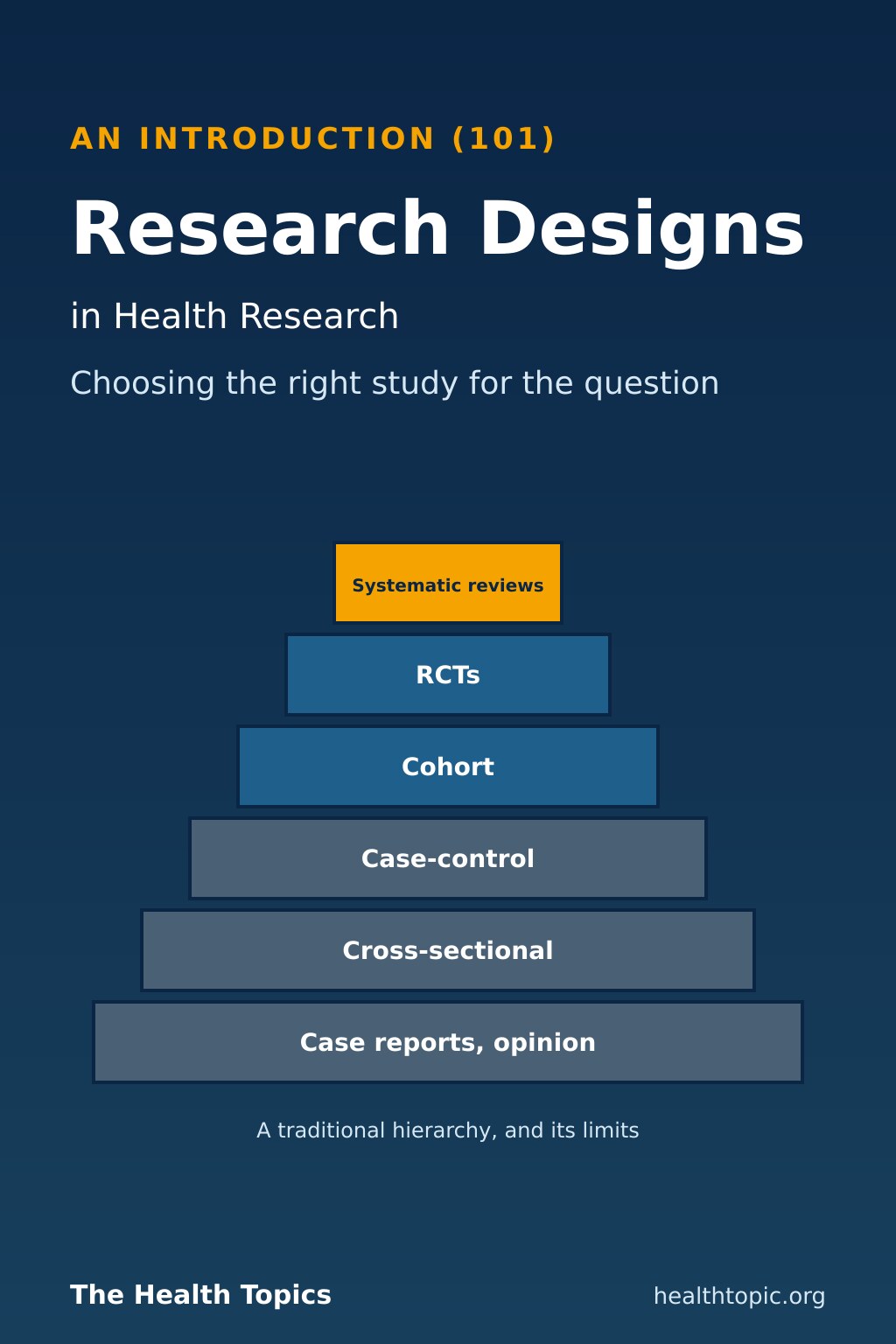
In brief: A research design is the plan that links a research question to the data that can answer it (Ahmad et al., 2013). A question about prevalence fits a cross-sectional study, a question about harm a case-control study, prognosis a cohort and therapy a randomised controlled trial (Mellis, 2020). Yet the label alone does not settle how trustworthy a result is: a 2024 Cochrane update of 47 methodological reviews and overviews found no difference or a very small difference between effect estimates from randomised trials and observational studies, with low certainty (Toews et al., 2024).
Research designs in health research: an introduction (101)
This guide introduces research designs for students and practitioners of health management, nursing, public health and clinical research. It is built on 613 records (434 articles and 179 reviews) from the Web of Science Core Collection, published from 1980 to 2026, and every empirical statement is traced to one of them. It covers definitions, families of designs, hierarchies of evidence, design choice and bias, novel designs, meta-research, reporting, Türkiye, debates and a roadmap for managers. It is a general primer: the corpus spans clinical and health services research, and in every field design choice also depends on ethics, feasibility and existing evidence.
Try it yourself: Name the design behind short study descriptions, choose a design for realistic health research questions, and place studies on a hierarchy of evidence while checking what the label does not tell you.
Open the interactive module: Research Design Lab
Learning objectives
By the end of this guide you should be able to:
- Define research design and distinguish it from study design, research methods and research methodology.
- Classify a study as experimental, quasi-experimental, observational (cohort, case-control, cross-sectional, ecological), qualitative, mixed methods or evidence synthesis.
- Match a research question to a suitable design while weighing ethics, feasibility and existing evidence.
- Evaluate hierarchies of evidence, design-specific biases and the meta-research comparing designs, including null and mixed findings.
- Apply a design checklist and an indicator set when commissioning or appraising evaluations in a health organisation.
Key concepts
- Research design. A framework or guiding plan for approaching research subjects for data collection and analysis to study a research problem (Ahmad et al., 2013).
- Observational study versus clinical trial. Clinical studies are divided into these two main types by the absence or presence of an intervention (S. Kim, 2024).
- Randomised controlled trial (RCT). The gold standard for efficacy and safety, with high internal but often weak external validity (H. J. Yang, 2016).
- Quasi-experimental design. An evaluation of an intervention’s effect without random allocation, often used when randomisation is not feasible or ethical (Geldsetzer & Fawzi, 2017; Reeves et al., 2017).
- Cohort study. A study that identifies people by exposure and follows them over time to assess the incidence of the outcome (Klebanoff & Snowden, 2018).
- Case-control study. A study that compares previous exposures among groups distinguished by later disease status (Sessler & Imrey, 2015).
- Cross-sectional study. A study that assesses exposure and outcome at the same time (Hartung & Touchette, 2009).
- Hierarchy (levels) of evidence. A ranking of designs determined primarily by their inherent bias and validity (Chen & Chi, 2023).
Contents
- Method, introduction and history
- Definitions, neighbouring concepts, classifications and hierarchies of evidence
- Choosing a design; design-specific biases; novel and complex designs; meta-research on design use
- Reporting guidance; designs in nursing and health services research
- Themes and bibliometric profile; research designs in Türkiye
- Debates, research gaps and implications for practice
- Summary, discussion questions, further reading, glossary, frequently asked questions and references
How this guide was produced
Database and date. Web of Science Core Collection, Advanced Search, 17 November 2026; no language or year limits; articles and reviews.
Query (verbatim). TI=("research design*" OR "study design*" OR "hierarchy of evidence" OR "evidence hierarchy" OR "levels of evidence") AND TI=(health* OR medic* OR clinic* OR nurs* OR epidemiolog* OR "health services" OR "public health" OR choos* OR select* OR overview OR primer OR guide OR introduc* OR typolog* OR classif*) AND DT=("Article" OR "Review")
Search development. The first block keeps a design or evidence hierarchy term in the title; the second requires a title term placing the record in health or marking it as introductory, guiding or classifying. A single search was sufficient.
Criteria. Included: records that explain, classify, compare, critique or guide the choice of designs, discuss levels of evidence, or analyse which designs a body of health literature uses. Excluded: single studies naming only their own design; protocols without results; off-topic records, including levels of evidence used only as a grading label; editorial items without substance.
Flow. See Figure 1: 1595 identified, 9 duplicates removed, no retracted publications, 1586 screened, 973 excluded (432 single empirical studies naming their own design without discussing designs; 381 protocols without results; 160 off-topic records or records using levels of evidence only as a grading label), 613 included (434 articles and 179 reviews, published 1980 to 2026).
Screening and extraction. AI-assisted screeners applied the criteria to titles and abstracts; the lead reviewer resolved 20 unsure records. Evidence was then extracted from the abstracts of a subset of 350 included records into a structured template; numbers from this subset are not corpus-wide counts.
Lessons from screening. The word “design” in a title is noisy: 432 records only named their own design and 381 were protocols.
Limitations. Single database; title search, which misses records that discuss designs without naming them in the title; abstract-level reading without quality appraisal or full-text checks; AI-assisted screening; English-language bias of Web of Science. Bibliometric theme counts are keyword matches and overlap. The corpus is dominated by clinical research, so health management examples are fewer than clinical ones.
Introduction
Once questions are formulated, selecting the design is perhaps the most important decision a researcher makes (Abutabenjeh & Jaradat, 2018). Errors in study design cannot be corrected afterwards; the main considerations are the question, study population, unit of analysis, type of study, measuring technique and sample size (Röhrig et al., 2009). Bias has to be handled at the design stage, because only confounding bias can be controlled in the analysis (Rivas-Ruiz et al., 2013).
Poor design choices are costly. Up to half of all clinical studies may be redundant, so researchers are urged to identify existing evidence systematically before a new trial (Lund et al., 2021). In research on calcium intake and bone outcomes, 73% of randomised trials and 99% of observational studies published at least five years after fracture trials were needed were judged research waste (Bolland et al., 2018). Open datasets add a newer risk: a review of 341 formulaic single-factor papers based on one national health survey found evidence that such research ignored multifactorial relationships and the risk of false discoveries (Suchak et al., 2025).
For health managers the topic is practical. Decision makers find health care database studies harder to review than randomised trials because so many design choices are involved (Schneeweiss et al., 2019), and even rigorous trials leave many decision questions unanswered (Atkins, 2007).
History and development
The empirical study of how design affects results is old. Work in the 1970s by Mosteller and colleagues noted that surgical and anaesthesia innovations showed greater gains in nonrandomised than in randomised trials (Colditz, 2010). In 113 reports published in 1980, nonrandomised trials with sequential assignment showed a higher likelihood of gain (p = 0.004), as did randomised trials that were not double-blind compared with double-blind trials (p = 0.02) (Colditz et al., 1989).
Practice changed quickly. In 444 articles in JAMA, The Lancet and the New England Journal of Medicine, case series fell from 30% in 1971 to 4% in 1991; among 118 clinical trials, randomised trials rose from 31% to 76%, and health services research rose from none to 12% (McDermott et al., 1995). Single-subject designs became important forms of aphasia treatment research over the same decades (Robey et al., 1999). Meanwhile epidemiologists debated classification itself, proposing distinct axes for directionality, sample selection and timing (Kramer & Boivin, 1987) or ranking axes by their bearing on validity (Maclure, 1991).
From the 2000s, levels of evidence moved into journals and guidelines (Figure 2). The American Academy of Orthopaedic Surgeons has developed clinical practice guidelines since 2006 (Gandhi et al., 2018), the journal Plastic and Reconstructive Surgery introduced a Level of Evidence rating for its publications in 2011 (Swanson, 2013), and several journals now require a statement of the level of evidence (Grant et al., 2014). In parallel, the need for evidence on real-world public health interventions drove designs other than the individually randomised trial, such as cluster trials, stepped wedge designs and interrupted time series (Sanson-Fisher et al., 2014). Recent records add master protocols (Ravi & Kesari, 2022), target trial emulation (Huybrechts et al., 2025), co-design with people with lived experience (Palmer et al., 2023) and artificial intelligence as a design aid (J. S. Lee, 2026).
Definitions
There is no single definition of research design, but the definitions in the corpus fall into three groups (Table 1). Plan definitions describe the design as the guiding plan for collecting and analysing data (Ahmad et al., 2013). Bias definitions describe designs as standardised strategies to reduce bias, limited by ethical, economic and temporal viability (Talavera et al., 2019). Classification definitions describe designs by the axes on which they differ (Kramer & Boivin, 1987) or by checklists of features that replace labels (Reeves et al., 2017). Vocabulary adds confusion: research design, research methods and research methodology are often not clearly distinguished (Abutabenjeh & Jaradat, 2018).
| Source | Year | Discipline | Definition (paraphrased) | Emphasised dimension |
|---|---|---|---|---|
| Ahmad et al. (2013) | 2013 | Medicine, general | A guiding plan for data collection and analysis; suitability depends on situation and objectives | Plan and fit |
| Rezigalla (2020) | 2020 | Medicine, general | Designs are qualitative, quantitative or mixed; observational designs are descriptive or analytic | Families |
| Talavera et al. (2019) | 2019 | Clinical research | Standardised strategies to reduce bias in baseline state, manoeuvre and outcome | Bias control |
| Kramer and Boivin (1987) | 1987 | Epidemiology | Directionality, sample selection and timing should be distinct axes of classification | Axes |
| Ato et al. (2013) | 2013 | Psychology | Manipulative, associative and descriptive strategies, each with several study types | Strategy |
| Leech and Onwuegbuzie (2009) | 2009 | Social science methodology | Mixed methods collect, analyse and interpret quantitative and qualitative data on one phenomenon | Combination |
| Abutabenjeh and Jaradat (2018) | 2018 | Public administration | Design, methods and methodology are distinct and should be clarified before choosing | Terminology |
| Reeves et al. (2017) | 2017 | Clinical epidemiology | A seven-question checklist classifies effect evaluations by features, a taxonomy without labels | Features over labels |
Table 1. Selected definitions in the corpus. Disciplines are the author’s classification based on the publishing journal.
Figure 3 brings these ideas together: a design is chosen for a question, carries typical threats to validity, and its result still has to be appraised. Most errors in clinical research arise from selection bias, confounding, measurement bias, reverse causation and excessive chance variation (Sessler & Imrey, 2015).
Neighbouring concepts
Several terms are used near, and sometimes instead of, research design (Table 2, Figure 4). One overview classifies clinical studies by the presence of an intervention and by timing (prospective or retrospective) (S. Kim, 2024); another classifies research designs as qualitative, quantitative or mixed (Rezigalla, 2020). This guide uses research design as the broader term (author’s usage). Labels are ambiguous too: “retrospective cohort” is commonly used incorrectly (Klebanoff & Snowden, 2018).
| Concept | What it is | Relation to research design | Source |
|---|---|---|---|
| Research design | The overall plan for collecting and analysing data to study a problem | The umbrella term | Ahmad et al., 2013 |
| Study design | The type of clinical study, classified by intervention and timing | Narrower, mostly quantitative | S. Kim, 2024 |
| Randomised controlled trial | Treatment allocated at random, with concealment and unpredictable implementation | One experimental design | Pandis et al., 2011 |
| Quasi-experimental design | Effect evaluation without random allocation | Experimental logic without randomisation | Reeves et al., 2017 |
| Cohort study | Identifies people by exposure and follows them to measure incidence | Observational, forward in logic | Klebanoff & Snowden, 2018 |
| Case-control study | Compares previous exposures between people with and without the outcome | Observational, starts from outcome | Sessler & Imrey, 2015 |
| Cross-sectional study | Assesses exposure and outcome at the same time | Observational, one point in time | Hartung & Touchette, 2009 |
| Qualitative research | Phenomenology, grounded theory, ethnography, narrative inquiry | Non-numerical family of designs | Driessnack et al., 2007a |
| Hierarchy of evidence | A ranking of designs by inherent bias and validity | A tool for judging designs, not a design | Chen & Chi, 2023 |
Table 2. Research design and its neighbouring concepts. Entries in the third column are the author’s synthesis.
Classifications of designs
Many overviews start with one split: observational studies, which observe without intervening, and experimental studies, which assess the effect of interventions (S. Kim, 2024; Manterola et al., 2019). Six families matter for health research (Table 3).
Experimental designs. Trials may be pragmatic, controlled or noncontrolled, randomised or nonrandomised, open label or blinded, and parallel, crossover or factorial (S. Kim, 2024). Variants change efficiency: in simulations comparing colonoscopic techniques, a parallel design often needed 10 to 15 times more patients than a crossover design for 80% power (van den Broek et al., 2013).
Quasi-experimental designs. These estimate effects without random allocation and are best classified by features such as clustering, group formation and confounding control (Reeves et al., 2017). One review groups alternatives to the randomised trial into an experimental approach (stepped-wedge) and observational approaches (propensity scores, instrumental variables, multiple baseline design, interrupted time series, difference-in-difference and regression discontinuity) (Schelvis et al., 2015). Here, stepped-wedge trials count as randomised designs, propensity scores and instrumental variables as analysis methods, and the rest as quasi-experimental designs (author’s classification). The simple before/after study is the usual fallback when an intervention is implemented universally, with clear threats to internal validity (Fergusson et al., 2002).
Observational designs. These are often retrospective and include ecological, cross-sectional, case-control, case-crossover and cohort designs, with diagnostic accuracy designs as a subset (Thiese, 2014). Ecological designs use the group or region as the unit of analysis when exposures cannot be measured accurately in many individuals (Morgenstern & Thomas, 1993). Nested case-control and case-cohort designs (DiPietro, 2010) and the self-controlled case series, which eliminates time-invariant confounding (Petersen et al., 2016), extend the list. In standard epidemiological reasoning, a case-control study is efficient when the outcome is rare or has a long latency, because it starts from the cases instead of following a very large cohort; a cross-sectional study is quick and suits prevalence, but it cannot show whether exposure or outcome came first.
Qualitative designs. A nursing overview series describes phenomenology, grounded theory, ethnography and narrative inquiry, among others (Driessnack et al., 2007a); case study and participatory action research are added elsewhere (Creswell et al., 2007). Newer designs include phenomenography (Bayuo et al., 2024) and longitudinal qualitative research, which focuses on change over time (Bayuo et al., 2025).
Mixed methods designs. Typologies classify these by the timing of the two strands (sequential or concurrent) and the emphasis placed on each (Bishop, 2015); one offers eight designs with a notation system (Leech & Onwuegbuzie, 2009).
Evidence syntheses. Meta-analyses summarise published evidence and feed guidelines (Crugliano et al., 2022). A Delphi of 67 experts from 30 countries consolidated 70 review typologies into 13 (Pandian et al., 2026). Field-specific typologies also exist, for example for personalised medicine trials (Superchi et al., 2022) and comparative diagnostic accuracy studies (B. D. Yang et al., 2021).
| Design | Question it answers | Main strength | Main threat | Citation |
|---|---|---|---|---|
| Randomised controlled trial | Therapy; efficacy and safety of an intervention | High internal validity | Weak external validity; often impractical or unethical | Mellis, 2020; H. J. Yang, 2016 |
| Quasi-experimental (for example interrupted time series) | Effects of policies or interventions that cannot be randomised | Uses routine data; feasible when a trial is too costly | Causal assumptions often unverifiable | Geldsetzer & Fawzi, 2017; Soumerai et al., 2017 |
| Simple before/after study | Effect of a universally implemented intervention | Feasible when a trial is precluded | Changes over time unrelated to the intervention; cointerventions | Fergusson et al., 2002; Joffe et al., 2011 |
| Prospective cohort | Prognosis; endpoints absent at enrolment | Unbiased recall from disease-free participants; repeated measures | In occupational cohorts, healthy worker effect and immortal time bias push estimates toward the null | Colditz, 2010; Crugliano et al., 2022; Y. Kim & Park, 2026; Mellis, 2020 |
| Case-control | Harm; association between an exposure and an endpoint | Efficient for rare outcomes or long latency (standard methodology) | Recall bias; questionnaire versions may only generate hypotheses | Colditz, 2010; Johansen et al., 2017; Mellis, 2020 |
| Cross-sectional | Prevalence of a risk factor or disease | Quick; estimates prevalence at one time point | Exposure and outcome measured together, so temporal order is unknown; ranked last for probability of bias | Crugliano et al., 2022; Hartung & Touchette, 2009; Talavera et al., 2019 |
| Qualitative interviews | Experiences of patients, carers and clinicians | Captures subjectivity and complexity | Often poorly designed, carried out and analysed | Broom, 2005 |
| Mixed methods | Complex health problems | Combines both data types | Bias when samples are not aligned across strands | Driessnack et al., 2007b; Sykes et al., 2018 |
| Systematic review and meta-analysis | What published evidence shows | At the apex when it includes high-quality studies | Only as good as its studies and its own methods | Ng et al., 2024; O’Kelly et al., 2020 |
Table 3. Comparison of the main designs, paraphrasing the cited sources.
Hierarchies and levels of evidence, and their critiques
A hierarchy of evidence ranks designs by their inherent bias and validity, and helps researchers decide which level of study is needed next (Chen & Chi, 2023). A typical version ascends from animal studies and expert opinion, through case reports and series, to cohort studies, randomised trials and finally systematic reviews and meta-analyses (Wallace et al., 2022). Hierarchies are institutionalised: the Federal Joint Committee (Gemeinsamer Bundesausschuss) assigns its highest level, Ia, to systematic reviews of randomised trials of therapeutic benefit (Peinemann & Kleijnen, 2016), and nursing has its own systems (Peterson et al., 2014). In 2646 articles, the citation impact of designs was commensurate with most proposed hierarchies (Patsopoulos et al., 2005).
The critiques are of four kinds. First, the ranking depends on the question: hierarchies vary with the central clinical issue (Bragge, 2010), and effectiveness hierarchies are inadequate for questions of appropriateness or feasibility (Evans, 2003). Second, systematic reviews sit at the apex only when they include high-quality studies and range down to level IV otherwise (Ng et al., 2024). Third, a place on the pyramid does not replace appraisal of the individual study (Wallace et al., 2022); in 87 cosmetic surgery articles, three level 1 studies had deficiencies that undermined their conclusions (Swanson, 2013). Levels also show how thin the evidence can be: only 17.9% of 408 recommendations in 22 orthopaedic guidelines rested on strong evidence (Reddy et al., 2022). Fourth, both standard justifications of the evidence-based medicine hierarchy, special access to causes and lower bias, have been argued to fail (Borgerson, 2009).
Some authors therefore build other hierarchies. A qualitative hierarchy ranks single case studies lowest and generalisable studies using conceptual frameworks and diversified samples highest (Daly et al., 2007). A three-tier hierarchy of reviews places meta-analyses and review overviews in Tier 1 and narrative, realist, integrative and mapping reviews in Tier 3 (Pandian et al., 2026).
Choosing a design for a question
Design choice starts with an answerable question. The PICO principle frames population, intervention, comparison and outcome; the next steps are to categorise the central clinical issue, search the literature and decide whether a quantitative or qualitative paradigm fits (Bragge, 2010). Two forces then narrow the choice: the question and the resources, including budget, time, patient numbers and expertise (Mellis, 2020). In occupational epidemiology the choice is nearly always determined by the question and feasibility constraints (Checkoway et al., 2007).
Three cautions temper any simple matching rule. Different designs can be applied to the same question (Rezigalla, 2020). A valuable question answered with a higher-bias design is better than an irrelevant question (Talavera et al., 2019). And ethics and feasibility can rule out the design a hierarchy would prefer: randomised trials are unethical or impractical in many paediatric situations (Mellis, 2020), and in pregnancy non-randomised studies will remain the mainstay because trials enrol too few pregnant participants to study uncommon serious outcomes (Huybrechts et al., 2025).
For health systems and policy, an evaluation must show whether a change occurred, whether it resulted from the intervention and whether it is significant (Sanson-Fisher et al., 2014). Quasi-experiments allow causal questions about interventions that cannot feasibly or ethically be randomised, for example because they have become the standard of care (Geldsetzer & Fawzi, 2017). For systematic reviews, 85% of 42 articles supported including non-randomised as well as randomised designs, a strong reason being the need to evaluate harm (Peinemann & Kleijnen, 2016).
Design choices also affect who takes part, and the evidence is mixed. Among 1,277 respondents surveyed after discharge from a Swiss public teaching hospital, placebo controls and random allocation lowered willingness to participate, while the source of funds made no difference (Agoritsas et al., 2011). A later vignette study found that random versus non-random allocation did not affect participation, whereas expressed equipoise and industry funding lowered it (Gayet-Ageron et al., 2020).
Design-specific biases
No study design is ideal (McKeever, 2021). Meta-epidemiological studies have quantified several biases in randomised trials. Across 1973 trials in 234 meta-analyses, inadequate or unclear sequence generation exaggerated intervention effects by an average 11% (ratio of odds ratios 0.89) and lack of double blinding by 13% (0.87), with the largest average bias for subjectively assessed outcomes (0.78) (Savović et al., 2012). A review of 24 meta-epidemiological studies found similar bias for sequence generation (0.93) and allocation concealment (0.90) (Page et al., 2016). In prevention trials with substantial noncompliance, often 20% to 40%, intention-to-treat analysis typically underestimates the effect (Colditz, 2010).
Non-randomised designs face selection bias above all, and matching and regression cannot remove residual confounding completely (Reeves et al., 2005). Analytic choices inside observational designs can matter as much as the label. In an electronic health record study of 189,286 joint replacement patients in Denmark and the United Kingdom, a time-dependent cohort (incidence rate ratio 0.90) and a case-control analysis (0.87) agreed, whereas time-fixed cohorts gave 0.36 and 0.65, which the authors read as false protective effects (Lalmohamed et al., 2016). In a study of more than 100,000 Medicaid patients, all antipsychotics were associated with diabetes under the weakest design, but only clozapine and olanzapine remained significant under the strongest (Gianfrancesco et al., 2006). Before-and-after designs carry their own trap: a children’s hospital without a paediatric medical emergency team saw mortality fall from 1.50% to 0.82% (relative risk 0.55) and from 1.02% to 0.70% (0.69) during the periods of two published studies that had reported mortality reductions with such teams (Joffe et al., 2011).
Novel and complex designs
Master protocols, that is basket, umbrella and platform trials, test more than one hypothesis within one protocol (Ravi & Kesari, 2022); among 131 personalised medicine trials, 65.6% were master protocols, 57.2% phase II and 86.3% in oncology (Superchi et al., 2022). Adaptive designs saved time in 29 industry-led early phase studies at a London clinical trials unit, by abolishing or mitigating substantial amendments and through adaptive scheduling (Lorch et al., 2012); in paediatrics, sequential, adaptive and Bayesian designs aim to limit experimentation to what is achievable, necessary and ethical (Baiardi et al., 2011).
Pragmatic trials, which assess effectiveness in real-life practice, are proposed, with high-quality observational studies, to complement classic trials, because guideline evidence often comes from strict trial conditions rather than real life (H. J. Yang, 2016). A pragmatic, decentralised trial in older patients with breast cancer is offered as a model, and broader inclusion criteria, telehealth visits and patient-reported outcomes are proposed to increase participation (Karihtala et al., 2024). A stepped-wedge, roll-in cluster randomised design was developed to evaluate disinvestment from health technologies of uncertain value (Haines et al., 2014). Target trial emulation conceptualises an observational study as an attempt to emulate a hypothetical randomised trial, which helps to identify design flaws; it is not a panacea (Huybrechts et al., 2025). Effectiveness-implementation hybrid designs are proposed to speed the scale-up of mental health care in low- and middle-income countries (Meffert et al., 2016); mental health researchers also list adaptive designs, partially randomised preference trials and hybrid trials as ways beyond classic trials (Lecomte et al., 2026).
Which designs do fields use? Evidence from meta-research
Studies of design use are field-specific and are not pooled here. Observational studies account for 70% to 80% of publications in biomedical journals (Manterola et al., 2019), and in 10,596 health science articles in PubMed from 1997, 2007 and 2017 they were the most common design (Masuadi et al., 2021). In paediatric surgery, retrospective case series were the most common design (45% of 1581 articles in 1998 and 46.8% of 3453 in 2013) and randomised trials made up 1.8% and 1.9% (Allin et al., 2016). In ten Chinese medical journals, randomised trials were 3.8% (60 of 1,578) of articles in 2008, with poor reporting in 73.3% of them (Jin et al., 2010).
Levels of evidence change slowly and unevenly. In 1580 sports medicine articles, level 1 and 2 studies rose from 6.8% in 1995 to 23.5% in 2010, while one journal, Arthroscopy, showed no significant change (Grant et al., 2014). In 418 cardiovascular articles from Saudi Arabia, 57.8% were level IV and there was no trend toward higher levels (p = 0.236) (Alotaibi et al., 2021); in 886 African anaesthesia and critical care articles, 32.8% were cross-sectional (Kanmounye et al., 2020).
Reporting guidance
A design helps readers only if it is reported clearly. A consensus report on implant dentistry calls adherence to STROBE and CONSORT necessary standards (Tonetti & Palmer, 2012), and a survey of Chinese journals called urgent implementation of CONSORT imperative (Jin et al., 2010). For reviews, 227 systematic reviews and meta-analyses in paediatric urology adhered to 70.1% of PRISMA criteria and 48.46% of AMSTAR-2 criteria, and 65% were of low and 20% of critically low methodological quality (O’Kelly et al., 2020). Among studies self-labelled as meta-epidemiological, 9.4% reported PROSPERO registration and 11% reported following PRISMA (Puljak et al., 2020).
Three further pieces of advice recur. First, describe what the study actually did, because labels such as retrospective and prospective are ambiguous (Klebanoff & Snowden, 2018). Second, draw the design: a graphical framework shows the key design variables of database studies in enough detail to reproduce them (Schneeweiss et al., 2019). Third, report ethics for every design: in five general medical journals, ethical approval and consent were not mentioned in 31% and 47% of papers, and omission was more likely in all designs except case-control and qualitative studies than in randomised trials (Schroter et al., 2006).
Designs in nursing and health services research
Nursing. A three-part series introduced nursing readers to quantitative designs, arguing that nursing care should be determined by sound research rather than by clinical preference or tradition (Sousa et al., 2007), to qualitative designs as groundwork for quantitative studies (Driessnack et al., 2007a) and to mixed and multiple methods as a growing option for complex health problems (Driessnack et al., 2007b). Others argue that qualitative nursing design should follow nursing’s own disciplinary knowledge rather than social science conventions (Thorne et al., 2016). Nurses meet hierarchies through guides to the evidence pyramid (Ingham-Broomfield, 2016). In 41 studies evaluating nursing documentation, most were retrospective (n = 20) (Saranto & Kinnunen, 2009), and in community nursing the meaning of “case study” is often not made explicit (Bergen & While, 2000).
Health services and systems research. Policy measures and organisational interventions are often not suited to a randomised trial (Schelvis et al., 2015). In 2012, the only widely agreed design criteria for health systems reviews were those of the Cochrane Effective Practice and Organisation of Care group: randomised trials, controlled clinical trials, controlled before-after studies and interrupted time series. In 414 health systems reviews, 13% gave no design criteria; of 359 that did, 50% limited synthesis to controlled trials and 68% to designs within these criteria (Rockers et al., 2012). Three field-specific reviews found frequent pre-post designs. Evaluations of clinical pathways most often used what the authors call a pragmatic pre-post design with a retrospective baseline, and only four of 55 performed a cost-effectiveness analysis (X. J. Lee et al., 2019). Among 24 studies of Indigenous youth peer-led health promotion, only one intervention was evaluated with a randomised design and most evaluations were pre-post studies (Vujcich et al., 2018). Of 36 published evaluations of COVID-19 policies, only four passed key design checks for identifying causal impact (Haber et al., 2022).
Themes and bibliometric profile
The 613 records span 1980 to 2026 (Figure 5): 64 before 2000, 111 in 2000 to 2009, 242 in 2010 to 2019 and 196 in 2020 to 2026.
Keyword matches in titles, abstracts and author keywords show the themes (Figure 6); one record can match several groups, so the counts overlap. The randomised controlled trial leads (159 records), followed by bias (99), systematic review or meta-analysis (97), cohort (94), observational designs in general (94) and case-control (67). Adaptive or novel trial designs (27), quasi-experimental designs (19) and mixed methods (10) are rare.
The most frequent journals are the Journal of Clinical Epidemiology (16 records), PLOS ONE (8), BMC Medical Research Methodology (8), the Journal of Advanced Nursing (5), Pain (5), Environmental Health Perspectives (4), BMJ (4) and BMJ Open (4), followed by 15 journals with 3 records each. The leading Web of Science categories are Public, Environmental and Occupational Health (89), Pharmacology and Pharmacy (51) and Medicine, General and Internal (50). Country counts come from author affiliation addresses, and a record can count for several countries: the United States leads (280 records), followed by the United Kingdom (103), Germany (54), Canada (53), Australia (42) and the Netherlands (37). No single journal holds more than 16 of the 613 records, which suggests that design guidance is written inside many specialties.
Research designs in Türkiye
The corpus says very little about Türkiye. Three included records have at least one author affiliated with an institution in Türkiye, and none of them mentions Türkiye or Turkey in its title or abstract. The first reviews observational and experimental designs frequently used in medical studies (Ögüs & Yazici, 2008). The second discusses study design challenges in clinical trials for a rare disease, pantothenate kinase-associated neurodegeneration (Videnovic et al., 2023). The third is the international study of review typologies (Pandian et al., 2026). None reports which designs are used in Turkish health research, how often Turkish health services evaluations use randomised or quasi-experimental designs, or how Turkish journals apply reporting guidelines.
Debates and contradictions
Do randomised and observational studies agree? The largest syntheses say mostly yes, with qualifications (Table 4). A 2014 Cochrane methodology review found a pooled ratio of odds ratios of 1.08 (95% CI 0.96 to 1.22), and 11 of 14 reviews found no significant difference (Anglemyer et al., 2014). Its 2024 update found no difference or a very small difference (1.08, 95% CI 1.01 to 1.15) with low certainty, and small differences in some subgroups, such as pharmaceutical interventions (1.12) (Toews et al., 2024). Both conclude that factors other than design must be considered when results disagree (Anglemyer et al., 2014; Toews et al., 2024), such as differences in population, intervention, comparator and outcome (Toews et al., 2024). Randomised and observational studies can also measure different constructs: the impact of offering a therapy versus exposure among those who received it (Colditz, 2010).
Field-level comparisons are more mixed (Table 4). For physical activity and social anxiety, randomised trials showed a non-significant effect (d = -0.24, p = 0.377), whereas longitudinal designs showed a significant one (d = -0.22, p = 0.001) (Zika & Becker, 2021); the effect sizes were similar, so the contrast lies in precision rather than in size or direction. Yet one review of occupational cancer epidemiology argues that divergent cohort and case-control estimates reflect exposure assessment rather than design (Y. Kim & Park, 2026).
| Comparison | Sample | Finding as reported | Direction | Source |
|---|---|---|---|---|
| Randomised versus observational | 14 reviews in the analysis; 1583 meta-analyses | Pooled ratio of odds ratios 1.08 (0.96 to 1.22); 11 of 14 reviews no significant difference | No clear difference | Anglemyer et al., 2014 |
| Randomised versus observational | 47 reviews and overviews; 34 in the primary analysis | Ratio of ratios 1.08 (1.01 to 1.15), low certainty; 23 of 34 reviews in agreement | No or very small difference | Toews et al., 2024 |
| Randomised versus nonrandomised; retrospective versus prospective | Orthodontic meta-analyses | No difference by randomisation (25 meta-analyses); retrospective nonrandomised trials inflated effects (40 meta-analyses) | Mixed | Papageorgiou et al., 2015 |
| Randomised trials, case-matched and cohort studies | 59 articles on robotic rectal surgery | No difference by design for leakage, mortality, margins, conversion or operating time; for complications and hospital stay the robotic advantage appeared in cohort studies (RR 0.83) but not in trials (RR 1.12, P = 0.27); case-matched results often similar to trials | Mostly consistent; design-dependent for two outcomes | Hoshino et al., 2021 |
| Case-control versus other observational | 82 meta-analyses of adverse effects | Confidence intervals overlapped in 78 of 82; 16 of 23 discrepancies from higher case-control estimates | Mostly consistent | Golder et al., 2013 |
| Questionnaire case-control versus nested case-control and cohort | Glioma risk factors | Inverse associations for medical radiation and hormone therapy only in questionnaire case-control studies; allergy inverse in all designs | Design-dependent for two of three exposures | Johansen et al., 2017 |
Table 4. Selected meta-research comparing designs. Findings are reported as the abstracts state them and are not pooled.
Rigid hierarchies or fitness for purpose? One position holds that the situation and objectives, not the absolute superiority of one design, determine suitability (Ahmad et al., 2013), and decision makers need cohort, registry and administrative data studies besides trials (Atkins, 2007). In health policy, one group argues that interrupted time series can estimate valid effects and that many policy studies do not require trials (Soumerai et al., 2017); another holds that quasi-experiments complement but do not replace randomised evaluations, because their causal assumptions are often unverifiable (Geldsetzer & Fawzi, 2017).
Certainty or design label? Newer approaches judge evidence by its features rather than its name. The Cochrane update rated certainty with GRADE (Toews et al., 2024), and the review typology hierarchy used adapted GRADE and ROBIS tools (Pandian et al., 2026). In cosmetic surgery, a methodology-based grade correlated only weakly with published levels (rho = 0.11) (Swanson, 2013).
Where does qualitative evidence belong? Separate hierarchies have been proposed for qualitative research (Daly et al., 2007) and for appropriateness and feasibility questions (Evans, 2003). In a scoping review of antimicrobial stewardship barriers, qualitative and mixed-methods studies identified a broader range of barriers than surveys or observational designs (Ishaqui et al., 2026). Yet formal qualitative inquiry frameworks were rare in 48 health education articles (Kegler et al., 2019).
Are designs labelled correctly? Often not. In 100 comparative diagnostic accuracy studies, 61 used 29 different design labels, only four of which referred to specific design features (B. D. Yang et al., 2021). One design classification tool reached only moderate reliability (kappa 0.45) with low accuracy (Hartling et al., 2011), another substantial reliability (kappa 0.67) (Seo et al., 2016). Allocation is often called random in dental literature although the procedures are often inappropriate (Pandis et al., 2011).
Research gaps
- In 2012, no widely agreed set of design selection criteria existed for systematic reviews of health systems research beyond the EPOC criteria (Rockers et al., 2012).
- No reviews had compared randomised trials with observational studies that used instrumental variables or marginal structural models (Anglemyer et al., 2014).
- The effects of attrition, selective reporting and the blinding of different groups on trial results need more research (Page et al., 2016; Savović et al., 2012).
- Little has been published on the practical application of adaptive designs in early phase research (Lorch et al., 2012), and little attention has been paid to designs for early phase behavioural intervention trials (Naar et al., 2018).
- There is little empirical assessment of whether qualitative findings generalise in a manner consistent with quantitative estimates in mixed-methods studies (Sykes et al., 2018).
- Consensus is lacking on what a meta-epidemiological study is (Puljak et al., 2020), and the new review typology hierarchy still needs empirical validation across disciplines (Pandian et al., 2026).
- Genetically informed designs have seldom been applied in perinatal pharmacoepidemiology (Carson et al., 2026).
- No record in the corpus studies design choice or design use in Türkiye (author’s observation from the corpus).
Implications for practice: a roadmap for health managers
Health managers rarely design trials, but they commission evaluations and act on evidence. A roadmap:
- Define the decision and the question. Write the question in PICO or PICOTS form before choosing a design (Bhardwaj et al., 2024; Bragge, 2010).
- Check what is already known. Systematically identify existing evidence first, to avoid redundant studies (Lund et al., 2021).
- Match the design to the question and constraints. Weigh question type, budget, time, patient numbers and expertise (Mellis, 2020); ethics may rule out randomisation (Geldsetzer & Fawzi, 2017).
- Prefer strong alternatives to simple before-after comparisons. Consider a randomised stepped-wedge design or quasi-experimental designs such as interrupted time series, difference-in-differences or regression discontinuity (Schelvis et al., 2015); simple pre/post designs were judged inappropriate for COVID-19 policy evaluation (Haber et al., 2022).
- Plan bias control at the design stage. Most biases cannot be fixed in the analysis (Rivas-Ruiz et al., 2013).
- Report the design. Use reporting guidelines and describe what was done, not only the label (Klebanoff & Snowden, 2018; Tonetti & Palmer, 2012).
- Appraise, do not just rank. Combine the hierarchy with critical appraisal of each study (Wallace et al., 2022).
| Indicator | What it shows | Basis in the literature |
|---|---|---|
| Share of internal evaluations with a concurrent comparison group or time series | Protection against changes over time unrelated to the intervention | Haber et al., 2022; Joffe et al., 2011 |
| Share of projects with a documented literature check before approval | Avoidance of redundant research | Lund et al., 2021 |
| Share of reports that follow a named reporting guideline | Transparency and reproducibility | O’Kelly et al., 2020; Tonetti & Palmer, 2012 |
| Share of reports with ethics approval and consent stated | Protection of participants across all designs | Schroter et al., 2006 |
| Share of database studies with a design diagram | Reviewability of observational studies | Schneeweiss et al., 2019 |
Table 5. Indicators for monitoring the design quality of evaluations in a health organisation (author’s synthesis; the third column names the motivating sources).
Summary
- A research design is the plan that links a question to data; it determines which biases a study is exposed to, and design errors cannot be repaired in the analysis.
- Designs fall into experimental, quasi-experimental, observational, qualitative, mixed methods and evidence synthesis families; labels are often used inconsistently.
- The question type points to a design (prevalence, harm, prognosis, therapy), but ethics, feasibility and existing evidence narrow the choice.
- Hierarchies of evidence are useful starting points, but they depend on the question and do not replace appraisal of each study.
- On average, randomised and observational effect estimates differ little, with low certainty; in specific fields, retrospective, before-after and time-fixed designs can mislead.
- In three reviews (clinical pathway evaluations, Indigenous youth peer-led health promotion and COVID-19 policy evaluations), pre-post designs predominated or few studies passed design checks; stronger quasi-experimental and randomised stepped-wedge designs are available. The corpus holds no abstract-level evidence on design use in Türkiye.
Discussion questions
- Mortality fell after your hospital introduced a rapid response team. What else could explain the fall, and which design would test the team’s effect?
- Why might a randomised trial and a cohort study of the same treatment give different answers, even if both are well conducted?
- Is a systematic review always at the top of the hierarchy? Why or why not?
- When is a qualitative design the best choice for a health management question? Give an example.
- A colleague calls a study “retrospective cohort” because it used old records. What would you ask to check the label?
- Design a study of research design use in Turkish health services research.
Further reading
- Mellis (2020): a short guide to matching question types and resources to a design.
- Reeves et al. (2017): classifying effect evaluations by design features rather than labels.
- Wallace et al. (2022): the hierarchy of evidence and why critical appraisal still matters.
- Borgerson (2009): a philosophical critique of the evidence-based medicine hierarchy.
- Toews et al. (2024): the latest Cochrane comparison of randomised and observational estimates.
- Soumerai et al. (2017): the case for quasi-experimental designs in health policy research.
Glossary
| Term | Turkish | Short definition |
|---|---|---|
| Research design | Araştırma tasarımı | The plan for collecting and analysing data to answer a research question |
| Randomised controlled trial | Randomize kontrollü çalışma | An experiment in which participants are allocated to groups at random |
| Quasi-experimental design | Yarı deneysel tasarım | An effect evaluation without random allocation, such as an interrupted time series |
| Cohort study | Kohort çalışması | A study that follows people grouped by exposure to measure new outcomes |
| Case-control study | Olgu-kontrol çalışması | A study that compares past exposures of people with and without an outcome |
| Cross-sectional study | Kesitsel çalışma | A study that measures exposure and outcome at the same time |
| Qualitative research | Nitel araştırma | Research that studies experiences and meanings with non-numerical data |
| Hierarchy of evidence | Kanıt hiyerarşisi | A ranking of designs by their inherent risk of bias |
| Bias | Yanlılık | Systematic error that pushes results away from the true value in one direction |
| Interrupted time series | Kesintili zaman serisi | A design that compares trends before and after an intervention at many time points |
Frequently asked questions
Is research design the same as research method? No. The literature distinguishes research design, research methods and research methodology, and confusion between them is common (Abutabenjeh & Jaradat, 2018).
Is the randomised controlled trial always the best design? It is the gold standard for efficacy, but it is often impractical or unethical and has weak external validity (H. J. Yang, 2016).
Do observational studies give different answers from trials? On average little or no difference has been found, with low certainty (Toews et al., 2024).
What is the difference between a prospective and a retrospective cohort? A cohort is retrospective when follow-up took place before the research began, not because the data were analysed later (Klebanoff & Snowden, 2018).
Can a hospital evaluate a new policy without randomisation? Yes. Interrupted time series can estimate valid effects of policies (Soumerai et al., 2017), although quasi-experimental assumptions are often unverifiable (Geldsetzer & Fawzi, 2017).
Related on this site: Coherence in research: an introduction (101) · Gioia methodology: an introduction (101)
References
- Abutabenjeh, S., & Jaradat, R. (2018). Clarification of research design, research methods, and research methodology: A guide for public administration researchers and practitioners. Teaching Public Administration, 36(3), 237-258. https://doi.org/10.1177/0144739418775787
- Agoritsas, T., Deom, M., & Perneger, T. V. (2011). Study design attributes influenced patients’ willingness to participate in clinical research: A randomized vignette-based study. Journal of Clinical Epidemiology, 64(1), 107-115. https://doi.org/10.1016/j.jclinepi.2010.02.007
- Ahmad, I., Marwat, M., & Khan, H. (2013). Comparative analysis of study designs in health research. Gomal Journal of Medical Sciences, 11(2), 242-244.
- Allin, B., Aveyard, N., Campion-Smith, T., Floyd, E., Kimpton, J., Swarbrick, K., Williams, E., & Knight, M. (2016). What evidence underlies clinical practice in paediatric surgery? A systematic review assessing choice of study design. PLOS ONE, 11(3), Article e0150864. https://doi.org/10.1371/journal.pone.0150864
- Alotaibi, S., Schuster, A. M., Perez-Villa, B., & Hernandez-Montfort, J. (2021). Levels of evidence within cardiovascular medicine research in Saudi Arabia: A systematic review. Journal of the Saudi Heart Association, 33(3), 237-243. https://doi.org/10.37616/2212-5043.1264
- Anglemyer, A., Horvath, H. T., & Bero, L. (2014). Healthcare outcomes assessed with observational study designs compared with those assessed in randomized trials. Cochrane Database of Systematic Reviews, (4), Article MR000034. https://doi.org/10.1002/14651858.MR000034.pub2
- Atkins, D. (2007). Creating and synthesizing evidence with decision makers in mind: Integrating evidence from clinical trials and other study designs. Medical Care, 45(10), S16-S22. https://doi.org/10.1097/MLR.0b013e3180616c3f
- Ato, M., López, J. J., & Benavente, A. (2013). A classification system for research designs in psychology. Anales de Psicología, 29(3), 1038-1059. https://doi.org/10.6018/analesps.29.3.178511
- Baiardi, P., Giaquinto, C., Girotto, S., Manfredi, C., & Ceci, A. (2011). Innovative study design for paediatric clinical trials. European Journal of Clinical Pharmacology, 67, S109-S115. https://doi.org/10.1007/s00228-011-0990-y
- Bayuo, J., Aziato, L., Wong, K. C. A., Su, J. J., Abu-Odah, H., & Wong, F. K. Y. (2024). Phenomenography: An emerging qualitative research design for nursing. Journal of Advanced Nursing, 80(2), 821-834. https://doi.org/10.1111/jan.15874
- Bayuo, J., Nyande, F. K., Awunyo, W., & Akpalu, E. (2025). The longitudinal qualitative research design in nursing, health, and social care research: Philosophy, methodology, and methods. BMC Medical Research Methodology, 26(1), Article 2. https://doi.org/10.1186/s12874-025-02736-6
- Bergen, A., & While, A. (2000). A case for case studies: Exploring the use of case study design in community nursing research. Journal of Advanced Nursing, 31(4), 926-934. https://doi.org/10.1046/j.1365-2648.2000.01356.x
- Bhardwaj, R., Agrawal, U., Vashist, P., & Manna, S. (2024). Determination of sample size for various study designs in medical research: A practical primer. Journal of Family Medicine and Primary Care, 13(7), 2555-2561. https://doi.org/10.4103/jfmpc.jfmpc_1675_23
- Bishop, F. L. (2015). Using mixed methods research designs in health psychology: An illustrated discussion from a pragmatist perspective. British Journal of Health Psychology, 20(1), 5-20. https://doi.org/10.1111/bjhp.12122
- Bolland, M. J., Avenell, A., & Grey, A. (2018). Assessment of research waste part 1: An exemplar from examining study design, surrogate and clinical endpoints in studies of calcium intake and vitamin D supplementation. BMC Medical Research Methodology, 18, Article 103. https://doi.org/10.1186/s12874-018-0556-0
- Borgerson, K. (2009). Valuing evidence: Bias and the evidence hierarchy of evidence-based medicine. Perspectives in Biology and Medicine, 52(2), 218-233.
- Bragge, P. (2010). Asking good clinical research questions and choosing the right study design. Injury, 41, 3-6. https://doi.org/10.1016/j.injury.2010.04.016
- Broom, A. (2005). Using qualitative interviews in CAM research: A guide to study design, data collection and data analysis. Complementary Therapies in Medicine, 13(1), 65-73. https://doi.org/10.1016/j.ctim.2005.01.001
- Carson, A. C., Zidan, M., Olstad, E. W., Gervin, K., Galesloot, T. E., Scholte, I., Ystrom, E., Nordeng, H., & van Gelder, M. M. H. J. (2026). Genetically informed research designs in perinatal pharmacoepidemiology: A methodological overview. Drug Safety, 49(7), 761-773. https://doi.org/10.1007/s40264-026-01647-9
- Checkoway, H., Pearce, N., & Kriebel, D. (2007). Selecting appropriate study designs to address specific research questions in occupational epidemiology. Occupational and Environmental Medicine, 64(9), 633-638. https://doi.org/10.1136/oem.2006.029967
- Chen, Y. N., & Chi, C. C. (2023). Levels of evidence and study designs: A brief introduction to dermato-epidemiologic research methodology. Dermatologica Sinica, 41(4), 199-205. https://doi.org/10.4103/ds.DS-D-23-00159
- Colditz, G. A. (2010). Overview of the epidemiology methods and applications: Strengths and limitations of observational study designs. Critical Reviews in Food Science and Nutrition, 50, 10-12. https://doi.org/10.1080/10408398.2010.526838
- Colditz, G. A., Miller, J. N., & Mosteller, F. (1989). How study design affects outcomes in comparisons of therapy. I: Medical. Statistics in Medicine, 8(4), 441-454. https://doi.org/10.1002/sim.4780080408
- Creswell, J. W., Hanson, W. E., Plano Clark, V. L., & Morales, A. (2007). Qualitative research designs: Selection and implementation. The Counseling Psychologist, 35(2), 236-264. https://doi.org/10.1177/0011000006287390
- Crugliano, G., Provenzano, M., Torino, C., Garofalo, C., Zicarelli, M., Coppolino, G., Bolignano, D., Serra, R., & Andreucci, M. (2022). The study designs used in epidemiologic research of chronic disease. Giornale Italiano di Cardiologia, 23(2), 100-112.
- Daly, J., Willis, K., Small, R., Green, J., Welch, N., Kealy, M., & Hughes, E. (2007). A hierarchy of evidence for assessing qualitative health research. Journal of Clinical Epidemiology, 60(1), 43-49. https://doi.org/10.1016/j.jclinepi.2006.03.014
- DiPietro, N. A. (2010). Methods in epidemiology: Observational study designs. Pharmacotherapy, 30(10), 973-984. https://doi.org/10.1592/phco.30.10.973
- Driessnack, M., Sousa, V. D., & Costa Mendes, I. A. (2007a). Overview of research designs relevant to nursing: Part 2: Qualitative research designs. Revista Latino-Americana de Enfermagem, 15(4), 684-688. https://doi.org/10.1590/S0104-11692007000400025
- Driessnack, M., Sousa, V. D., & Costa Mendes, I. A. (2007b). An overview of research designs relevant to nursing: Part 3: Mixed and multiple methods. Revista Latino-Americana de Enfermagem, 15(5), 1046-1049. https://doi.org/10.1590/S0104-11692007000500025
- Evans, D. (2003). Hierarchy of evidence: A framework for ranking evidence evaluating healthcare interventions. Journal of Clinical Nursing, 12(1), 77-84. https://doi.org/10.1046/j.1365-2702.2003.00662.x
- Fergusson, D., Hebert, P., & Shapiro, S. (2002). The before/after study design in transfusion medicine: Methodologic considerations. Transfusion Medicine Reviews, 16(4), 296-303. https://doi.org/10.1053/tmrv.2002.35211
- Gandhi, J. S., Shea, K. G., Sponseller, P. D., Brighton, B. K., & Ganley, T. J. (2018). Evidence-based medicine in pediatric orthopaedics: Evidence-based Practice Committee summary of levels of evidence, clinical practice guidelines, appropriate use criteria, and best practice guidelines. Journal of Pediatric Orthopaedics, 38(6), e349-e353. https://doi.org/10.1097/BPO.0000000000001185
- Gayet-Ageron, A., Rudaz, S., & Perneger, T. (2020). Study design factors influencing patients’ willingness to participate in clinical research: A randomised vignette-based study. BMC Medical Research Methodology, 20(1), Article 93. https://doi.org/10.1186/s12874-020-00979-z
- Geldsetzer, P., & Fawzi, W. (2017). Quasi-experimental study designs series-paper 2: Complementary approaches to advancing global health knowledge. Journal of Clinical Epidemiology, 89, 12-16. https://doi.org/10.1016/j.jclinepi.2017.03.015
- Gianfrancesco, F., Pesa, J., Wang, R. H., & Nasrallah, H. (2006). Assessment of anti psychotic-related risk of diabetes mellitus in a Medicaid psychosis population: Sensitivity to study design. American Journal of Health-System Pharmacy, 63(5), 431-441. https://doi.org/10.2146/ajhp050144
- Golder, S., Loke, Y. K., & Bland, M. (2013). Comparison of pooled risk estimates for adverse effects from different observational study designs: Methodological overview. PLOS ONE, 8(8), Article e71813. https://doi.org/10.1371/journal.pone.0071813
- Grant, H. M., Tjoumakaris, F. P., Maltenfort, M. G., & Freedman, K. B. (2014). Levels of evidence in the clinical sports medicine literature: Are we getting better over time? The American Journal of Sports Medicine, 42(7), 1738-1742. https://doi.org/10.1177/0363546514530863
- Haber, N. A., Clarke-Deelder, E., Feller, A., Smith, E. R., Salomon, J. A., MacCormack-Gelles, B., Stone, E. M., Bolster-Foucault, C., Daw, J. R., Hatfield, L. A., Fry, C. E., Boyer, C. B., Ben-Michael, E., Joyce, C. M., Linas, B. S., Schmid, I., Au, E. H., Wieten, S. E., Jarrett, B., . . . Stuart, E. A. (2022). Problems with evidence assessment in COVID-19 health policy impact evaluation: A systematic review of study design and evidence strength. BMJ Open, 12(1), Article e053820. https://doi.org/10.1136/bmjopen-2021-053820
- Haines, T., O’Brien, L., McDermott, F., Markham, D., Mitchell, D., Watterson, D., & Skinner, E. (2014). A novel research design can aid disinvestment from existing health technologies with uncertain effectiveness, cost-effectiveness, and/or safety. Journal of Clinical Epidemiology, 67(2), 144-151. https://doi.org/10.1016/j.jclinepi.2013.08.014
- Hartling, L., Bond, K., Santaguida, P. L., Viswanathan, M., & Dryden, D. M. (2011). Testing a tool for the classification of study designs in systematic reviews of interventions and exposures showed moderate reliability and low accuracy. Journal of Clinical Epidemiology, 64(8), 861-871. https://doi.org/10.1016/j.jclinepi.2011.01.010
- Hartung, D. M., & Touchette, D. (2009). Overview of clinical research design. American Journal of Health-System Pharmacy, 66(4), 398-408. https://doi.org/10.2146/ajhp080300
- Hoshino, N., Sakamoto, T., Hida, K., Takahashi, Y., Okada, H., Obama, K., & Nakayama, T. (2021). Difference in surgical outcomes of rectal cancer by study design: Meta-analyses of randomized clinical trials, case-matched studies, and cohort studies. BJS Open, 5(2), Article zraa067. https://doi.org/10.1093/bjsopen/zraa067
- Huybrechts, K. F., Bateman, B. T., & Hernández-Díaz, S. (2025). Modern evidence generation on medication effectiveness and safety during pregnancy: Study design considerations. Clinical Pharmacology & Therapeutics, 117(4), 895-909. https://doi.org/10.1002/cpt.3598
- Ingham-Broomfield, J. P. R. (2016). A nurses’ guide to the hierarchy of research designs and evidence. Australian Journal of Advanced Nursing, 33(3), 38-43.
- Ishaqui, A. A., Saleem, Z., Mallhi, T. H., Alshahrani, S. M., Orayj, K., Ahmad, S. A., Asiri, R., Alsaleh, E. A., Imran, M., Kaddoura, M. A., Jawed, B., Kumar, N., Khan, Y. H., Iqbal, A., & Maqsood, M. B. (2026). Multilevel barriers to antimicrobial stewardship in tertiary care hospitals: A comparative systematic scoping review of high-income versus low-/middle-income countries evidence mapped by study design and healthcare professionals. Naunyn-Schmiedeberg’s Archives of Pharmacology, 399(10), 14719-14741. https://doi.org/10.1007/s00210-026-05303-y
- Jin, Z. C., Yu, D. H., Zhang, L. M., Meng, H., Lu, J., Gao, Q. B., Cao, Y., Ma, X. Q., Wu, C., He, Q., Wang, R., & He, J. (2010). A retrospective survey of research design and statistical analyses in selected Chinese medical journals in 1998 and 2008. PLOS ONE, 5(5), Article e10822. https://doi.org/10.1371/journal.pone.0010822
- Joffe, A. R., Anton, N. R., & Burkholder, S. C. (2011). Reduction in hospital mortality over time in a hospital without a pediatric medical emergency team: Limitations of before-and-after study designs. Archives of Pediatrics & Adolescent Medicine, 165(5), 419-423.
- Johansen, C., Schüz, J., Andreasen, A. M. S., & Dalton, S. O. (2017). Study designs may influence results: The problems with questionnaire-based case-control studies on the epidemiology of glioma. British Journal of Cancer, 116(7), 841-848. https://doi.org/10.1038/bjc.2017.46
- Kanmounye, U. S., Tochie, J. N., Mbonda, A., Wafo, C. K., Daya, L., Atem, T. H., Nyalundja, A. D., & Eyaman, D. C. (2020). Systematic review and bibliometric analysis of African anesthesia and critical care medicine research part I: Hierarchy of evidence and scholarly productivity. BMC Anesthesiology, 20(1), Article 247. https://doi.org/10.1186/s12871-020-01167-8
- Karihtala, P., Schiza, A., Fountzilas, E., Geisler, J., Meattini, I., Risi, E., Biganzoli, L., & Valachis, A. (2024). Clinical trials in older patients with cancer: Typical challenges, possible solutions, and a paradigm of study design in breast cancer. Acta Oncologica, 63. https://doi.org/10.2340/1651-226X.2023.40365
- Kegler, M. C., Raskind, I. G., Comeau, D. L., Griffith, D. M., Cooper, H. L. F., & Shelton, R. C. (2019). Study design and use of inquiry frameworks in qualitative research published in Health Education & Behavior. Health Education & Behavior, 46(1), 24-31. https://doi.org/10.1177/1090198118795018
- Kim, S. (2024). Overview of clinical study designs. Clinical and Experimental Emergency Medicine, 11(1), 33-42. https://doi.org/10.15441/ceem.23.036
- Kim, Y., & Park, D. U. (2026). Beyond cohort versus case-control: The primacy of exposure assessment over study design in occupational cancer epidemiology. Epidemiology and Health, 48, Article e2026026. https://doi.org/10.4178/epih.e2026026
- Klebanoff, M. A., & Snowden, J. M. (2018). Historical (retrospective) cohort studies and other epidemiologic study designs in perinatal research. American Journal of Obstetrics and Gynecology, 219(5), 447-450. https://doi.org/10.1016/j.ajog.2018.08.044
- Kramer, M. S., & Boivin, J. F. (1987). Toward an unconfounded classification of epidemiologic research design. Journal of Chronic Diseases, 40(7), 683-688. https://doi.org/10.1016/0021-9681(87)90104-4
- Lalmohamed, A., van Staa, T. P., Vestergaard, P., Leufkens, H. G. M., de Boer, A., Emans, P., Cooper, C., & de Vries, F. (2016). Statins and risk of lower limb revision surgery: The influence of differences in study design using electronic health records from the United Kingdom and Denmark. American Journal of Epidemiology, 184(1), 58-66. https://doi.org/10.1093/aje/kwv311
- Lecomte, T., Raugh, I., Caiada, M., & Menon, M. (2026). Beyond RCTs: Better research designs and methods for psychosocial efficacy studies in mental health. Canadian Journal of Psychiatry, 71(12), 893-903. https://doi.org/10.1177/07067437261456381
- Lee, J. S. (2026). Artificial intelligence-assisted medical research design for novice researchers: A narrative review. Journal of the Korean Medical Association, 69(2), Article 102. https://doi.org/10.5124/jkma.25.0156
- Lee, X. J., Blythe, R., Choudhury, A. A. K., Simmons, T., Graves, N., & Kularatna, S. (2019). Review of methods and study designs of evaluations related to clinical pathways. Australian Health Review, 43(4), 448-456. https://doi.org/10.1071/AH17276
- Leech, N. L., & Onwuegbuzie, A. J. (2009). A typology of mixed methods research designs. Quality & Quantity, 43(2), 265-275. https://doi.org/10.1007/s11135-007-9105-3
- Lorch, U., Berelowitz, K., Ozen, C., Naseem, A., Akuffo, E., & Taubel, J. (2012). The practical application of adaptive study design in early phase clinical trials: A retrospective analysis of time savings. European Journal of Clinical Pharmacology, 68(5), 543-551. https://doi.org/10.1007/s00228-011-1176-3
- Lund, H., Bala, M., Blaine, C., Brunnhuber, K., & Robinson, K. A. (2021). How to improve the study design of clinical trials in internal medicine: Recent advances in the evidence-based methodology. Polish Archives of Internal Medicine, 131(9), 848-853. https://doi.org/10.20452/pamw.16076
- Maclure, M. (1991). Taxonomic axes of epidemiologic-study designs: A refutationist perspective. Journal of Clinical Epidemiology, 44(10), 1045-1053. https://doi.org/10.1016/0895-4356(91)90006-U
- Manterola, C., Quiroz, G., Salazar, P., & García, N. (2019). Methodology of study designs most frequently used in clinical research. Revista Médica Clínica Las Condes, 30(1), 36-49. https://doi.org/10.1016/j.rmclc.2018.11.005
- Masuadi, E., Mohamud, M., Almutairi, M., Alsunaidi, A., Alswayed, A. K., & Aldhafeeri, O. F. (2021). Trends in the usage of statistical software and their associated study designs in health sciences research: A bibliometric analysis. Cureus, 13(1), Article e12639. https://doi.org/10.7759/cureus.12639
- McDermott, M. M., Lefevre, F., Feinglass, J., Reifler, D., Dolan, N., Potts, S., & Senger, K. (1995). Changes in study design, gender issues, and other characteristics of clinical research published in 3 major medical journals from 1971 to 1991. Journal of General Internal Medicine, 10(1), 13-18. https://doi.org/10.1007/BF02599570
- McKeever, L. (2021). Overview of study designs: A deep dive into research quality assessment. Nutrition in Clinical Practice, 36(3), 569-585. https://doi.org/10.1002/ncp.10647
- Meffert, S. M., Neylan, T. C., Chambers, D. A., & Verdeli, H. (2016). Novel implementation research designs for scaling up global mental health care: Overcoming translational challenges to address the world’s leading cause of disability. International Journal of Mental Health Systems, 10, Article 19. https://doi.org/10.1186/s13033-016-0049-7
- Mellis, C. M. (2020). How to choose your study design. Journal of Paediatrics and Child Health, 56(7), 1018-1022. https://doi.org/10.1111/jpc.14929
- Morgenstern, H., & Thomas, D. (1993). Principles of study design in environmental epidemiology. Environmental Health Perspectives, 101, 23-38. https://doi.org/10.2307/3431657
- Naar, S., Czajkowski, S. M., & Spring, B. (2018). Innovative study designs and methods for optimizing and implementing behavioral interventions to improve health. Health Psychology, 37(12), 1081-1091. https://doi.org/10.1037/hea0000657
- Ng, M. K., Magruder, M. L., Heckmann, N. D., Delanois, R. E., Piuzzi, N. S., Krebs, V. E., & Mont, M. A. (2024). How-to create an orthopaedic systematic review: A step-by-step guide part I: Study design. Journal of Arthroplasty, 39(7), 1863-1868. https://doi.org/10.1016/j.arth.2024.03.059
- O’Kelly, F., DeCotiis, K., Aditya, I., Braga, L. H., & Koyle, M. A. (2020). Assessing the methodological and reporting quality of clinical systematic reviews and meta-analyses in paediatric urology: Can practices on contemporary highest levels of evidence be built? Journal of Pediatric Urology, 16(2), 207-217. https://doi.org/10.1016/j.jpurol.2019.12.002
- Ögüs, E., & Yazici, A. C. (2008). Research designs frequently used in medical studies: Review. Türkiye Klinikleri Tıp Bilimleri Dergisi, 28(4), 500-507.
- Page, M. J., Higgins, J. P. T., Clayton, G., Sterne, J. A. C., Hróbjartsson, A., & Savovic, J. (2016). Empirical evidence of study design biases in randomized trials: Systematic review of meta-epidemiological studies. PLOS ONE, 11(7), Article e0159267. https://doi.org/10.1371/journal.pone.0159267
- Palmer, V. J., Bibb, J., Lewis, M., Densley, K., Kritharidis, R., Dettmann, E., Sheehan, P., Daniell, A., Harding, B., Schipp, T., Dost, N., & McDonald, G. (2023). A co-design living labs philosophy of practice for end-to-end research design to translation with people with lived-experience of mental ill-health and carer/family and kinship groups. Frontiers in Public Health, 11, Article 1206620. https://doi.org/10.3389/fpubh.2023.1206620
- Pandian, V., Al Zaabi, A., Pokorna, A., Manias, E., Ahmadi, F., Mohammadi, E., Bahramnezhad, F., Kozachik, S., Uchmanowicz, I., Chalkias, A., Gelling, L., Ho, M. H., McKenna, H., Alhalaiqa, F., Karadag, A., Davidson, P., Arja, S., Alameddine, M., Palmieri, P., . . . Vahedian-Azimi, A. (2026). Developing a standardized, expert-validated taxonomy and evidence hierarchy for review typologies: A multi-methods study. Intensive and Critical Care Nursing, 96, Article 104501. https://doi.org/10.1016/j.iccn.2026.104501
- Pandis, N., Polychronopoulou, A., & Eliades, T. (2011). Randomization in clinical trials in orthodontics: Its significance in research design and methods to achieve it. European Journal of Orthodontics, 33(6), 684-690. https://doi.org/10.1093/ejo/cjq141
- Papageorgiou, S. N., Xavier, G. M., & Cobourne, M. T. (2015). Basic study design influences the results of orthodontic clinical investigations. Journal of Clinical Epidemiology, 68(12), 1512-1522. https://doi.org/10.1016/j.jclinepi.2015.03.008
- Patsopoulos, N. A., Analatos, A. A., & Ioannidis, J. P. A. (2005). Relative citation impact of various study designs in the health sciences. JAMA, 293(19), 2362-2366. https://doi.org/10.1001/jama.293.19.2362
- Peinemann, F., & Kleijnen, J. (2016). Algorithm for choosing the study design in systematic reviews. Klinische Pädiatrie, 228(5), 235-239. https://doi.org/10.1055/s-0042-111688
- Petersen, I., Douglas, I., & Whitaker, H. (2016). Self controlled case series methods: An alternative to standard epidemiological study designs. BMJ, 354, Article i4515. https://doi.org/10.1136/bmj.i4515
- Peterson, M. H., Barnason, S., Donnelly, B., Hill, K., Miley, H., Riggs, L., & Whiteman, K. (2014). Choosing the best evidence to guide clinical practice: Application of AACN levels of evidence. Critical Care Nurse, 34(2), 58-68. https://doi.org/10.4037/ccn2014411
- Puljak, L., Makaric, Z. L., Buljan, I., & Pieper, D. (2020). What is a meta-epidemiological study? Analysis of published literature indicated heterogeneous study designs and definitions. Journal of Comparative Effectiveness Research, 9(7), 497-508. https://doi.org/10.2217/cer-2019-0201
- Ravi, R., & Kesari, H. V. (2022). Novel study designs in precision medicine: Basket, umbrella and platform trials. Current Reviews in Clinical and Experimental Pharmacology, 17(2), 114-121. https://doi.org/10.2174/1574884716666210316114157
- Reddy, A. K., Scott, J., Checketts, J. X., Fishbeck, K., Boose, M., Stallings, L., & Vassar, M. (2022). Levels of evidence backing the AAOS clinical practice guidelines. Journal of Orthopaedics, Trauma and Rehabilitation, 29(2). https://doi.org/10.1177/2210491721992533
- Reeves, B. C., van Binsbergen, J., & van Weel, C. (2005). Systematic reviews incorporating evidence from nonrandomized study designs: Reasons for caution when estimating health effects. European Journal of Clinical Nutrition, 59, S155-S161. https://doi.org/10.1038/sj.ejcn.1602190
- Reeves, B. C., Wells, G. A., & Waddington, H. (2017). Quasi-experimental study designs series-paper 5: A checklist for classifying studies evaluating the effects on health interventions, a taxonomy without labels. Journal of Clinical Epidemiology, 89, 30-42. https://doi.org/10.1016/j.jclinepi.2017.02.016
- Rezigalla, A. A. (2020). Observational study designs: Synopsis for selecting an appropriate study design. Cureus, 12(1), Article e6692. https://doi.org/10.7759/cureus.6692
- Rivas-Ruiz, F., Pérez-Vicente, S., & González-Ramírez, A. R. (2013). Bias in clinical epidemiological study designs. Allergologia et Immunopathologia, 41(1), 54-59. https://doi.org/10.1016/j.aller.2012.04.005
- Robey, R. R., Schultz, M. C., Crawford, A. B., & Sinner, C. A. (1999). Single-subject clinical-outcome research: Designs, data, effect sizes, and analyses. Aphasiology, 13(6), 445-473. https://doi.org/10.1080/026870399402028
- Rockers, P. C., Feigl, A. B., Røttingen, J.-A., Fretheim, A., de Ferranti, D., Lavis, J. N., Melberg, H. O., & Bärnighausen, T. (2012). Study-design selection criteria in systematic reviews of effectiveness of health systems interventions and reforms: A meta-review. Health Policy, 104(3), 206-214. https://doi.org/10.1016/j.healthpol.2011.12.007
- Röhrig, B., du Prel, J.-B., & Blettner, M. (2009). Study design in medical research: Part 2 of a series on the evaluation of scientific publications. Deutsches Ärzteblatt International, 106(11), 184-189. https://doi.org/10.3238/arztebl.2009.0184
- Sanson-Fisher, R. W., D’Este, C. A., Carey, M. L., Noble, N., & Paul, C. L. (2014). Evaluation of systems-oriented public health interventions: Alternative research designs. Annual Review of Public Health, 35, 9-27. https://doi.org/10.1146/annurev-publhealth-032013-182445
- Saranto, K., & Kinnunen, U. M. (2009). Evaluating nursing documentation: Research designs and methods: Systematic review. Journal of Advanced Nursing, 65(3), 464-476. https://doi.org/10.1111/j.1365-2648.2008.04914.x
- Savović, J., Jones, H. E., Altman, D. G., Harris, R. J., Jüni, P., Pildal, J., Als-Nielsen, B., Balk, E. M., Gluud, C., Gluud, L. L., Ioannidis, J. P. A., Schulz, K. F., Beynon, R., Welton, N., Wood, L., Moher, D., Deeks, J. J., & Sterne, J. A. C. (2012). Influence of reported study design characteristics on intervention effect estimates from randomised controlled trials: Combined analysis of meta-epidemiological studies. Health Technology Assessment, 16(35), 1-82. https://doi.org/10.3310/hta16350
- Schelvis, R. M. C., Oude Hengel, K. M., Burdorf, A., Blatter, B. M., Strijk, J. E., & van der Beek, A. J. (2015). Evaluation of occupational health interventions using a randomized controlled trial: Challenges and alternative research designs. Scandinavian Journal of Work, Environment & Health, 41(5), 491-503. https://doi.org/10.5271/sjweh.3505
- Schneeweiss, S., Rassen, J. A., Brown, J. S., Rothman, K. J., Happe, L., Arlett, P., Dal Pan, G., Goettsch, W., Murk, W., & Wang, S. V. (2019). Graphical depiction of longitudinal study designs in health care databases. Annals of Internal Medicine, 170(6), 398-406. https://doi.org/10.7326/M18-3079
- Schroter, S., Plowman, R., Hutchings, A., & Gonzalez, A. (2006). Reporting ethics committee approval and patient consent by study design in five general medical journals. Journal of Medical Ethics, 32(12), 718-723. https://doi.org/10.1136/jme.2005.015115
- Seo, H. J., Kim, S. Y., Lee, Y. J., Jang, B. H., Park, J. E., Sheen, S. S., & Hahn, S. K. (2016). A newly developed tool for classifying study designs in systematic reviews of interventions and exposures showed substantial reliability and validity. Journal of Clinical Epidemiology, 70, 200-205. https://doi.org/10.1016/j.jclinepi.2015.09.013
- Sessler, D. I., & Imrey, P. B. (2015). Clinical research methodology 1: Study designs and methodologic sources of error. Anesthesia and Analgesia, 121(4), 1034-1042. https://doi.org/10.1213/ANE.0000000000000815
- Soumerai, S. B., Ceccarelli, R., & Koppel, R. (2017). False dichotomies and health policy research designs: Randomized trials are not always the answer. Journal of General Internal Medicine, 32(2), 204-209. https://doi.org/10.1007/s11606-016-3841-9
- Sousa, V. D., Driessnack, M., & Costa Mendes, I. A. (2007). An overview of research designs relevant to nursing: Part 1: Quantitative research designs. Revista Latino-Americana de Enfermagem, 15(3), 502-507. https://doi.org/10.1590/S0104-11692007000300022
- Suchak, T., Aliu, A. E., Harrison, C., Zwiggelaar, R., Geifman, N., & Spick, M. (2025). Explosion of formulaic research articles, including inappropriate study designs and false discoveries, based on the NHANES US national health database. PLOS Biology, 23(5), Article e3003152. https://doi.org/10.1371/journal.pbio.3003152
- Superchi, C., Brion Bouvier, F., Gerardi, C., Carmona, M., San Miguel, L., Sanchez-Gómez, L. M., Imaz-Iglesia, I., Garcia, P., Demotes, J., Banzi, R., & Porcher, R. (2022). Study designs for clinical trials applied to personalised medicine: A scoping review. BMJ Open, 12(5), Article e052926. https://doi.org/10.1136/bmjopen-2021-052926
- Swanson, E. (2013). Levels of evidence in cosmetic surgery: Analysis and recommendations using a new CLEAR classification. Plastic and Reconstructive Surgery Global Open, 1(8), Article e66. https://doi.org/10.1097/GOX.0000000000000001
- Sykes, B. L., Verma, A., & Hancock, B. H. (2018). Aligning sampling and case selection in quantitative-qualitative research designs: Establishing generalizability limits in mixed-method studies. Ethnography, 19(2), 227-253. https://doi.org/10.1177/1466138117725341
- Talavera, J. O., Roy-García, I., Palacios-Cruz, L., Rivas-Ruiz, R., Hoyo, I., & Pérez-Rodríguez, M. (2019). Back to the clinic. Methods I. Research designs. Higher quality of information, greater certainty to the response. Gaceta Médica de México, 155(4), 399-405. https://doi.org/10.24875/GMM.19005226
- Thiese, M. S. (2014). Observational and interventional study design types; an overview. Biochemia Medica, 24(2), 199-210. https://doi.org/10.11613/BM.2014.022
- Thorne, S., Stephens, J., & Truant, T. (2016). Building qualitative study design using nursing’s disciplinary epistemology. Journal of Advanced Nursing, 72(2), 451-460. https://doi.org/10.1111/jan.12822
- Toews, I., Anglemyer, A., Nyirenda, J. L., Alsaid, D., Balduzzi, S., Grummich, K., Schwingshackl, L., & Bero, L. (2024). Healthcare outcomes assessed with observational study designs compared with those assessed in randomized trials: A meta-epidemiological study. Cochrane Database of Systematic Reviews, (1), Article MR000034. https://doi.org/10.1002/14651858.MR000034.pub3
- Tonetti, M., & Palmer, R. (2012). Clinical research in implant dentistry: Study design, reporting and outcome measurements: Consensus report of Working Group 2 of the VIII European Workshop on Periodontology. Journal of Clinical Periodontology, 39, 73-80. https://doi.org/10.1111/j.1600-051X.2011.01843.x
- van den Broek, F. J. C., Kuiper, T., Dekker, E., Zwinderman, A. H., Fockens, P., & Reitsma, J. B. (2013). Study designs to compare new colonoscopic techniques: Clinical considerations, data analysis, and sample size calculations. Endoscopy, 45(11), 922-927. https://doi.org/10.1055/s-0033-1344434
- Videnovic, A., Pfeiffer, H. C. V., Tylki-Szymanska, A., Berry-Kravis, E., Ezgü, F., Ganju, J., Jurecka, A., & Lang, A. E. (2023). Study design challenges and strategies in clinical trials for rare diseases: Lessons learned from pantothenate kinase-associated neurodegeneration. Frontiers in Neurology, 14, Article 1098454. https://doi.org/10.3389/fneur.2023.1098454
- Vujcich, D., Thomas, J., Crawford, K., & Ward, J. (2018). Indigenous youth peer-led health promotion in Canada, New Zealand, Australia, and the United States: A systematic review of the approaches, study designs, and effectiveness. Frontiers in Public Health, 6, Article 31. https://doi.org/10.3389/fpubh.2018.00031
- Wallace, S. S., Barak, G., Truong, G., & Parker, M. W. (2022). Hierarchy of evidence within the medical literature. Hospital Pediatrics, 12(8). https://doi.org/10.1542/hpeds.2022-006690
- Yang, B. D., Olsen, M., Vali, Y., Langendam, M. W., Takwoingi, Y., Hyde, C. J., Bossuyt, P. M. M., & Leeflang, M. M. G. (2021). Study designs for comparative diagnostic test accuracy: A methodological review and classification scheme. Journal of Clinical Epidemiology, 138, 128-138. https://doi.org/10.1016/j.jclinepi.2021.04.013
- Yang, H. J. (2016). Clinicoepidemiological research designs in childhood allergic diseases. Allergy, Asthma & Respiratory Disease, 4(2), 91-99. https://doi.org/10.4168/aard.2016.4.2.91
- Zika, M. A., & Becker, L. (2021). Physical activity as a treatment for social anxiety in clinical and non-clinical populations: A systematic review and three meta-analyses for different study designs. Frontiers in Human Neuroscience, 15, Article 653108. https://doi.org/10.3389/fnhum.2021.653108
Source verification and use of AI. Author names, publication years, titles, journals, volumes, pages and DOIs in the reference list were taken from the Web of Science records of the included studies, with author names taken from the full-name (AF) field; journal names were normalised from the capitalised Web of Science form, and titles were set in sentence case. Author names and titles were corrected only for obvious export errors, capitalisation and diacritics, and three missing page or article numbers were completed from PubMed. Claims attributed to sources were checked against the abstracts in an independent verification at abstract level; full texts were not reviewed, so numbers are reported as the abstracts state them. AI tools were used to support title and abstract screening, to extract evidence from abstracts into a structured template, to draft the text and to generate the figures. Responsibility for the content rests with the author, Prof. Dr. Mehmet Nurullah Kurutkan.
Data and supplementary material. The full list of the 613 included records, the screening log and the verification report are provided in the supplementary file “RD_101_supplementary.xlsx”, available from the author on request.
Cite this page (APA 7)
Kurutkan, M. N. (2026, November 18). Research Designs in Health Research: An Introduction (101). The Health Topics. https://healthtopic.org/topics/research-designs-in-health-research-an-introduction-101/